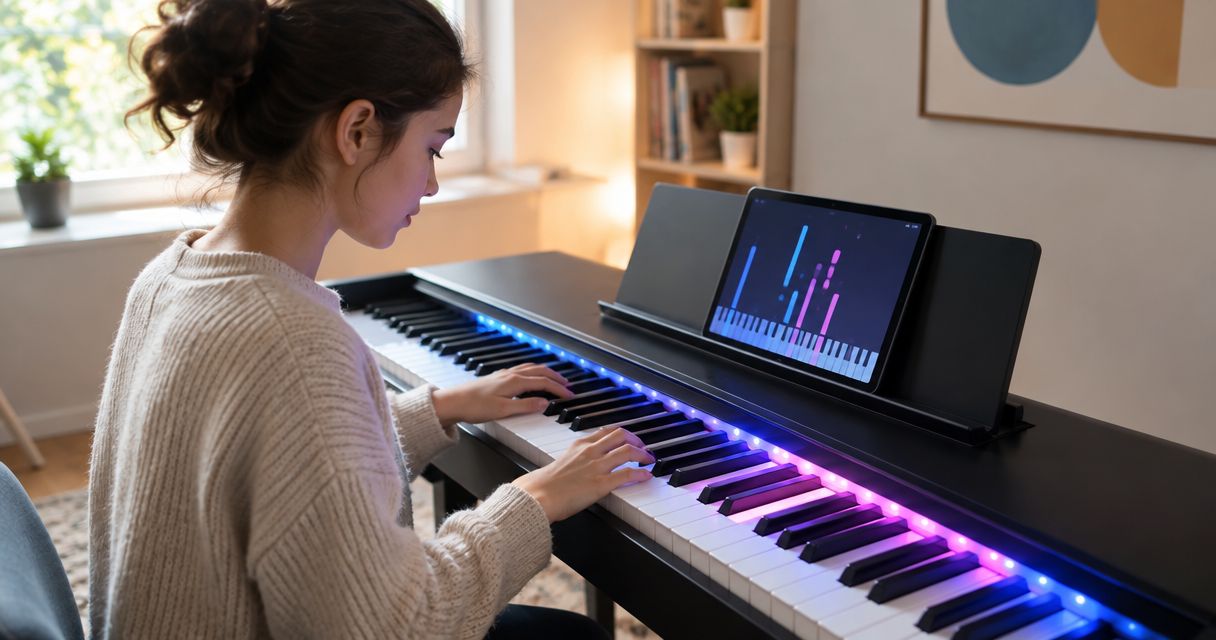
Best overall: “Twinkle, Twinkle, Little Star.” Best for your first melody: “Mary Had a Little Lamb.” Best for first two-hand practice: “Frère Jacques.” These piano songs for beginners work as LED-guided practice choices when you choose a simple arrangement; this 2026 guide ranks six songs by the skill each helps you practise.
- Twinkle, Twinkle, Little Star is the best overall choice among piano songs for beginners using simple melody arrangements.
- Mary Had a Little Lamb suits your first LED-guided melody; Frère Jacques suits introductory two-hand practice.
- Pianoledshop suits beginners seeking piano learning through lights synced to an app.
- Choose an easy piano arrangement first, then practise rhythm and repeat short phrases without watching the lights.
Why this matters
A familiar song is not automatically an easy piano arrangement. The melody can be manageable while its accompaniment adds chords, jumps, and coordination problems. Choose the arrangement before you choose the challenge.
Pianoledshop sells Piano LED Plus, a learning system that guides hobbyist and beginner players with lights synced to an app. That makes visual guidance part of the learning process, not a replacement for listening or deciding which fingers to use.
For your 2026 practice plan, start with a melody you recognise and a version you can explain: one hand, a short phrase, and a clear rhythm. The recommendations below concern song arrangements, not a confirmed app catalogue. Check the app’s song list before choosing a piece for synced-light practice.
What makes the best beginner piano song?
Use these criteria before selecting a version of any song:
- Small hand range: A melody with nearby notes lets you concentrate on the sequence instead of constantly relocating your hand.
- Recognisable phrasing: Knowing how the tune sounds gives you a reference for timing and wrong notes.
- Repeated patterns: Repeated phrases let you revisit the same movement rather than solve a new passage every line.
- Manageable rhythm: Start with a version whose note lengths you can count steadily, including pauses.
- Separate learning tasks: A melody-only version lets you learn the tune before adding accompaniment.
- A clear next step: The arrangement should support a specific goal, such as steadier timing or an independent left hand.
LED cues show where to play. Your arrangement still determines how far you move, how many notes you play together, and how much coordination the song demands.
Beginner piano songs at a glance
This 2026 ranking assumes simplified arrangements. A full accompaniment or decorative introduction changes the difficulty, so compare versions rather than judging by the title alone.
| Rank and song | Best for | Standout learning feature | Key limitation |
|---|---|---|---|
| 1. Twinkle, Twinkle, Little Star | Balanced first-song practice | Repeated phrases with contrasting sections | Repetition can encourage automatic playing without listening |
| 2. Mary Had a Little Lamb | Your first melody | A compact opening built around three pitches | A short melody offers limited hand-movement practice |
| 3. Ode to Joy | Stepwise melodic movement | The main theme moves largely between neighbouring notes | Longer phrases need attention to endings and note lengths |
| 4. Frère Jacques | Introductory two-hand coordination | Short repeated phrases that you can learn separately | Playing it as a round adds a separate coordination challenge |
| 5. Amazing Grace | Sustained notes and musical phrasing | A melody that invites careful listening between notes | Uneven note lengths need more than correct key selection |
| 6. Happy Birthday to You | Playing for a familiar occasion | A recognisable tune with a practical use | Leaps and an opening pickup complicate a first attempt |
1. Twinkle, Twinkle, Little Star: best for balanced first practice
“Twinkle, Twinkle, Little Star” is the default choice if you want one song that combines repetition with movement across the keyboard. Learn a melody-only version first. Its returning phrases give you something familiar to revisit after the contrasting middle section.
With LED guidance, notice the distance between successive notes rather than treating every illuminated key as an unrelated instruction. Say whether the melody repeats, moves higher, or moves lower. That gives the sequence a shape you can remember.
Twinkle, Twinkle, Little Star pros:
- Familiar melody provides a listening reference.
- Repeated phrases reduce the amount of new material.
- Contrasting phrases introduce a change without requiring a different song.
Twinkle, Twinkle, Little Star cons:
- Repetition makes it easy to stop listening closely.
- An arrangement with chords adds difficulty absent from the melody alone.
Best for: A beginner who wants a balanced first piece rather than the shortest possible exercise.
Verdict: Start here. Finish the melody with steady timing before adding a left-hand part.
2. Mary Had a Little Lamb: best for your first LED-guided melody
“Mary Had a Little Lamb” is the simplest starting point in this list when you use its familiar opening melody. That opening uses three pitches, keeping the initial task compact. You can focus on matching a short sequence to the sound you already know.
Avoid turning the exercise into a race to press the next lit key. Choose a finger for each note in the opening, then repeat the phrase with the same fingering. Consistent movement is the goal, not merely reaching the right key somehow.
Mary Had a Little Lamb pros:
- Compact opening keeps your attention on a small area.
- Repeated notes introduce the difference between repetition and movement.
- Short phrases make stopping and restarting straightforward.
Mary Had a Little Lamb cons:
- Limited movement does not prepare you for wider jumps.
- A familiar tune can hide careless note lengths if you rush.
Best for: Your first session following a melody on illuminated keys.
Verdict: Play first if Twinkle feels too demanding. Move on once the opening is steady without continuous visual help.
3. Ode to Joy: best for learning stepwise movement
The main theme of “Ode to Joy” gives you a clear introduction to a melody that moves largely by neighbouring notes. Choose a simplified theme arrangement, not an excerpt that includes a fuller accompaniment. The familiar tune provides context for where each phrase is heading.
Watch the relationship between notes as you follow the lights. Adjacent keys require a different movement from a repeated note or a jump. Practise the phrase ending deliberately; reaching the final key is not the same as holding it for the correct length.
Ode to Joy pros:
- Stepwise movement makes melodic direction easy to follow.
- Recurring patterns give you useful repetition.
- Phrase endings offer a clear place to check timing.
Ode to Joy cons:
- Similar passages can tempt you to assume the next note.
- Fuller arrangements introduce accompaniment beyond this beginner recommendation.
Best for: A beginner ready to move beyond a tiny note pattern while keeping the melody manageable.
Verdict: Choose next for melodic control. Listen for complete phrases rather than celebrating individual correct notes.
4. Frère Jacques: best for introductory two-hand practice
“Frère Jacques” works well as a set of short phrases that you can learn separately. Begin with the melody in one hand. For two-hand practice, choose a beginner arrangement with a simple accompanying part rather than immediately attempting a round.
A round overlaps the same tune at different starting points. That is a distinct task from playing the melody with an accompaniment. Keep the first two-hand exercise simple enough that you can identify what each hand is supposed to do.
Frère Jacques pros:
- Repeated phrases support focused practice.
- Clear phrase boundaries make hand-by-hand learning practical.
- A simplified accompaniment provides a separate coordination task.
Frère Jacques cons:
- A round is more demanding than a single melody.
- Repeating phrases does not remove the need to coordinate both hands.
Best for: A player who can already perform a short melody and wants to introduce the left hand.
Verdict: Choose for coordination, not for speed. Learn each hand’s role before putting the parts together.
5. Amazing Grace: best for sustained notes and phrasing
“Amazing Grace” is a useful change of emphasis after songs built around shorter, repeated patterns. Choose a simplified melody arrangement and listen to where the phrases breathe. Holding a note is part of playing it, not empty time before the next cue.
Use the lights to locate notes, then keep your attention on their duration. Do not shorten a sustained note just because you are eager to prepare the next one. Sing or hum the phrase before playing it if that helps you hear the musical shape.
Amazing Grace pros:
- Sustained notes encourage attention to duration.
- Distinct phrases give you natural practice boundaries.
- The melody supports listening as well as key-finding.
Amazing Grace cons:
- Uneven note lengths need deliberate counting.
- More elaborate versions add accompaniment and decorative notes.
Best for: A beginner whose key selection is improving but whose playing still sounds rushed or disconnected.
Verdict: Choose for phrasing. Keep the spaces and sustained notes as intentional as the key presses.
6. Happy Birthday to You: best for a familiar occasion
“Happy Birthday to You” gives you a recognisable tune to play for an occasion, but it is not the easiest first exercise here. Its familiar melody includes leaps and a pickup: notes that begin before the first full bar. Choose a simple melody arrangement before adding chords.
Practise the opening and the wider movement separately. Knowing the words helps you recognise the tune, but your hand still needs to learn where it travels. Follow the timing of the arrangement rather than pressing the sequence as quickly as possible.
Happy Birthday to You pros:
- Familiar words provide a strong melodic reference.
- A clear occasion gives the practice a purpose.
- Leaps introduce a new movement challenge.
Happy Birthday to You cons:
- The opening pickup needs attention to timing.
- Wider movement makes it less suitable as your very first melody.
Best for: A beginner preparing a short, recognisable performance after learning simpler patterns.
Verdict: Wait until nearby-note melodies feel comfortable. Then practise the leaps before attempting the whole song.
How these songs are ranked
The order prioritises a manageable melody, recognisable phrasing, repetition, and a distinct learning task. It is a practice sequence, not a claim that every arrangement of the first song is easier than every arrangement of the last.
For 2026, use the ranking to choose your next skill: first notes, melodic movement, coordination, or phrasing. Do not advance merely because you reached the end once.
Turn LED cues into a repeatable practice routine
Try a 10-minute practice session with one song rather than jumping between all six. This is a suggested routine, not a promised learning timeline. Start with a phrase of 2 bars, or a shorter musical unit if that is easier to manage.
- Listen first: Hear or sing the phrase before playing.
- Choose fingering: Decide which fingers will play the notes before repeating them.
- Follow lights: Play slowly enough to preserve the rhythm.
- Check rhythm: Listen for held notes, repeated notes, and pauses.
- Recall phrase: Attempt the same passage without watching the lights continuously.
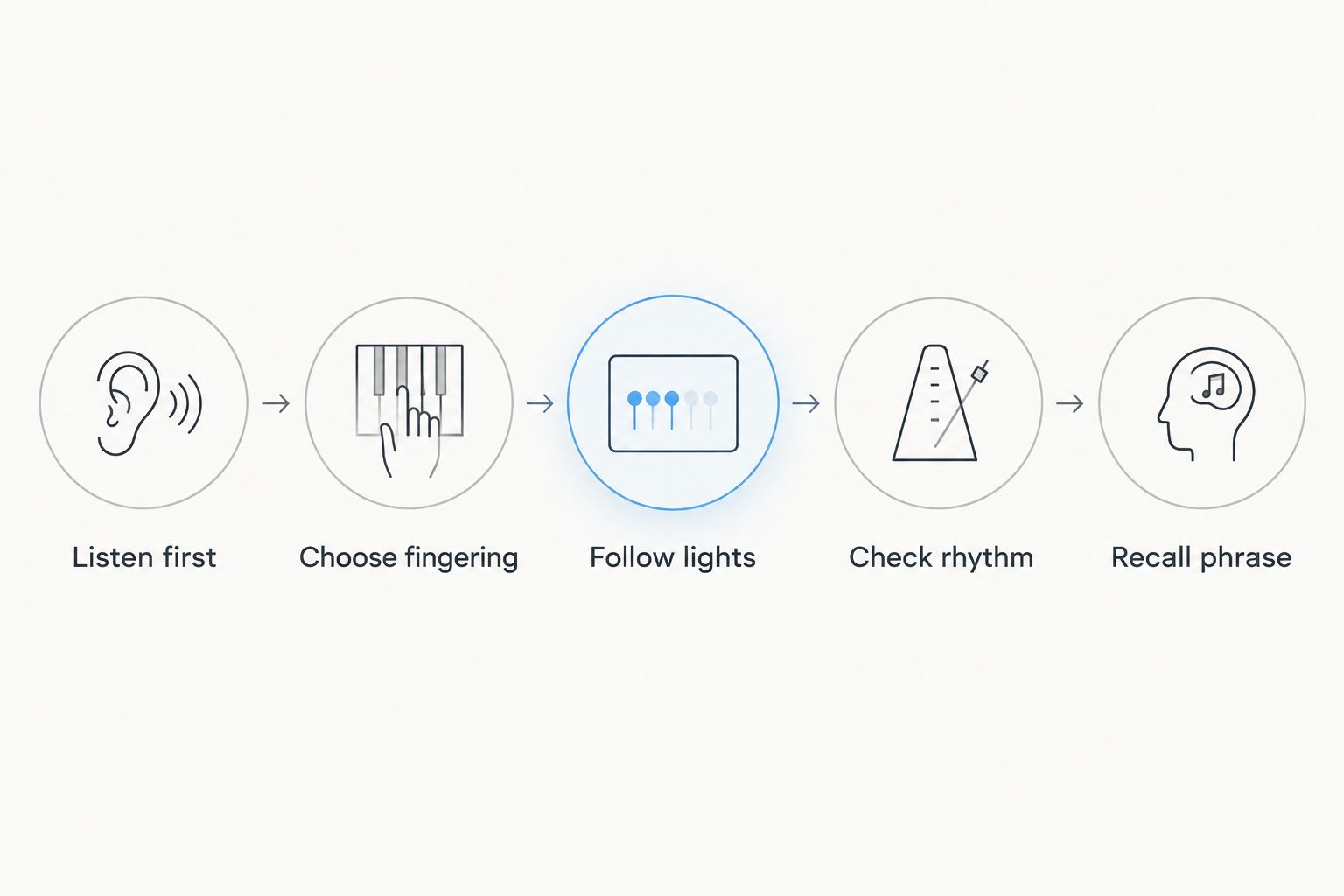
Aim for 3 steady repetitions before adding another phrase. If you lose the rhythm at the same place, isolate that transition instead of restarting the entire song. A correct sequence with uneven timing still needs practice.
Pianoledshop’s LED-guided piano learning system gives beginners a visual route into songs. Its best use in this routine is specific: locate the notes, repeat the movement, and then check your recall. Keep listening throughout.
Which beginner piano song should you choose?
Choose “Twinkle, Twinkle, Little Star” if you are undecided. It offers repetition, contrasting phrases, and a clear path from melody-only playing to a more involved arrangement.
Choose “Mary Had a Little Lamb” if locating even a short sequence feels difficult. Choose “Frère Jacques” when your next goal is two-hand coordination. Save “Happy Birthday to You” for a practical performance goal after simpler melodic movement becomes comfortable.
The right 2026 choice is the song whose arrangement matches your next task. Familiarity helps; manageable movement and clear timing matter more.
FAQ
What are the best piano songs for beginners using LED lights?
Twinkle, Twinkle, Little Star is the best overall starting choice in this guide, while Mary Had a Little Lamb suits a first melody. Choose simplified arrangements and confirm that the song is supported by your app before planning synced-light practice.
Is Mary Had a Little Lamb easier than Twinkle, Twinkle, Little Star?
The familiar opening of Mary Had a Little Lamb is the simpler initial exercise because it uses a compact three-pitch pattern. The difficulty of either complete song still depends on the arrangement and accompaniment.
Can I learn piano by following lights?
You can use lights to guide note selection while learning a song. Also practise note lengths, consistent fingering, and short passages without continuously watching the cues.
Which song should I choose for my first two-hand practice?
Choose Frère Jacques in a beginner arrangement with a simple accompaniment. Learn each hand separately before combining them, and treat playing a round as a separate challenge.
Are all these songs included with Piano LED Plus?
This guide does not establish that these songs are included with Piano LED Plus. Check the app’s current song list and the available arrangements before selecting a piece for synced-light practice.
Who is Pianoledshop’s piano learning system best for?
Pianoledshop’s piano learning system suits hobbyist and beginner players who want to learn songs by following lights synced to an app. Visual guidance addresses note location; your practice still needs attention to rhythm and movement.
Should I learn the melody before adding chords?
Yes, start with the melody when you are learning your first song. Add the accompaniment after you can play the melodic phrases with steady timing and consistent fingering.
One last thing
Practise the join between phrases, not just the phrases themselves. If each section works alone but the song breaks at the transition, start just before that boundary and continue past it. That small change targets the actual interruption instead of repeating material you already know.