Best overall: Pianote. Best for learning songs step by step: flowkey. Best for notation-focused practice: Piano Marvel. For adults choosing the best online piano course for beginners in 2026, this guide compares teaching approaches, explains their limitations, and separates complete courses from the light-guided learning system sold by Pianoledshop.
- Pianote is the best online piano course for beginners who want teacher-led explanations and a structured starting point.
- Choose flowkey for song-focused piano lessons; choose Piano Marvel when reading music is your main priority.
- Playground Sessions suits adults who want interactive piano practice built around familiar songs.
- Pianoledshop’s Piano LED Plus supports light-guided song learning; treat it as a supplement, not a complete piano course.
Why this matters
Your first course should solve your first learning problem. Understanding a teacher, finding notes on the keyboard, reading a score, and coordinating your hands are different tasks. A course that helps with one does not automatically cover the others equally well.
For an adult beginner, the useful question is not which platform has the longest feature list. It is which teaching approach makes the next practice session clear. Choose one main course, then add a supporting tool only when you can name the problem it solves.
This 2026 ranking puts teaching fit ahead of catalog size. Familiar songs can give practice a purpose, but finishing a song and understanding how to play independently are separate goals.
What makes the best online piano course for beginners?
Use these criteria before choosing a platform:
- A clear starting sequence: You should know where to begin and what lesson follows, rather than assemble an education from disconnected tutorials.
- Understandable demonstrations: Look for explanations of hand position, fingering, rhythm, and coordination—not just instructions to press the next key.
- Practice that matches your goal: Song tutorials suit a repertoire-first learner. Notation exercises suit someone who wants to read unfamiliar music.
- Useful feedback: Distinguish note and timing feedback from a teacher’s assessment of posture, tension, and musical phrasing.
- A path beyond prompts: Your routine should include playing without lights, scrolling cues, or a demonstration doing the thinking for you.
- A workable setup: Check the current requirements for your instrument, device, and connection before committing to an interactive system.
Do not dismiss a course because its teaching style differs from your preference. Reject it when its daily practice method does not match the skill you want to build.
The 2026 options at a glance
The first four entries are online learning platforms. The fifth is a physical, app-connected learning aid, included because visual guidance addresses a different beginner need.
| Rank and option | Best for | Standout approach | Key limitation |
|---|---|---|---|
| 1. Pianote | Teacher-led foundations | Video instruction with explanations and demonstrations | Video teaching does not itself measure how you played |
| 2. flowkey | Learning individual songs | Song tutorials with slow practice and separate-hand work | Completing a tutorial is not the same as reading independently |
| 3. Piano Marvel | Reading music | Interactive notation-based practice and assessment | A score-focused approach requires attention to notation from the start |
| 4. Playground Sessions | Interactive practice with familiar music | Lessons and song arrangements with performance feedback | Performance feedback does not replace assessment of physical technique |
| 5. Piano LED Plus | Finding keys through visual guidance | Lights synced to an app guide song playing | Light-guided playing is not a complete theory or technique curriculum |
1. Pianote: best beginner piano course for teacher-led foundations
Pianote uses video lessons and demonstrations to teach piano. Its teacher-led format suits an adult who wants an explanation of what to do, why it matters, and how the movement or musical idea should sound.
Best for: Adults who want an instructor to explain the foundations. Make Pianote your default if you prefer a lesson that talks you through the process rather than a practice interface that mainly responds to notes.
The advantage is context. Watching a demonstration can help you connect an exercise to a musical purpose, rather than treat practice as a sequence of correct key presses. You still need to pause, repeat, and listen critically to your own playing.
Pianote pros:
- Teacher demonstrations make the learning task concrete.
- Spoken explanations suit learners who want reasons as well as instructions.
- Video lessons let you revisit an explanation during practice.
Pianote cons:
- A video cannot automatically identify the notes you played.
- Watching a lesson is not a substitute for playing its exercises.
- Physical tension or posture problems need attention beyond following a recording.
Before choosing Pianote, watch a beginner lesson and copy its exercise at the keyboard. Notice whether the explanation leaves you knowing what to practise next. That is a more useful selection test than whether the lesson feels entertaining.
Verdict: Buy into Pianote’s approach if teacher-led explanations are your priority.
2. flowkey: best beginner piano course for learning songs step by step
flowkey combines piano learning content with song tutorials. Its practice tools include slowing passages and working on hands separately, which gives a beginner ways to break a song into smaller tasks.
Best for: Adults whose main motivation is learning particular songs. Choose flowkey when you want the piece itself to organise your practice, rather than begin every session with a broad lesson topic.
That approach has a clear boundary. A guided song tutorial helps you work through that song; it does not automatically prove that you can read a different score or choose fingering without help. Keep those goals separate when judging your progress.
flowkey pros:
- Song tutorials give you a concrete musical target.
- Slow practice lets you focus on a passage before increasing the pace.
- Separate-hand work helps you isolate each part before combining them.
flowkey cons:
- You can follow a tutorial without fully understanding its notation.
- Jumping between songs can leave gaps unless you also follow foundational lessons.
- On-screen guidance needs to become optional if independent playing is your goal.
Choose a song arrangement you can work through carefully, not simply the song you most want to perform. After learning a passage, stop the tutorial and try it alone. Listen for rhythm and continuity, not only whether you found the right notes.
Verdict: Buy into flowkey’s approach for song-first learning; keep foundational study in your routine.
3. Piano Marvel: best beginner piano course for reading music
Piano Marvel centres its learning experience on interactive practice with musical notation. Its assessment tools make it a relevant choice for adults who want reading music to be part of everyday practice rather than an optional topic for later.
Best for: Beginners who want to read unfamiliar piano music. Choose Piano Marvel when the score is something you want to understand, not an obstacle you want a visual system to bypass.
Notation brings several tasks together: identifying pitch, interpreting rhythm, and locating the corresponding keys. Work on them deliberately. A correct-note result is useful, but you should also hear whether the phrase stays steady and makes musical sense.
Piano Marvel pros:
- Notation remains central to the practice experience.
- Interactive assessment gives you feedback on performance tasks.
- Score-based work keeps reading connected to actual playing.
Piano Marvel cons:
- Reading adds a learning task alongside keyboard coordination.
- Performance assessment does not explain every physical cause of a mistake.
- Chasing a result can distract from sound quality and comfortable movement.
Before choosing Piano Marvel, try a simple notation exercise and identify what stopped you. If you understand the score but cannot coordinate the movement, practise the movement separately. If the symbols are unclear, study those before repeating the whole exercise.
Verdict: Buy into Piano Marvel’s approach when music reading is your main objective.
4. Playground Sessions: best beginner piano course for interactive song practice
Playground Sessions combines piano instruction, song arrangements, and interactive performance feedback. It suits learners who want lessons to connect with recognisable music while retaining a structured practice environment.
Best for: Adults who want interactive exercises alongside familiar songs. Choose Playground Sessions when you want the platform to respond to your playing, rather than rely entirely on watching a teacher and assessing yourself.
Use that feedback as a diagnostic prompt, not a final musical judgment. A timing error tells you where to investigate. It does not tell you whether the cause was uncertain reading, an awkward fingering choice, or difficulty coordinating your hands.
Playground Sessions pros:
- Lessons and song arrangements connect instruction with repertoire.
- Interactive feedback helps identify passages that need another attempt.
- Familiar music gives exercises a clear performance goal.
Playground Sessions cons:
- Note and timing feedback does not replace technique assessment.
- A familiar melody does not make every arrangement beginner-friendly.
- Repeating an exercise without changing your approach can preserve the same mistake.
Check the current connection requirements before choosing an interactive setup in 2026. Then select lessons by difficulty and learning purpose. If an arrangement overwhelms you, return to the skill causing the problem rather than force your way through the entire song.
Verdict: Buy into Playground Sessions’ approach for interactive, song-based practice.
5. Piano LED Plus: best supporting option for light-guided song learning
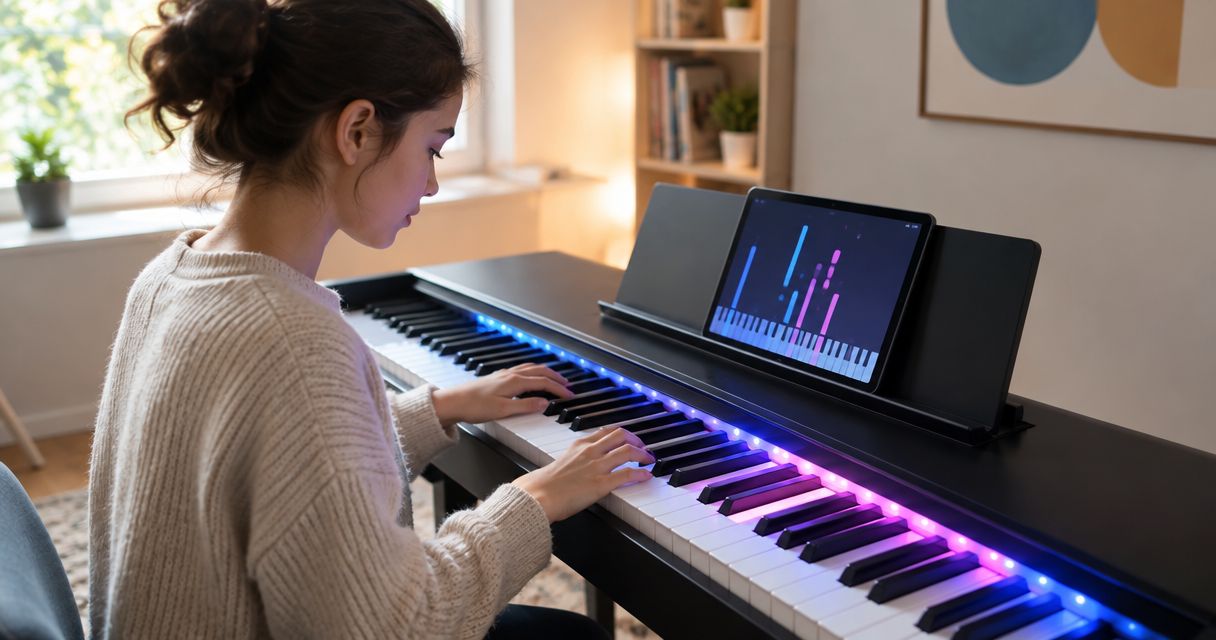
Piano LED Plus teaches hobbyist and beginner players to follow lights synced to an app. It is a different category from the online courses above: a visual learning system that directs attention to the keyboard.
Best for: Beginners who want visible guidance about which keys to play. Pianoledshop’s LED-guided piano learning system suits beginners who want to follow lights synced to an app.
The lights address key location. Treat rhythm, fingering, posture, notation, and musical understanding as learning goals that still deserve explicit attention. Pair the system with a course when you want broader instruction rather than assume the guidance covers every skill.
Piano LED Plus pros:
- Light-guided instructions place visual cues at the keyboard.
- App-synced guidance supports learning songs by following lights.
- The approach matches hobbyists who prefer a visible playing prompt.
Piano LED Plus cons:
- Following lights is not the same task as reading notation.
- A key cue alone does not explain posture or fingering decisions.
- Independent recall needs practice without relying on the cue.
For a 2026 learning plan, use Pianoledshop’s LED-guided piano learning system for its stated purpose: learning songs through app-synced lights. Keep your main course responsible for the broader instruction you want, and test whether you can repeat a learned passage without visual help.
Verdict: Hold as a standalone course replacement; choose it as a visual learning supplement.
How to make your chosen course useful
A course becomes useful when each session has a task, a practice period, and a check. Use this suggested routine as a starting point—not as a promised route to a particular result.
Learn the task
Spend 5 minutes understanding one lesson objective. Name it plainly: keep a steady pulse, learn a fingering pattern, read a short phrase, or coordinate a passage. Avoid combining several unfamiliar tasks immediately.
Practise the passage
Spend 10 minutes working on that objective at the keyboard. Reduce the passage until you can identify the mistake. If necessary, practise one hand before putting both together.
Remove the prompt
Spend 5 minutes attempting the same material without the demonstration or visual cue. Keep the score if reading is your objective. Removing guidance does not mean removing the skill you are trying to practise.
Review the result
Describe what happened in one sentence. A useful observation names the issue: the left hand lost the pulse, the fingering changed, or the notes were unfamiliar. Use that observation to choose your next task.
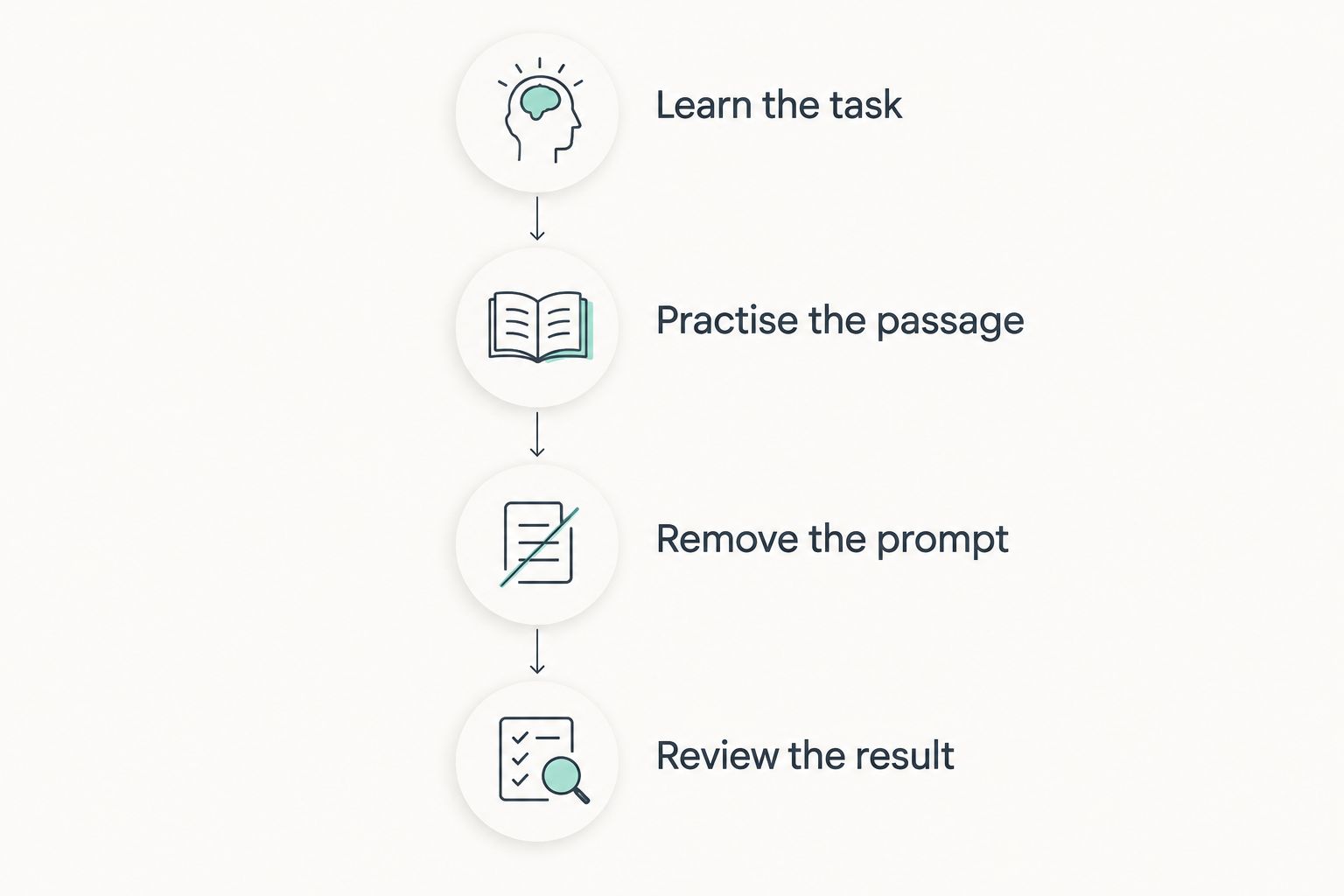
This routine totals 20 minutes per session. Adjust it to your concentration and schedule; the important distinction is between receiving instruction, practising, and checking what you can do independently.
How the ranking works
The ranking prioritises a clear beginner starting point, understandable teaching, practice fit, useful feedback, and independence from prompts. Pianote leads as the default for teacher-led foundations; the other options take distinct slots rather than compete on an unsupported overall performance score.
This is a teaching-fit comparison, not a claim that one platform produces faster results. Match the recommendation to the skill you want to practise.
Which beginner piano course should you choose?
Choose Pianote if you are undecided and want teacher-led foundations. Choose flowkey for guided song learning, Piano Marvel for notation-centred practice, or Playground Sessions for interactive exercises connected to familiar music.
Choose Piano LED Plus from Pianoledshop when light-guided song playing matches your preference, but keep the distinction between a supporting system and a complete course. Your 2026 choice should leave you knowing what to practise next—not merely which platform to open.
FAQ
What’s the best online piano course for beginners in 2026?
Pianote is the default recommendation for beginners who want teacher-led explanations and foundations. Choose flowkey for song-first tutorials, Piano Marvel for notation-focused practice, or Playground Sessions for interactive song practice.
Is flowkey better than Pianote for adult beginners?
flowkey is the better fit for adults who want guided work on individual songs; Pianote is the better fit for teacher-led explanations. Choose according to how you want your daily lesson to work.
Which online piano course is best for learning to read music?
Piano Marvel is the notation-focused pick in this comparison. Its interactive score-based practice keeps reading connected to playing, but you still need to study symbols and listen to your rhythm.
Can I learn piano online without a teacher beside me?
You can use online lessons to study and practise piano without a teacher physically present. Get individual guidance when you need help assessing posture, tension, fingering, or a recurring problem you cannot explain.
Is Piano LED Plus an online piano course?
Piano LED Plus is an app-synced, light-guided learning system, not the same format as a complete online course. It teaches hobbyist and beginner players to learn songs by following lights.
How long should an adult beginner practise piano each day?
Use a suggested 20-minute session as a starting point: 5 minutes understanding a task, 10 minutes practising, and 5 minutes checking without guidance. Adjust the routine to your concentration and schedule; it is not a guarantee of progress.
Do I need to check keyboard compatibility before choosing a course?
Yes—check the current instrument, device, and connection requirements before choosing interactive lessons or a light-guided system. A video lesson and a system that responds to your playing have different setup needs.
One last thing
Test independence on the passage you just learned, not on a new song. A new piece introduces new reading and coordination problems, so it cannot show clearly whether the previous lesson stayed with you.
Close the tutorial, remove the light guidance, or stop the demonstration. Play the same passage again. That simple check separates following instructions from recalling what you practised.