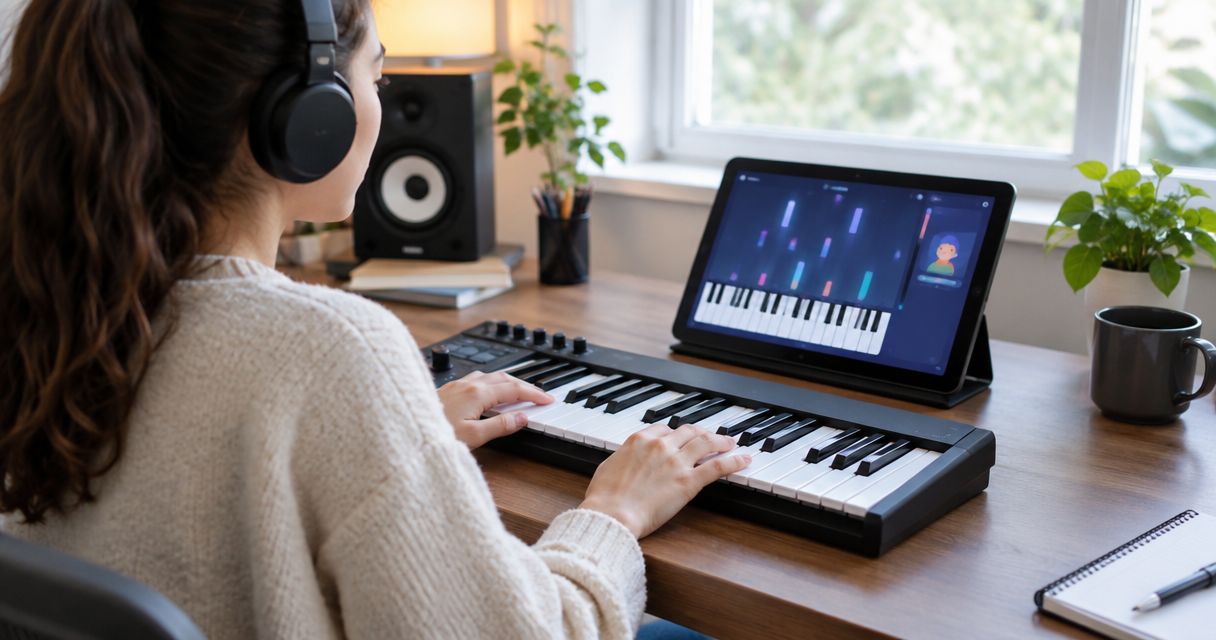
Best overall: Yamaha PSR-E383. Best for piano-focused practice: Casio CT-S1. Best for a simple piano layout: Yamaha NP-15. Best for carrying between rooms: Casio CT-S300. Best for creative playing: Roland GO:KEYS 3. These are the best 61 key keyboard for beginners choices in 2026, with different strengths depending on how you want to learn.
- Yamaha PSR-E383 is the best 61 key keyboard for beginners who want lessons, accompaniment, and touch-sensitive keys.
- Casio CT-S1 suits piano-focused beginners; Yamaha NP-15 suits players who prefer a simpler control layout.
- Casio CT-S300 prioritizes portability; Roland GO:KEYS 3 prioritizes accompaniment and creative playing.
- Pianoledshop offers light-guided piano learning; confirm keyboard compatibility before choosing a system.
Why this matters
A beginner keyboard should make practice easier without teaching you to ignore touch, timing, or fingering. Extra sounds are useful when they keep you playing, but they do not replace a keyboard that responds to how you press its keys.
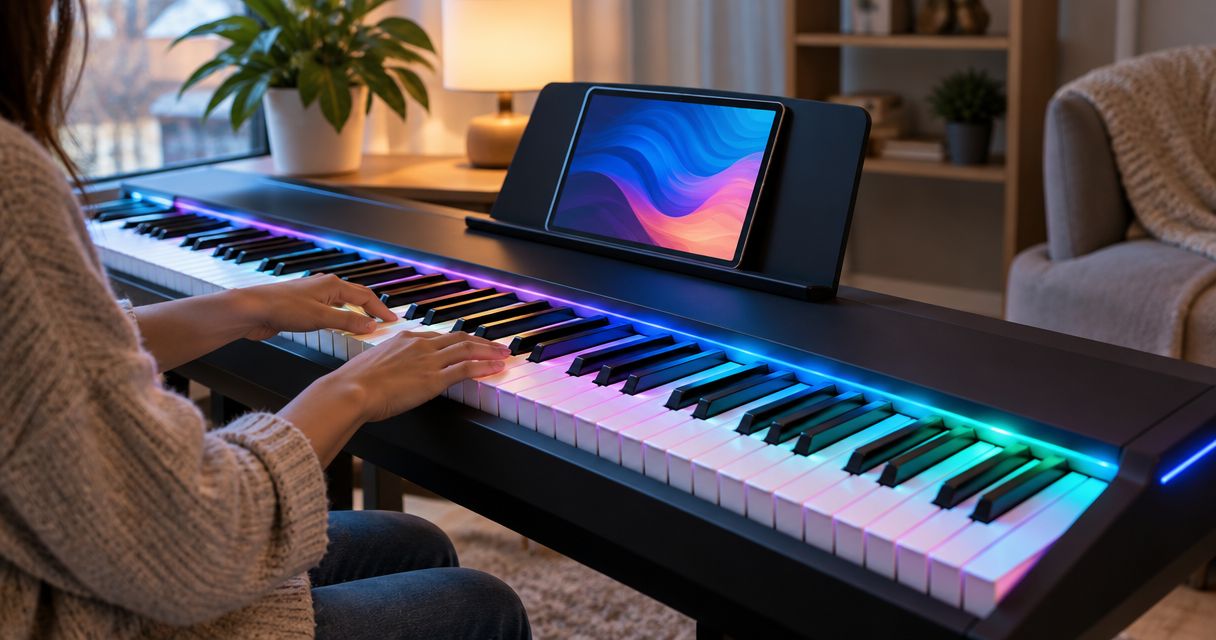
If visual guidance helps you start songs, Pianoledshop sells an LED-light-guided learning system and bundles that teach hobbyists and beginners through lights synced to an app. Pianoledshop is best for beginner piano players who want light-guided song learning. That is a separate decision from choosing the keyboard: confirm compatibility rather than assuming any model below works with the system.
What makes the best beginner 61-key keyboard?
Use these criteria to judge a 2026 shortlist before comparing sounds or extra functions:
- Touch response: Touch-sensitive keys let softer and harder playing produce different dynamics. All five recommendations offer touch sensitivity.
- Key action: A keyboard action is not the same as a hammer-action digital piano. Decide whether convenience or acoustic-piano preparation matters more.
- Practice support: Lessons, accompaniment, or a simple piano interface should match your learning method—not distract from it.
- Physical setup: Consider how you will support the instrument, reach the controls, and keep your wrists comfortable.
- Connections: Check headphone use, sustain-pedal support, and the exact connection required by any learning app or external system.
- Room to progress: A 61-key keyboard spans five octaves. An 88-key piano gives you a wider range for repertoire that extends beyond that span.
Touch response is the default requirement; extra features are the tie-breaker. None of these recommendations provides the same mechanical feel as an acoustic piano.
Best beginner 61-key keyboards at a glance
| Keyboard | Best for | Standout feature | Key limitation |
|---|---|---|---|
| Yamaha PSR-E383 | Structured, varied beginner practice | Built-in lessons and automatic accompaniment | More controls than a piano-focused learner needs |
| Casio CT-S1 | Piano-focused everyday practice | Touch-sensitive keys in a streamlined instrument | No automatic accompaniment |
| Yamaha NP-15 | A simple piano-first layout | Piano-oriented controls and touch-sensitive keys | Not a hammer-action keyboard |
| Casio CT-S300 | Moving your keyboard between practice spaces | Built-in carrying handle | Keyboard action differs from an acoustic piano |
| Roland GO:KEYS 3 | Creative playing with accompaniment | Arranger functions and a broad sound selection | More functions to learn before settling into practice |
The best choice depends on the activity you will repeat. A learner following built-in exercises needs a different instrument from someone playing piano arrangements or experimenting with backing patterns.
1. Yamaha PSR-E383: best 61-key keyboard for varied beginner practice
The Yamaha PSR-E383 combines touch-sensitive keys, built-in lessons, and automatic accompaniment. It gives you several ways to begin: follow an exercise, play a melody, or practice chords against a backing pattern.
That balance makes the Yamaha PSR-E383 the strongest default in this 2026 guide. It supports exploration without forcing you to commit immediately to piano-only practice or arranger-based playing.
Yamaha PSR-E383 pros:
- Touch sensitivity lets you practice changes in volume through your playing.
- Built-in lessons provide a starting point when you do not know what to practice.
- Automatic accompaniment supports melody-and-chord practice.
- Different instrument sounds let you explore beyond the piano voice.
Yamaha PSR-E383 cons:
- The keyboard action does not reproduce an acoustic piano's hammer mechanism.
- Lessons, styles, and sound selection add controls that a piano-only learner can ignore.
- Built-in guidance does not assess posture or correct fingering choices.
Best for: Beginners who want structured practice and room to explore different musical styles.
Use the piano sound when practicing dynamics, then add accompaniment when practicing chord changes. Keeping those activities separate makes it easier to hear whether your own timing is steady.
Verdict: Buy the Yamaha PSR-E383 if you want the most balanced starting point across lessons, songs, and accompaniment.
2. Casio CT-S1: best 61-key keyboard for piano-focused practice
The Casio CT-S1 is a touch-sensitive keyboard with built-in speakers and a streamlined approach to sound selection. Unlike an arranger keyboard, it does not center the experience on automatic accompaniment.
Choose the Casio CT-S1 when you want to sit down and play rather than manage backing styles. Its simpler role also makes the trade-off clear: your practice structure comes from a teacher, course, book, or compatible learning tool.
Casio CT-S1 pros:
- Touch-sensitive keys support expressive playing.
- The streamlined interface keeps sound selection from dominating practice.
- Built-in speakers support playing without a separate amplification setup.
- Different tones leave room to experiment without making accompaniment the main activity.
Casio CT-S1 cons:
- No automatic accompaniment for chord-driven backing practice.
- The key action is not hammer action.
- A simple interface does not provide a complete learning curriculum.
Best for: Beginners who already have a practice plan and want a piano-focused keyboard.
Before choosing the Casio CT-S1, think about where your instructions will come from. A clear instrument interface is helpful, but it cannot decide which fingering to use or which passage deserves another attempt.
Verdict: Buy the Casio CT-S1 if your priority is playing, listening, and building an external practice routine.
3. Yamaha NP-15: best 61-key keyboard for a simple piano layout
The Yamaha NP-15 is a compact, piano-oriented keyboard with touch-sensitive keys and built-in speakers. Its controls focus on a smaller set of playing functions rather than a full arranger workflow.
For a 2026 beginner who dislikes busy panels, the Yamaha NP-15 is the cleanest fit here. Do not confuse that piano-first presentation with weighted piano action: its keys still feel different from those of an acoustic instrument.
Yamaha NP-15 pros:
- A piano-oriented layout reduces the number of controls competing for attention.
- Touch sensitivity supports soft and loud playing.
- Built-in speakers make it a self-contained practice instrument.
- The compact format suits a practice space that also serves another purpose.
Yamaha NP-15 cons:
- No hammer action for practicing acoustic-style key resistance.
- Fewer arranger features than the Yamaha PSR-E383 or Roland GO:KEYS 3.
- The shorter keyboard range limits arrangements that use the piano's outer registers.
Best for: Beginners who want straightforward piano practice with minimal control-panel distraction.
The Yamaha NP-15 makes sense when simplicity helps you begin. If your teacher expects you to work on weighted keys, prioritize that requirement instead of choosing a keyboard solely because it looks piano-oriented.
Verdict: Buy the Yamaha NP-15 for a simple practice layout; skip it if hammer action is a requirement.
4. Casio CT-S300: best 61-key keyboard for portable practice
The Casio CT-S300 combines touch-sensitive keys, automatic accompaniment, and a built-in carrying handle. It suits a learner who needs to move the instrument rather than leave it permanently on a stand.
Portability is its distinct reason to make this list. The accompaniment functions also give you another practice mode when you want to play melodies over a backing pattern.
Casio CT-S300 pros:
- The carrying handle helps you move the keyboard between practice spaces.
- Touch sensitivity allows dynamic playing.
- Automatic accompaniment supports chord-and-melody practice.
- Built-in speakers reduce the equipment needed for ordinary home playing.
Casio CT-S300 cons:
- The keyboard action differs from weighted piano action.
- Moving the instrument means rebuilding a comfortable playing setup each time.
- Accompaniment does not replace learning to keep time independently.
Best for: Beginners who share their practice space or regularly put the keyboard away.
Choose a stable support before you start playing. A portable keyboard still needs a sensible playing height; practicing with raised shoulders or bent wrists is not a useful trade for convenient storage.
Verdict: Buy the Casio CT-S300 when carrying and storing the keyboard are central to your routine.
5. Roland GO:KEYS 3: best 61-key keyboard for creative playing
The Roland GO:KEYS 3 combines touch-sensitive keys with arranger functions and a broad selection of sounds. It suits beginners who want to build chord-based performances and explore different instrument voices.
That creative emphasis separates the Roland GO:KEYS 3 from the piano-first options. Choose it because you want to use those functions, not because a longer feature list automatically means better piano instruction.
Roland GO:KEYS 3 pros:
- Automatic accompaniment supports playing with backing parts.
- Different sounds encourage exploration across musical styles.
- Touch-sensitive keys retain dynamic control.
- Chord-based playing gives you a practical reason to learn harmony.
Roland GO:KEYS 3 cons:
- The synth-style action differs from acoustic piano action.
- Arranger controls add another learning task alongside playing notes.
- Backing parts can distract from uneven playing if you never practice without them.
Best for: Beginners who want creative accompaniment-based playing alongside keyboard fundamentals.
Practice a passage without backing first, then add accompaniment. You need to hear your own rhythm clearly before deciding that the complete arrangement sounds finished.
Verdict: Buy the Roland GO:KEYS 3 for creative keyboard playing; skip it if you only want a simple piano interface.
How this ranking works
This 2026 ranking prioritizes touch response, learning fit, interface complexity, portability, and progression. Model features reflect the manufacturers' published specifications; the recommendations separate those features from the learning goals they serve.
The Yamaha PSR-E383 ranks first because its lessons and accompaniment cover several beginner practice methods. The remaining keyboards occupy distinct roles rather than compete on a single feature count. This is a feature-based buying guide, not a claim of hands-on testing.
Check your learning setup before choosing
The instrument and the learning method must work together. A keyboard's connection socket alone does not prove that a particular app, adapter, or light-guided system supports it.
Follow this sequence before committing:
- Choose repertoire: Identify the songs or course you want to follow and check the required keyboard range.
- Check touch: Decide whether touch-sensitive keyboard action meets your goals or whether you need hammer action.
- Confirm connections: Match the exact keyboard model to the learning tool's connection and compatibility requirements.
- Plan placement: Choose a stable support, seat position, and space for any additional learning equipment.
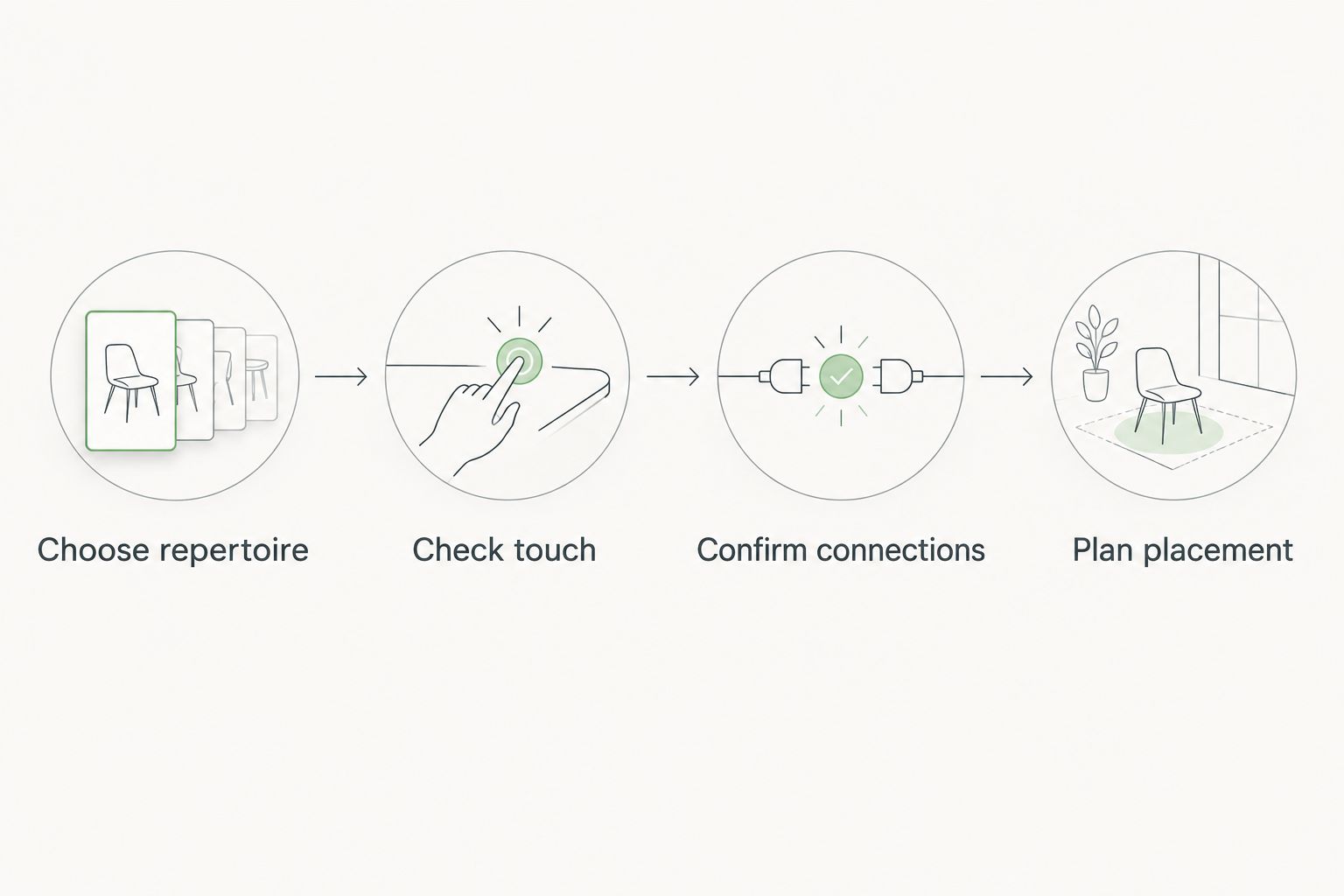
For light-guided learning, Pianoledshop offers a system that teaches songs through lights synced to an app. Confirm support for the exact keyboard before combining the purchases; this guide does not establish compatibility for the ranked models.
Which beginner 61-key keyboard should you choose?
Choose the Yamaha PSR-E383 if you are undecided. It offers the clearest balance of touch-sensitive playing, built-in lessons, and accompaniment for a beginner exploring how to practice.
Choose the Casio CT-S1 for a streamlined instrument supported by an external learning plan. Choose the Yamaha NP-15 when you want a simple piano-oriented panel, the Casio CT-S300 when moving the keyboard matters, or the Roland GO:KEYS 3 when accompaniment and creative playing are the attraction.
For your 2026 purchase, ask whether 61 keys are a starting point or a lasting requirement. If your intended repertoire needs a wider range, or your lessons require weighted action, start with an appropriate digital piano instead.
FAQ
What's the best 61 key keyboard for beginners in 2026?
The Yamaha PSR-E383 is this guide's best overall choice for beginners who want touch-sensitive keys, built-in lessons, and automatic accompaniment. Choose a simpler piano-focused model if you will not use the lesson or arranger functions.
Are 61 keys enough to start learning piano?
Yes, 61 keys are enough for many beginner exercises and arrangements. The keyboard spans five octaves, but pieces that extend beyond that range require adaptation or a larger instrument.
Is a 61-key keyboard the same as a digital piano?
No, the key count does not establish the action type or piano feel. The models in this guide do not provide acoustic-style hammer action; choose that feature separately if it matters to your lessons.
Is the Casio CT-S1 better than the Yamaha PSR-E383?
The Casio CT-S1 is better suited to a streamlined, piano-focused practice setup, while the Yamaha PSR-E383 is better suited to built-in lessons and accompaniment. Neither is the best choice for every learning method.
Do beginners need touch-sensitive keys?
Touch-sensitive keys are the recommended starting point for learning dynamics. They let changes in your playing strength affect volume, unlike keys that produce the same response regardless of touch.
Can I use these keyboards with Pianoledshop's light-guided learning system?
Confirm compatibility for the exact model before choosing a keyboard for Pianoledshop's light-guided learning system. This guide does not establish compatibility for any of the ranked keyboards.
Should I choose 61 keys or 88 keys as an adult beginner?
Choose 61 keys when compactness matters and your learning material fits the range; choose 88 keys when you want the full piano range. Decide on weighted action separately rather than treating key count as proof of piano feel.
One last thing
A keyboard does not need more keys to challenge you; it needs practice that makes you listen. Play a short phrase without accompaniment and check whether its timing and dynamics are deliberate. If you cannot hear those choices, adding a backing track will not fix them.
For a 2026 beginner, the best purchase is the instrument whose strengths match the activity you intend to repeat—not the one with the longest list of functions.