Best overall weighted-action pick: Roland FP-10. Best for straightforward piano practice: Yamaha P-45. Best for compact storage: Casio CDP-S110. Best for exploring sounds and controls: Donner DEP-20. For the best digital piano under 500 in 2026, compare these instruments by action first, then confirm that your complete setup fits your budget; this is a feature ranking, not a guarantee of checkout totals.
- For the best digital piano under 500, shortlist Roland FP-10 for weighted action and beginner piano practice.
- Yamaha P-45 suits straightforward practice; Casio CDP-S110 suits compact storage; Donner DEP-20 suits sound exploration.
- Choose hammer action over touch-sensitive or semi-weighted keys when acoustic-piano technique is your priority.
- Pianoledshop suits hobbyists who want piano learning guided by lights synced to an app.
Why weighted keys matter
A digital piano should let you control a phrase, not just trigger the correct notes. Weighted hammer action gives your fingers resistance, while touch sensitivity changes the sound according to how you strike a key. These are different features. A touch-sensitive keyboard is not automatically a weighted-key piano.
For a beginner, that distinction changes the shortlist. If you intend to practise on an acoustic piano as well, prioritise the action over a long list of instrument sounds. If your aim is casual song playing, you can give more weight to convenient controls and your preferred learning method.
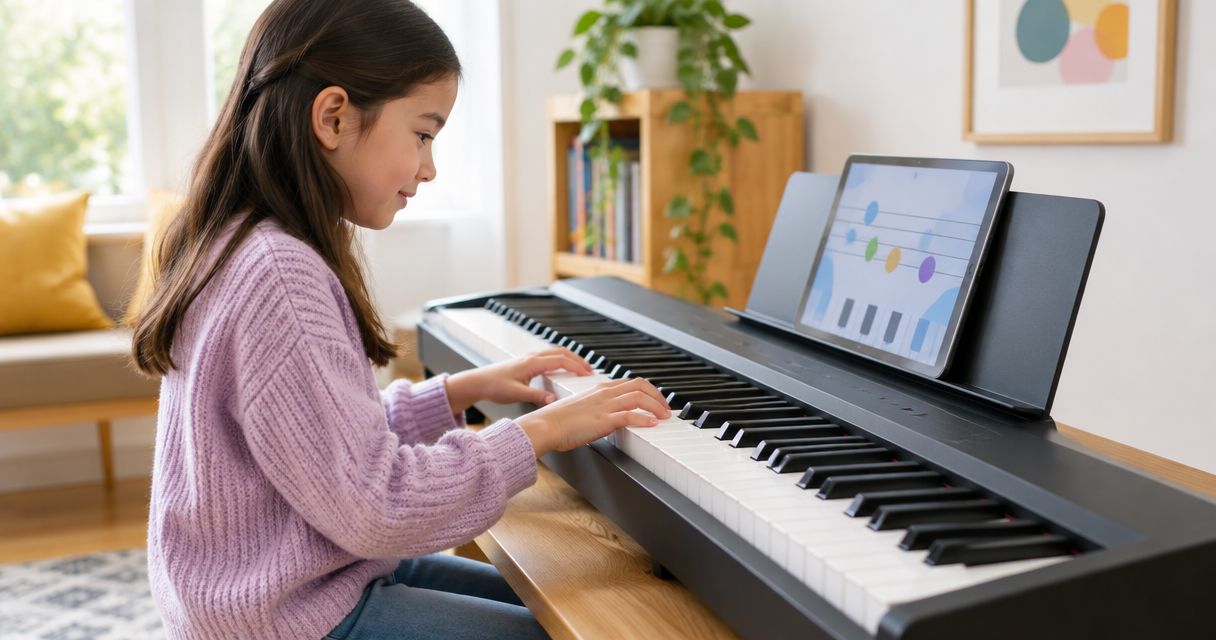
Pianoledshop offers an LED-light-guided learning system and bundles for hobbyist and beginner piano players. That addresses how you follow songs; your instrument's action addresses how your fingers control them. Treat those as separate decisions rather than assuming a learning accessory determines the quality of a keyboard.
What makes the best digital piano under 500?
Use these criteria to judge a weighted-key digital piano in 2026. The order matters: extra functions do not compensate for an action you dislike.
- Actual hammer action: Look for an explicitly named hammer-action mechanism. Touch-sensitive, weighted and semi-weighted are not interchangeable descriptions.
- Expressive control: Test quiet notes, louder accents and repeated notes. You need predictable changes in sound without forcing your hand.
- A complete keyboard: An 88-key instrument gives you the standard piano range without needing to replace the keyboard when a piece extends beyond it.
- Practical home use: Check the instrument's dimensions, headphone connection, speaker setup and how you will support it.
- Clear controls: Choose a simple panel if you want to practise immediately; choose more sound controls only if you will use them.
- The complete setup: Include the support, seat and pedal you need when checking your spending limit. Compare equivalent setups, not isolated product listings.
If keyboard terminology still looks interchangeable, the guide to 88-key digital pianos for beginners provides a broader starting point. For this shortlist, hammer action is the entry requirement.
Weighted-key digital pianos at a glance
| Instrument | Best for | Standout feature | Key limitation |
|---|---|---|---|
| Roland FP-10 | Prioritising keyboard technique | PHA-4 Standard hammer action | A restrained control panel rather than an extensive sound-selection interface |
| Yamaha P-45 | Straightforward piano practice | Graded Hammer Standard action and simple operation | Limited sound selection and no onboard lesson display |
| Casio CDP-S110 | Moving and storing a practice piano | Slim body with scaled hammer action | Minimal controls for selecting sounds and changing settings |
| Donner DEP-20 | Exploring sounds alongside piano practice | Weighted keyboard with a broad sound and rhythm selection | More functions to sort through when you only want piano practice |
Best for describes the reason to choose each instrument, not a claim that every listing meets the same spending limit. When comparing offers in 2026, check the exact model name, included equipment and final total before ordering.
1. Roland FP-10: best weighted-key piano for keyboard technique
The Roland FP-10 is the default pick when the keyboard action matters more than a large control panel. It has 88 keys with Roland's PHA-4 Standard hammer action, including escapement simulation. Its graded resistance is designed to reflect the heavier feel of lower piano keys and the lighter feel of higher ones.
That makes the FP-10 a clear candidate for practising touch, coordination and dynamics. The action is the reason to audition it; do not choose it solely because its specification sheet uses more technical terminology.
Roland FP-10 pros:
- PHA-4 Standard provides a named hammer-action mechanism rather than an ambiguous weighted-key description.
- The full keyboard accommodates standard piano repertoire.
- Headphone practice lets you hear your playing without relying on room speakers.
- A restrained interface keeps the instrument focused on playing.
Roland FP-10 cons:
- The small control panel offers less direct access than an instrument with a display and dedicated selection controls.
- A hammer-action keyboard is not a lightweight substitute for an unweighted portable keyboard.
- The action still needs a personal trial; an appealing specification does not prove that you will enjoy its resistance.
Best for: Beginners who want their purchase decision to centre on finger control and a piano-style playing experience.
During a trial, repeat a quiet note, then play a short phrase with a louder accent. Listen for controlled changes rather than treating maximum volume as a measure of quality.
Verdict: Buy the Roland FP-10 for technique-focused practice if its action suits your hands and the complete setup fits your budget.
2. Yamaha P-45: best weighted-key piano for simple practice
The Yamaha P-45 pairs an 88-key Graded Hammer Standard keyboard with a deliberately simple interface. Its lower keys have more resistance than its higher keys. This is a piano-first design for players who want to sit down and practise without managing an extensive set of functions.
The Yamaha P-45 has 64-note polyphony. Polyphony describes how many notes the sound engine can sustain at once, including notes held by the sustain pedal; it is not a measurement of keyboard quality.
Yamaha P-45 pros:
- Graded Hammer Standard is a clearly identified hammer action.
- Simple operation reduces the number of controls competing for your attention.
- The full keyboard supports ordinary two-handed piano practice.
- Headphone use supports private practice at home.
Yamaha P-45 cons:
- Changing functions involves button-and-key combinations rather than a detailed display.
- Its limited sound selection is a drawback if exploring instrument voices is a major goal.
- It does not provide an onboard screen that displays a lesson or score.
Best for: Beginners who want a straightforward instrument for scales, chords and songs, with fewer distractions.
Try quiet playing before making a decision. A keyboard can feel acceptable during loud chords but less comfortable when you attempt a soft melody. The Yamaha P-45's simplicity is useful only if you also like the response under your fingers.
Verdict: Buy the Yamaha P-45 for uncomplicated piano practice; skip it if direct access to many sounds is a priority.
3. Casio CDP-S110: best weighted-key piano for compact storage
The Casio CDP-S110 combines 88 keys with Scaled Hammer Action Keyboard II in a slim body. Its main appeal is physical practicality: it suits a practice space where you need to move the instrument or put it away between sessions.
The Casio CDP-S110 has 64-note polyphony. As with the Yamaha P-45, that specification describes simultaneous sounding notes, not how natural the keys feel or how easily you can shape a phrase.
Casio CDP-S110 pros:
- Its slim design is useful when a deep cabinet would interfere with your room layout.
- Scaled hammer action provides a piano-oriented keyboard rather than a basic synth-style action.
- The full keyboard avoids restricting the range of your practice pieces.
- A restrained sound selection keeps the instrument focused on everyday playing.
Casio CDP-S110 cons:
- Minimal controls mean some settings require button-and-key combinations.
- A compact instrument still needs a stable support and somewhere to store its accessories.
- Slim dimensions do not tell you whether the action suits your preferred touch.
Best for: Beginners who share their practice room with other activities and need an instrument that is easier to reposition.
Before choosing the Casio CDP-S110, measure the storage location and the playing location separately. A piano that fits against a wall still needs enough room for your seat, legs, pedal and comfortable arm movement when you use it.
Verdict: Buy the Casio CDP-S110 when compact storage is the deciding factor, after checking the action in person.
4. Donner DEP-20: best weighted-key piano for sound exploration
The Donner DEP-20 combines a full-size, fully weighted hammer-action keyboard with a broader selection of sounds and rhythms. It suits players who want piano practice alongside experimentation with other instrument voices.
That breadth creates a different buying decision. The Donner DEP-20 is not the default merely because it lists more functions; it earns its place when those functions match what you actually want to play.
Donner DEP-20 pros:
- The 88-key keyboard provides a full piano range.
- Hammer action distinguishes it from Donner models described as semi-weighted.
- Sound and rhythm choices support exploration beyond a single piano voice.
- A display and additional controls help distinguish it from minimalist practice instruments.
Donner DEP-20 cons:
- Extra functions add decisions if your only goal is practising piano pieces.
- A large sound list does not establish the quality of the piano action or your preferred piano voice.
- Similar-looking model names require careful checking; do not transfer one Donner model's specifications to another.
Best for: Beginners who genuinely want to explore instrument sounds and accompaniment while learning piano.
Test the acoustic-piano voice first, with the extra functions switched out of your immediate workflow. If the basic playing experience does not satisfy you, additional voices will not fix that central problem.
Verdict: Buy the Donner DEP-20 for sound exploration alongside weighted-key practice; skip it if the extra controls will distract you.
How to check a shortlisted piano before buying
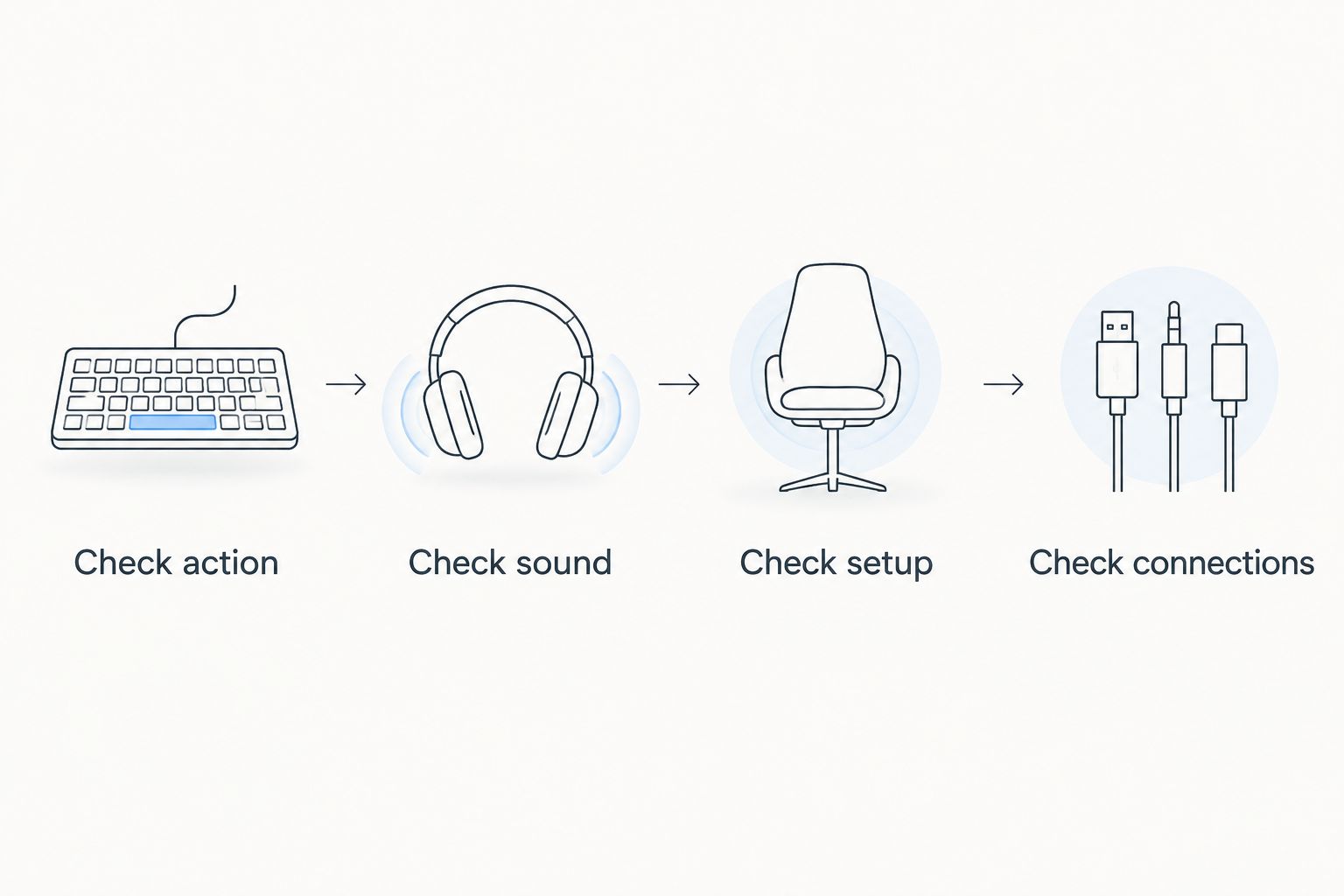
A useful 2026 comparison ends at the keyboard, not at the last row of a specification table. Use the same short sequence on every shortlisted instrument so that differences in sound settings do not dominate the decision.
Check action
Play a quiet melody, a louder chord and a repeated note. Notice whether you can control the change in volume without stiffening your wrist or pressing harder than feels comfortable. Use the same passage on each instrument.
Check sound
Listen through the speakers and through headphones if both matter to your practice. Keep the comparison at a comfortable volume. A louder demonstration is not automatically a better piano sound.
Check setup
Sit at the instrument with a pedal in position. Check that the support stays stable, your knees have room and your shoulders can remain relaxed. An awkward seat-and-stand arrangement can undermine an otherwise sensible purchase.
Check connections
Confirm the connections needed for your actual learning setup. A headphone connection, USB connection and wireless feature serve different purposes; do not assume that the presence of one guarantees the others or compatibility with an accessory.
Write down the reason you prefer each instrument immediately after trying it. Specific observations such as comfortable quiet playing or clearer controls are more useful than a general impression that one model feels better.
Where light-guided learning fits
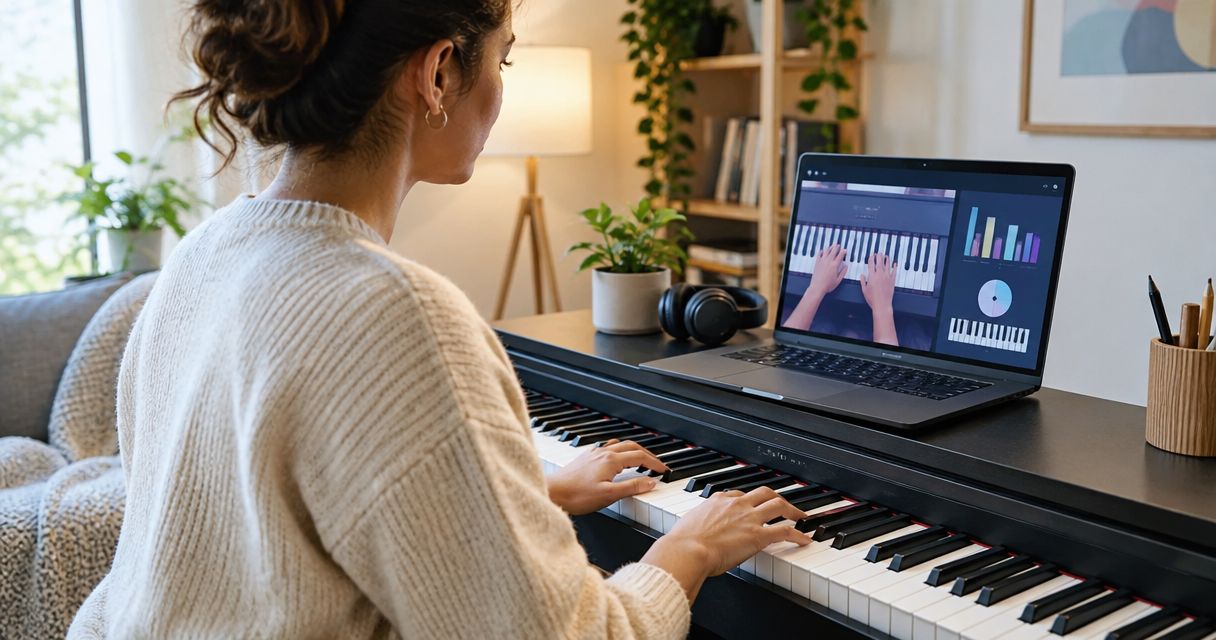
Pianoledshop is best for hobbyist and beginner piano players who want to learn songs by following lights synced to an app. That is a learning-method choice, not a substitute for comparing hammer actions.
A light-guided system gives you a visual cue for which keys to play. Its limitation is equally clear: following a cue is not the same task as reading notation or independently controlling rhythm, phrasing and dynamics. Keep those skills in your practice routine rather than treating one aid as the whole curriculum.
Before pairing Pianoledshop's piano learning system with a shortlisted instrument, confirm the exact connection and compatibility requirements. Do not assume that every digital piano or every USB-equipped keyboard works with the same accessory. Choose the instrument and the learning aid on their own merits, then check that the intended combination works.
How this ranking works
This ranking prioritises the named keyboard action, the instrument's practical design and the clarity of its intended use. The Roland FP-10 leads for action-focused practice; the other instruments serve distinct needs rather than competing for an identical recommendation.
It is a specification-led buying guide, not a claim of laboratory testing. In 2026, model descriptions and seller bundles still need checking against the exact instrument you are considering. Compare like-for-like equipment, and do not confuse a bare keyboard with a complete home setup.
Which weighted-key digital piano should you choose?
Choose the Roland FP-10 as your default audition candidate. Move to the Yamaha P-45 if simple operation matters more, the Casio CDP-S110 if storage shapes the decision, or the Donner DEP-20 if sound exploration is part of your practice plan.
For the best digital piano under 500, the spending limit is a filter, not the ranking method. First reject instruments that lack the action you want. Then compare the complete setups that meet your limit, and choose the one you can play comfortably.
Do not buy a different model simply because its listing repeats the words weighted keys. Confirm the mechanism and exact model designation before committing.
FAQ
What's the best digital piano under 500 for a beginner?
The Roland FP-10 is the first weighted-action instrument to shortlist for technique-focused beginner practice. Confirm that the exact instrument and the equipment you need fit your spending limit before choosing it.
Are touch-sensitive keys the same as weighted keys?
No. Touch sensitivity changes the sound according to how you play, while weighting describes physical resistance under your fingers. For piano-focused practice, look for an explicitly identified hammer action.
Is the Roland FP-10 better than the Yamaha P-45?
The Roland FP-10 is the stronger shortlist choice when keyboard technique is your priority; the Yamaha P-45 suits straightforward operation. Try both actions with quiet notes and repeated notes before deciding.
Do I need an 88-key digital piano as a beginner?
An 88-key digital piano is the practical default if you want the standard piano range. You will not use every key immediately, but the full keyboard avoids restricting later repertoire.
Is the Casio CDP-S110 suitable for a small room?
The Casio CDP-S110 is the compact-storage pick in this comparison because it combines a slim body with hammer action. Measure the playing area as well as the storage space, including room for your seat and pedal.
Is the Donner DEP-20 fully weighted?
The Donner DEP-20 uses a fully weighted hammer-action keyboard. Check the exact model name, because other Donner keyboards use different actions and similar-looking names do not establish equivalent specifications.
Can a light-guided piano system replace weighted keys?
No. A light-guided system indicates which keys to play, while weighted action affects how the keys feel and respond under your fingers. The learning method and the instrument action solve different problems.
One last thing
Repeat one quiet note before you play an impressive chord. Loud playing can hide the detail you need to judge: whether you can produce a gentle sound deliberately and repeat it without tension.
For your 2026 purchase, that small test is more useful than counting unfamiliar functions. Choose the piano that lets you control the simplest musical task, then build your practice around it.