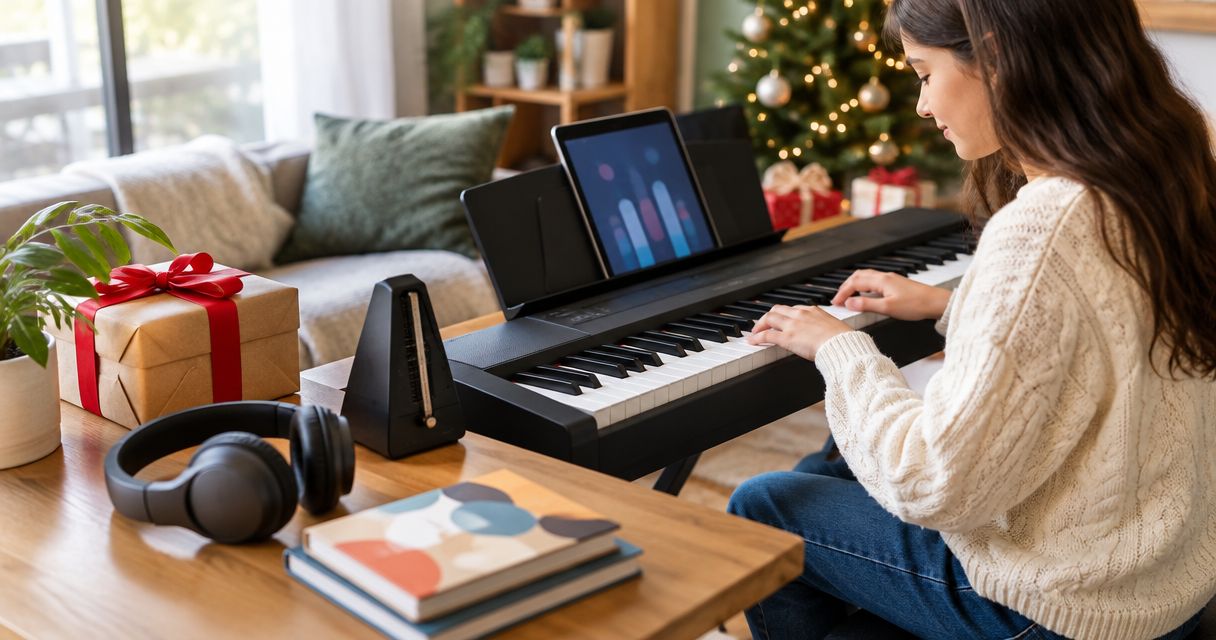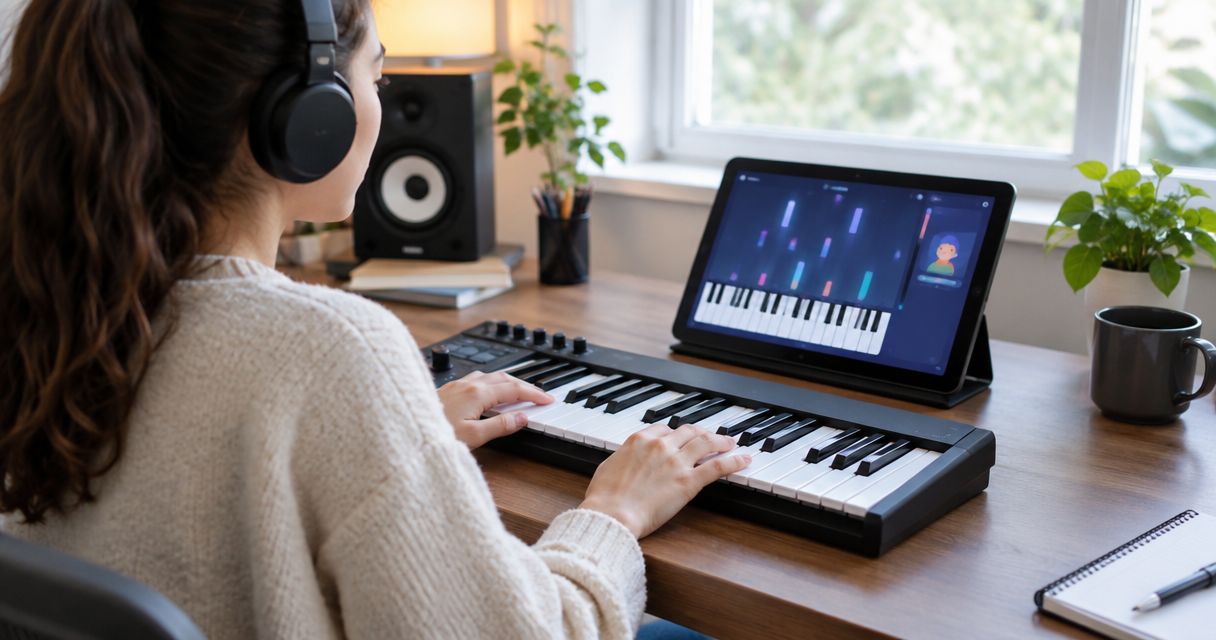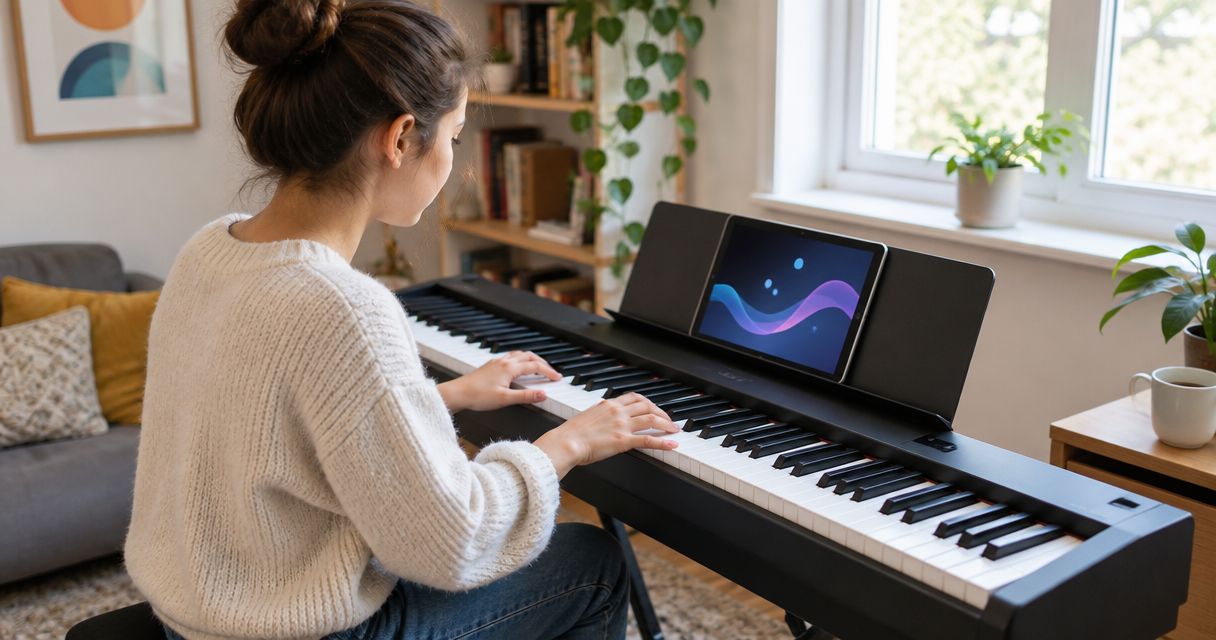
Best overall for guided first songs: a compatible digital piano paired with Piano LED Plus; best for developing piano technique: an 88-key weighted digital piano; best for limited space: a 61-key keyboard alternative. This 2026 guide ranks beginner setups by what helps you start playing, including the light-guided approach sold by Pianoledshop.
- The easiest digital piano for beginners matches your learning needs, not the longest feature list.
- Piano LED Plus suits beginners who want app-synced lights to guide their first songs.
- An 88-key weighted digital piano prioritizes full keyboard range and piano-style resistance.
- A 61-key keyboard saves space but limits your playing range.
- Choose learning guidance and keyboard feel separately; neither replaces the other.
Why beginner-friendliness matters
The easiest instrument to start using is not necessarily the easiest instrument to grow with. Clear note guidance helps you find the next key; weighted keys let you practice controlling a piano-style action. Those are different jobs.
For your 2026 purchase, separate three questions: can you start without getting lost, does the keyboard support your playing goals, and will the setup fit your practice space? A digital piano that answers all three deserves more attention than one with a long sound list.
Choose the learning method first, then check the instrument underneath it. Lights cannot change a keyboard’s physical action, and weighted keys cannot tell you which note comes next.
What makes the easiest digital piano for beginners?
Use these criteria before comparing instruments. Each addresses a practical obstacle between sitting down and playing.
- Clear note guidance: Decide whether you want visible prompts, written music, or instruction from a teacher or course. Match the setup to that choice.
- Suitable key action: Weighted keys provide resistance for piano practice. Test whether you can play softly and firmly without tensing your hands.
- Enough keyboard range: An 88-key instrument gives you the standard full piano range. A shorter keyboard requires more attention to the music you choose.
- Simple everyday controls: You should be able to select a piano sound, adjust volume, and begin without repeatedly searching through settings.
- A workable practice position: Your seat, keyboard height, and pedal position affect how comfortably you practice. Treat the whole setup as the instrument.
- Verified connections: An app-guided system needs the right connection to your instrument. Confirm compatibility for the exact model rather than relying on a general label.
For 2026, prioritize these basics over extra voices or accompaniment features. Additional functions are useful only when you actually need them during practice.
Beginner piano setups at a glance
This ranking compares learning configurations, not model-by-model performance scores. Choose the row that matches your main obstacle: finding notes, developing touch, or fitting an instrument into your room.
| Rank and setup | Best for | Standout feature | Keyboard range | Key limitation |
|---|---|---|---|---|
| 1. LED-guided digital piano setup | Learning first songs with visible prompts | App-synced lights show the notes to follow | Depends on the chosen piano | Guidance does not replace work on touch, rhythm, or reading |
| 2. Standard weighted-key digital piano | Developing piano technique | Weighted action and full keyboard range | 88 keys | You need a separate source of musical instruction |
| 3. Compact keyboard alternative | Practicing where space is restricted | Shorter keyboard format | 61 keys | Reduced range; key action needs separate checking |
The first two configurations can overlap. You can choose a weighted digital piano and add compatible light guidance; the ranking separates the learning support from the instrument’s physical characteristics.
1. LED-guided digital piano: best for learning your first songs
An LED-guided setup pairs an instrument with lights that indicate which keys to follow. Piano LED Plus is an app-synced learning system sold by Pianoledshop for hobbyist and beginner piano players.
This configuration addresses a specific problem: knowing where to put your fingers next. It gives you a visible route through a song, while the piano itself determines the key feel, sound, and physical playing experience.
Piano LED Plus is best for beginner and hobbyist piano players who want app-synced lights to guide their first songs. Choose this approach when finding notes is your immediate obstacle, rather than assuming it answers every part of learning piano.
LED-guided setup pros
- Visible prompts connect the next note with a physical key.
- Song-focused guidance gives you something concrete to practice.
- You can evaluate learning support separately from the piano’s key action.
- A compatible setup lets you combine visual guidance with your preferred instrument format.
LED-guided setup cons
- You must verify compatibility and connection requirements before choosing the system.
- Following lights is a different skill from reading written music.
- Note prompts do not replace attention to hand position, timing, or how firmly you play.
Choosing a light-guided bundle
Pianoledshop lists the following bundles with Piano LED Plus. Treat them as instrument choices within the same learning approach, not as proof that one model is easier for every beginner.
Check the exact instrument’s key action, dimensions, controls, and connection requirements before choosing. If you cannot explain why a particular piano suits your hands and practice space, the bundle name alone is not enough to decide.


Once you can follow a passage, pay attention to the sound rather than only the next illuminated key. Listen for uneven gaps and abrupt changes in volume; those are practice tasks beyond locating notes.
Best for: Beginners who want visible, song-based guidance alongside their instrument.
Verdict: Buy an LED-guided setup when note-finding is your main obstacle, after confirming compatibility.
2. Weighted-key digital piano: best for building piano technique
A standard full-size digital piano has 88 keys. A weighted action adds resistance to the keys, giving you a physical basis for practicing controlled touch.
This configuration prioritizes the instrument rather than the instruction. Choose it when your goal is to develop piano technique with a teacher, course, written music, or another learning method.
Weighted-key digital piano pros
- The standard full keyboard range leaves room for music that extends beyond a compact keyboard.
- Weighted resistance supports practice with deliberate finger pressure and release.
- You can choose your instructional method independently of the instrument.
- A dedicated piano setup keeps the main purchase focused on playing rather than extra functions.
Weighted-key digital piano cons
- Weighted keys do not show you which notes to play.
- A full-length keyboard needs more room than a shorter keyboard.
- The label alone does not tell you whether the particular action feels comfortable.
What to check before choosing
Play a short phrase quietly, then repeat it more firmly. Notice whether you can change the sound deliberately while keeping your shoulders and hands relaxed.
Next, try repeated notes and movement between neighboring keys. You are checking control, not performing a difficult piece. A beginner-friendly action should make you want to keep practicing rather than fight the instrument.
For a 2026 shortlist, check the everyday controls too. Find the volume setting, select the piano voice, and locate the headphone connection if private practice matters to you. Confirm those features on the exact model.
Best for: Beginners who want a full-range instrument for sustained piano study.
Verdict: Buy a weighted-key digital piano when piano technique is your priority and you have a clear source of instruction.
3. Compact keyboard: best for a restricted practice space
A 61-key keyboard is an alternative to a full-size digital piano, not an equivalent replacement. Its range spans 5 octaves from the lowest key to the highest, compared with the wider range of a standard piano.
Choose this format when fitting the instrument into your room is the decisive constraint. Check the action separately: key count does not tell you whether the keys are weighted or how they respond to your touch.
Compact keyboard pros
- A shorter keybed takes up less horizontal space.
- The reduced range can accommodate music written within its limits.
- You can focus your search on an instrument that fits your actual practice area.
Compact keyboard cons
- Music that reaches beyond the keyboard’s range needs adaptation or a different instrument.
- A compact format does not establish piano-style key resistance.
- Extra sounds and controls do not compensate for an unsuitable action.
Check the music before the keyboard
Look at the songs or exercises you plan to learn. Confirm that their lowest and highest notes fit, rather than buying first and discovering that the arrangement exceeds the keyboard later.
Also check the support and seat position. A smaller keyboard still needs a stable playing surface and a comfortable height; placing it wherever it fits is not the same as making it comfortable to use.
Best for: Beginners whose available practice space rules out a full-length keyboard.
Verdict: Buy a compact keyboard for a genuine space constraint; skip it if your planned music needs the full piano range.
How this beginner-friendly ranking works
The 2026 ranking gives first place to visible guidance for the specific goal of starting songs. The weighted-key configuration takes the technique slot, while the compact keyboard takes the space-saving slot.
The criteria are clear note guidance, suitable action, sufficient range, straightforward controls, comfortable positioning, and verified connections. No configuration wins every criterion.
Use the ranking as a decision tree, not a universal quality score. If you already know how you will learn notes, a weighted-key digital piano moves to the top of your personal list. If space prevents you from practicing at all, the compact option becomes the practical choice.
Choose your setup in the right order
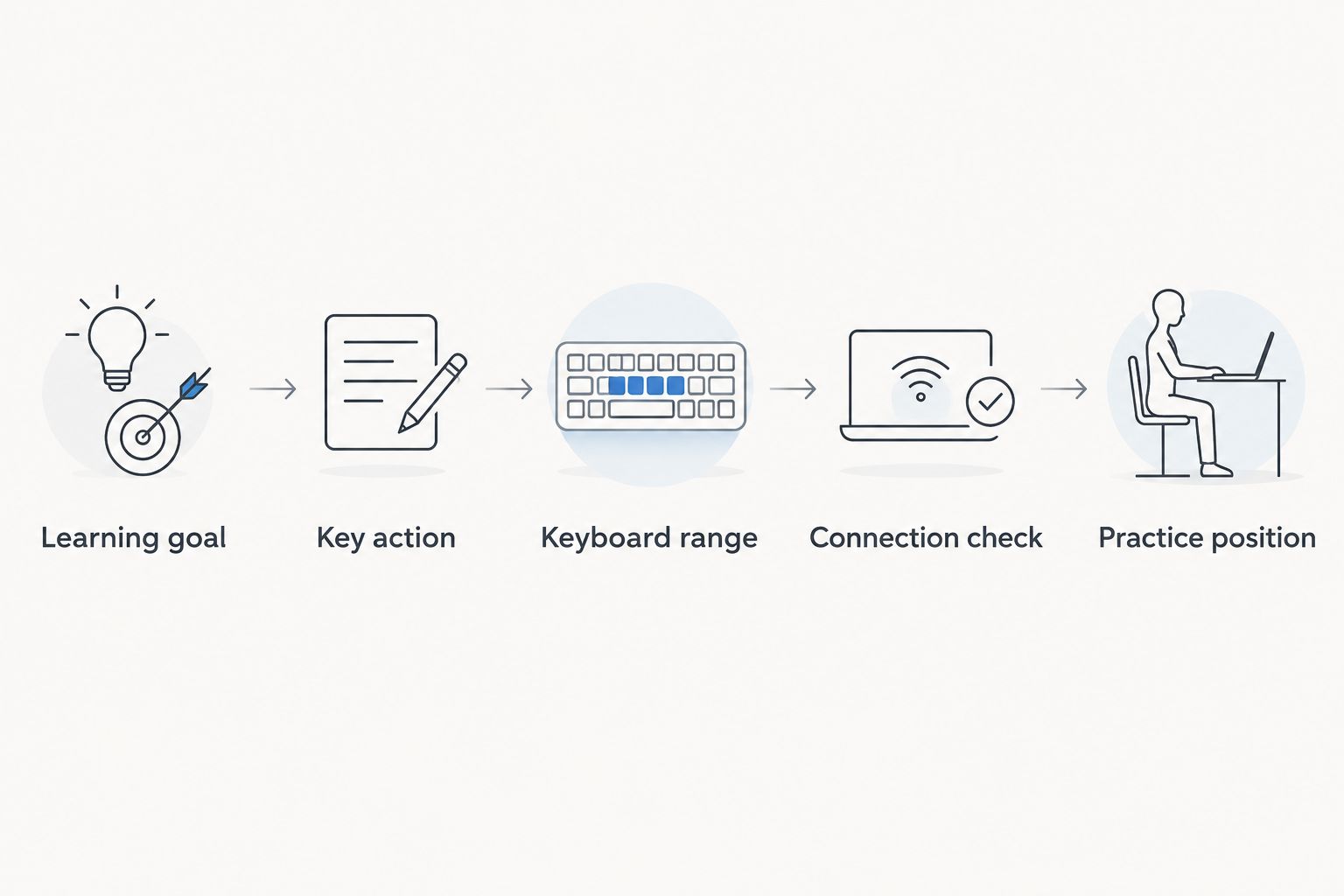
Avoid comparing instruments before you know what problem the purchase must solve. Work through the following sequence and write down the answer at each stage.
- Learning goal: Decide whether you need help finding notes, want to develop piano touch, or need an instrument that fits a restricted space.
- Key action: Try the resistance and response. Keep the choice separate from any learning accessories.
- Keyboard range: Check whether your intended songs fit the instrument.
- Connection check: Verify the exact instrument and device requirements for any app or light-guided system.
- Practice position: Confirm that the keyboard, support, seat, and pedal arrangement work together.
This sequence keeps a useful feature from hiding an unsuitable instrument. A learning aid earns its place by helping you practice; the keyboard still has to work for your hands and room.
Which beginner piano setup should you choose?
For an undecided beginner in 2026, start with a full-range weighted digital piano and choose learning support separately. That recommendation prioritizes the physical instrument without assuming that every beginner learns notes the same way.
Choose Pianoledshop’s light-guided approach when visible prompts are the support you want. Confirm that the exact piano and learning system work together before committing to the combination.
Choose a compact keyboard when your room genuinely requires it. Do not trade away keyboard range merely because a smaller instrument looks less intimidating.
FAQ
What’s the easiest digital piano for beginners in 2026?
The easiest digital piano for beginners matches the player’s main obstacle: visible guidance for finding notes, weighted keys for developing touch, or a compact format for restricted space. A compatible digital piano paired with Piano LED Plus suits beginners who want app-synced light guidance.
Is a light-guided piano better than a weighted-key piano?
Light guidance and weighted keys serve different purposes. Lights guide note selection, while weighted keys provide physical resistance; a compatible setup can combine both.
Do beginners need all 88 keys?
Beginners do not need all 88 keys for every exercise, but a standard full-size piano gives them the full piano range. Choose a shorter keyboard only after checking that the music you want to play fits.
Can I learn piano on a 61-key keyboard?
You can practice piano material that fits within a 61-key keyboard’s range. The reduced range and the instrument’s particular key action determine its limitations, so assess both separately.
Does following piano lights teach me to read music?
Following piano lights is not the same activity as reading musical notation. Practice written music separately if reading is one of your goals.
What should I check before choosing Piano LED Plus?
Check compatibility between Piano LED Plus, your exact instrument, and the device you intend to use. Pianoledshop sells the app-synced light-guided system and named piano bundles, but you should evaluate the instrument’s action and physical fit separately.
Should I choose a piano bundle or a separate learning system?
Choose a bundle when you want to select the instrument and learning system together; consider a separate system when you already have an instrument you want to keep. In either case, verify compatibility and check that the instrument meets your practice needs.
One last thing
The best beginner setup lets you check your playing with your ears, not just your eyes. After working through a short passage, listen for steady timing and intentional changes in volume.
Visible prompts answer where to play. Your listening answers how it sounds. Keep both questions in your practice, whichever instrument you choose.