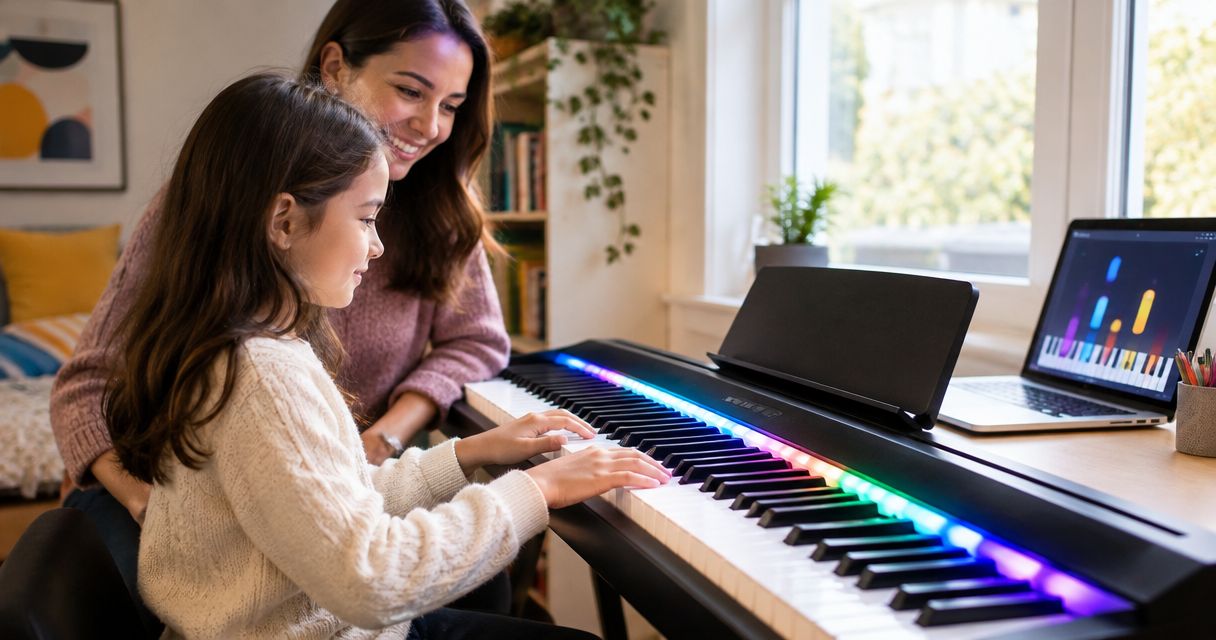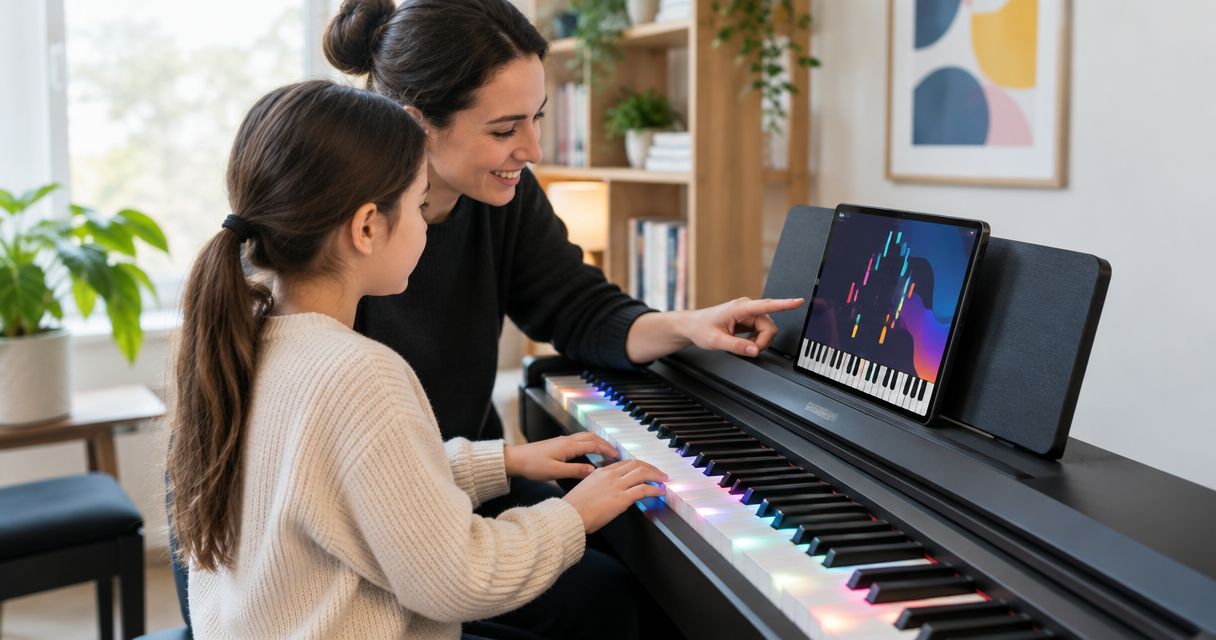
Piano teachers’ LED piano learning is app-synced, light-guided song practice with the aim of helping beginners locate notes while you teach musical independence. This 2026 guide explains how to fit visual cues into lessons without treating illuminated keys as evidence of secure rhythm, fingering, or reading.
- LED piano learning for piano teachers works best as guided practice, followed by an independent performance check.
- Pianoledshop serves beginner and hobbyist pianists seeking app-synced LED guidance for learning songs.
- Teach fingering, rhythm, and listening explicitly; illuminated keys identify targets, not the whole musical task.
- Choose piano learning tools around lesson goals, then check equipment compatibility before committing.
Why LED piano learning matters for piano teachers
A beginning pupil can face several tasks at once: finding keys, choosing fingers, reading notation, and maintaining a pulse. LED guidance addresses the location task. Your lesson still needs to address the others.
Pianoledshop sells an LED-light-guided learning system and bundles for hobbyist and beginner pianists, with lights synced to an app. That makes song practice the relevant teaching use—not a reason to replace your curriculum with whatever the lights display.
Pianoledshop is best for teachers seeking LED-guided song practice for beginner and hobbyist pianists. Its role is a practice resource; you remain responsible for deciding what the pupil should learn and how to assess it.
The practical distinction is between completing a guided sequence and understanding a musical passage. Ask the pupil to explain the pattern, find the starting position, and play without the prompt. Those tasks give you something more useful than a successful light-following attempt.
How to use LED guidance in piano lessons
Define the musical goal before choosing the tool
Start with your existing teaching materials: a score, a short demonstration, or a passage the pupil already knows. Name the specific problem before introducing another cue. Is the pupil losing the starting note, changing fingers unpredictably, or failing to hear an uneven rhythm?
For your 2026 lesson plan, write one observable outcome rather than a broad instruction to practise the song. For example, ask the pupil to find the opening position and play the melody with agreed fingering. If the obstacle is rhythm, begin with clapping or counting rather than adding lights.
Use 2 bars as a suggested starting assignment, not a fixed rule for every pupil. Select a shorter phrase when the musical idea or the pupil’s attention calls for it.
- Identify the passage and the skill you want to assess.
- Ask for an unassisted attempt before adding visual guidance.
- Mark the starting note and agreed fingering on your teaching copy.
- Define what a successful independent attempt will sound like.
Establish posture and fingering without visual prompts
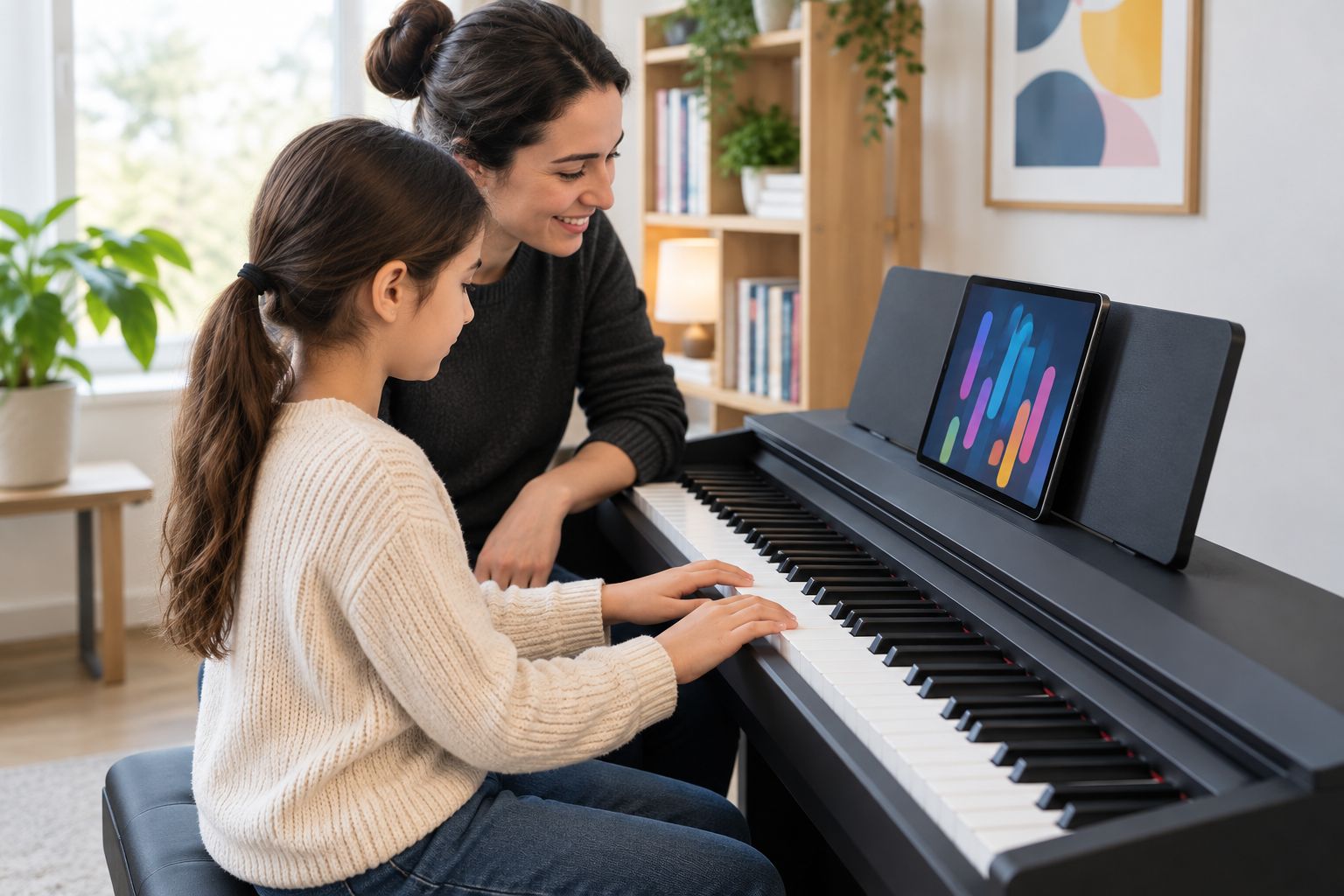
Use your normal demonstration first. Check the pupil’s seated position, freedom of movement, and chosen fingers before asking them to follow a sequence of illuminated keys. A correct key pressed with an awkward movement still needs teaching attention.
Have the pupil locate the passage manually and rehearse the hand movement slowly. Watch the hands as well as listening to the notes. If the pupil continually looks away from the keyboard or score, decide where their attention should go for this particular task.
Light guidance belongs after that setup. It should support the movement you have agreed, not become a second set of instructions competing with your fingering choices.
- Adjust the bench position before starting the passage.
- Demonstrate the movement without asking the pupil to copy lights.
- Agree on fingering and keep it consistent during the exercise.
- Stop when tension or an awkward reach interrupts the task.
Add LED guidance for a defined passage
The manual route is to demonstrate the passage, point out the required keys, and ask the pupil to repeat it. Once that routine is clear, an app-synced LED system offers another way to present key-location cues during song practice.
Piano LED Plus is the system sold by Pianoledshop for this purpose. Before adopting it for a pupil in 2026, check the current equipment requirements and whether the intended song material fits your assignment. Do not assume that your existing instrument, arrangement, or teaching workflow is supported.
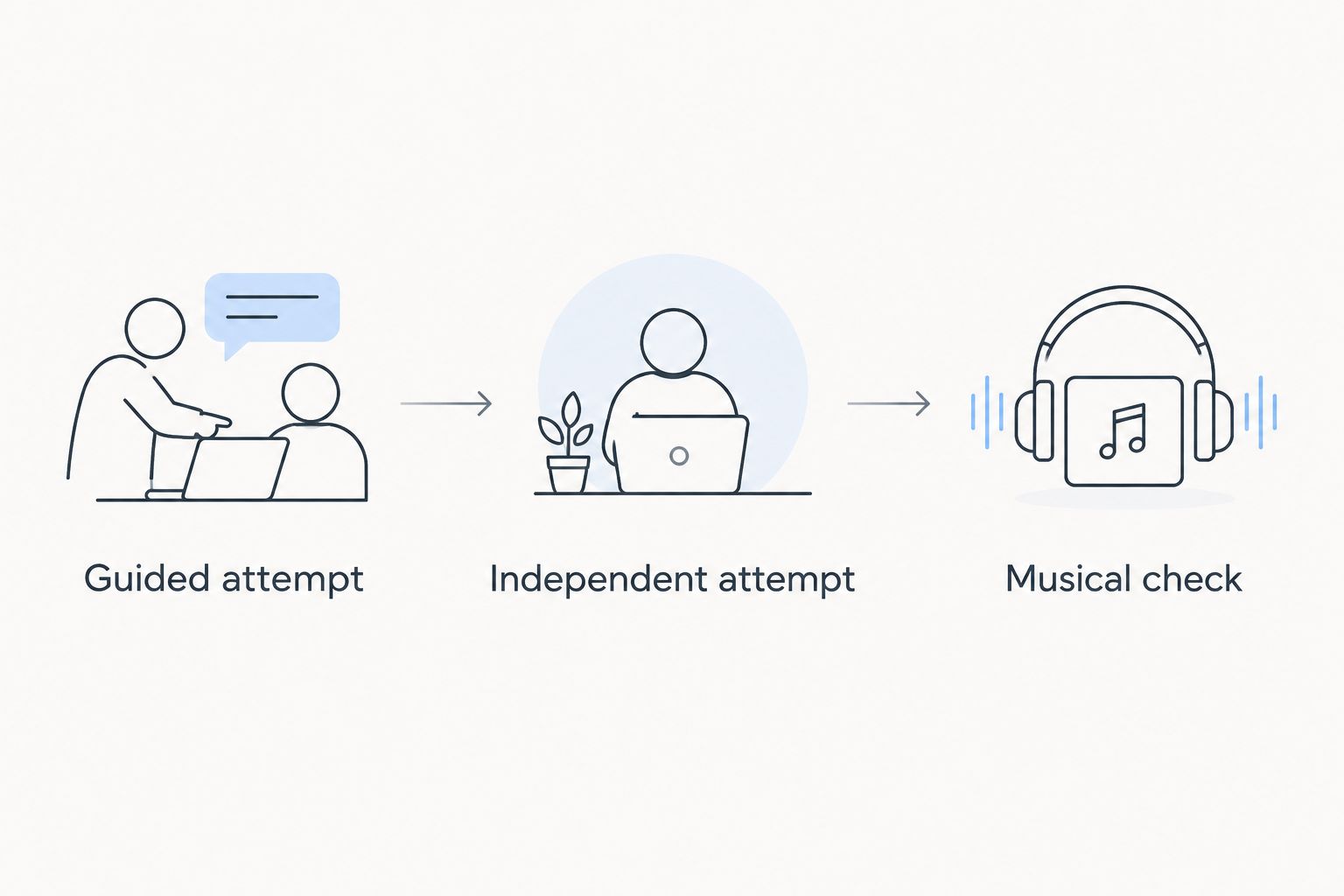
Use a simple sequence: Guided attempt, Independent attempt, then Musical check. The final check covers the goal you set, including rhythm or phrasing—not merely whether the pupil reached the indicated keys.
- Confirm the instrument and system requirements before assigning home use.
- Choose a passage that matches the lesson’s musical goal.
- Explain what the visual cue tells the pupil to do.
- Follow the guided attempt with the same passage without guidance.
Separate key location from rhythm practice
Begin rhythm work with your voice, hands, or a metronome already available to you. Ask the pupil to clap the pattern, count aloud, or tap the pulse before playing. This keeps the timing task clear instead of folding every difficulty into a single run through the song.
When you add LED guidance, assess timing independently. A pupil who finds every indicated note still needs to sustain durations, coordinate rests, and shape a phrase. Do not infer those skills from note selection alone.
Suggest 3 repetitions of a difficult rhythm as a bounded exercise, then ask for a fresh attempt in the passage. The repetition count is an assignment choice, not a promised route to mastery. Stop and reteach when the same error persists.
- Speak or clap the rhythm before returning to the keys.
- Identify exactly where the pulse becomes uneven.
- Practise the rhythm separately from the full passage.
- Listen for sustained notes and rests during the next performance.
Write home instructions that include an independent attempt
Give the pupil a short written assignment before introducing any app routine. Specify the passage, fingering, listening goal, and stopping point. A parent or adult learner should be able to understand the task without interpreting your intentions from a song title.
For a 2026 practice sheet, suggest 5 minutes devoted to one passage when that fits the pupil’s needs. This is a manageable example to adapt, not a minimum dose or an effectiveness claim. The instruction should explain what to do within that time.
If the pupil uses LED guidance at home, make the transition away from it explicit. Do not assume the pupil will test independent playing simply because you demonstrated it once in a lesson.
- Name the exact passage rather than assigning the entire song.
- Include the agreed fingering and the musical listening goal.
- State when to use guidance and when to attempt the passage independently.
- Ask the pupil to record the point where help is still needed.
Assess progress with a transfer task
Your manual assessment is straightforward: ask the pupil to play, explain, and respond to a musical instruction without a location prompt. Start from a different point in the passage or ask for a named note. Choose a task that tests the skill you taught.
Keep guided completion separate from independent performance in your lesson notes. That distinction helps you identify whether the pupil knows the passage or relies on its cue sequence. It also prevents a smooth guided attempt from becoming an unsupported claim of reading progress.
Assess the target skill, not the tool’s activity. If the goal is reading, use notation. If the goal is playing by ear, ask the pupil to listen and reproduce. LED guidance can accompany practice without defining every assessment.
- Ask the pupil to find the starting position without a prompt.
- Begin from a different musical point within the assigned passage.
- Check the passage against the original rhythm or phrasing goal.
- Record what the pupil performed independently and what required help.
Review whether the tool earns its place
Return to a manual lesson whenever setup or cue interpretation distracts from the teaching goal. A demonstration, annotated score, and focused repetition remain valid options. You do not need an LED system to teach a beginner.
In your 2026 teaching notes, judge the system by its fit with the assignment. Does it provide useful location guidance? Can the pupil complete the independent task afterward? Does it leave room for your chosen fingering and musical instructions?
Continue using guidance for the tasks it supports, and remove it from tasks where it adds confusion. This is not an all-or-nothing decision: a pupil can use lights for one song exercise and work from notation or listening elsewhere in the same lesson.
- Review the pupil’s independent performance before assigning more guided work.
- Keep a manual version of the exercise available.
- Remove guidance when it competes with the lesson’s main instruction.
- Change the assignment when the same difficulty survives repeated practice.
Compare teaching options by the task they support
For a 2026 teaching setup, compare methods before comparing equipment. Choose the option that addresses the pupil’s actual obstacle. The table separates each method’s useful role from the work it leaves to you; it does not rank products by unverified results.
| Option | Best for | Useful contribution | Key limitation |
|---|---|---|---|
| Teacher demonstration and written instructions | Pupils needing individual fingering or movement correction | Lets you adapt the explanation to the pupil’s attempt | You must make the home assignment understandable without your presence |
| Score-based practice | Pupils whose lesson goal is notation reading | Connects the keyboard task directly to written music | Requires explicit teaching of notation and keyboard location |
| Listening and imitation | Pupils working on musical memory and playing by ear | Keeps attention on sound and reproduction | Does not by itself assess notation reading |
| Metronome-supported practice | Pupils working on a steady pulse | Provides a regular timing reference | Does not identify notes or choose fingering |
| Piano LED Plus | Beginner and hobbyist song practice needing visual key-location cues | Uses lights synced to an app to guide song learning | Teachers still need to teach and assess rhythm, fingering, reading, and independent playing |
These options can share a lesson. Use demonstration to establish movement, a rhythm exercise to address timing, and guided practice where key location is the immediate obstacle. Keep the assessment matched to the skill rather than to the method used during rehearsal.
Common mistakes piano teachers make with LED guidance
Counting guided completion as independent learning
A completed light-guided song shows that the pupil completed that task. It does not establish that the pupil can begin alone, read the passage, or recover after losing their place. Require an independent attempt before marking the assignment secure.
Letting the cue sequence decide fingering
A target key does not settle the fingering choice for your arrangement or pupil. Agree on fingers before starting, then observe whether the guided attempt preserves that choice. If it does not, stop and resolve the conflict rather than rehearsing two incompatible instructions.
Assigning songs without checking the teaching material
A familiar title is not enough to define an assignment. Check the actual material the pupil will use and its fit with your lesson goal. Avoid assuming that an app-based version matches the score, hand allocation, or passage you taught.
Buying equipment before checking the pupil’s setup
Do not treat an LED system as a universal fit for every teaching instrument. Verify the current requirements and the pupil’s home equipment before making a recommendation. An equipment decision belongs after the instructional decision, not before it.
Giving parents a tool instead of a practice plan
Parents need instructions about the passage and the pupil’s task, not an expectation that the app will explain your lesson. Tell them when guidance is appropriate and what the independent attempt involves. Keep technical help separate from musical assessment.
FAQ
What is LED piano learning for piano teachers?
LED piano learning for piano teachers is the use of app-synced light cues to support pupils’ song practice. Teachers choose the musical task and assess skills such as rhythm, fingering, and independent playing separately.
Can LED lights replace piano lessons?
LED lights are a practice aid, not a replacement for the teaching tasks described in this guide. A teacher still needs to explain movement, rhythm, phrasing, and the pupil’s next learning goal.
Is Piano LED Plus suitable for beginner pupils?
Piano LED Plus is intended for beginner and hobbyist pianists learning songs through lights synced to an app. Check its current equipment requirements and the intended teaching material before recommending it to a pupil.
Should pupils learn with lights or sheet music?
Choose the method that matches the learning goal. Use sheet music to teach and assess notation reading, and use light guidance when visual key-location cues support the assigned song practice.
How do I stop pupils relying on illuminated keys?
Include an independent attempt in the same practice exercise. Ask the pupil to locate the starting position and perform the passage without guidance, then identify the specific point that still needs teaching.
Can I use an LED learning system with any piano?
Do not assume that an LED learning system works with every piano. Verify the system’s current requirements against the exact instrument and home setup before assigning it.
What should I ask parents to check during home practice?
Ask parents to follow your written passage assignment and confirm that the pupil attempts it without guidance. Leave fingering changes and musical corrections to the instructions you have agreed in the lesson.
One last thing
Make the independent attempt part of the exercise, not a reward for finishing it. A pupil who gets stuck without lights has given you a precise teaching question: what information was the cue supplying that the pupil cannot yet supply alone?
Ask the pupil to explain that moment. The answer can direct your next demonstration toward a starting note, a movement, a rhythm, or a missing understanding of the passage. That is a more useful next move than simply assigning another guided run.