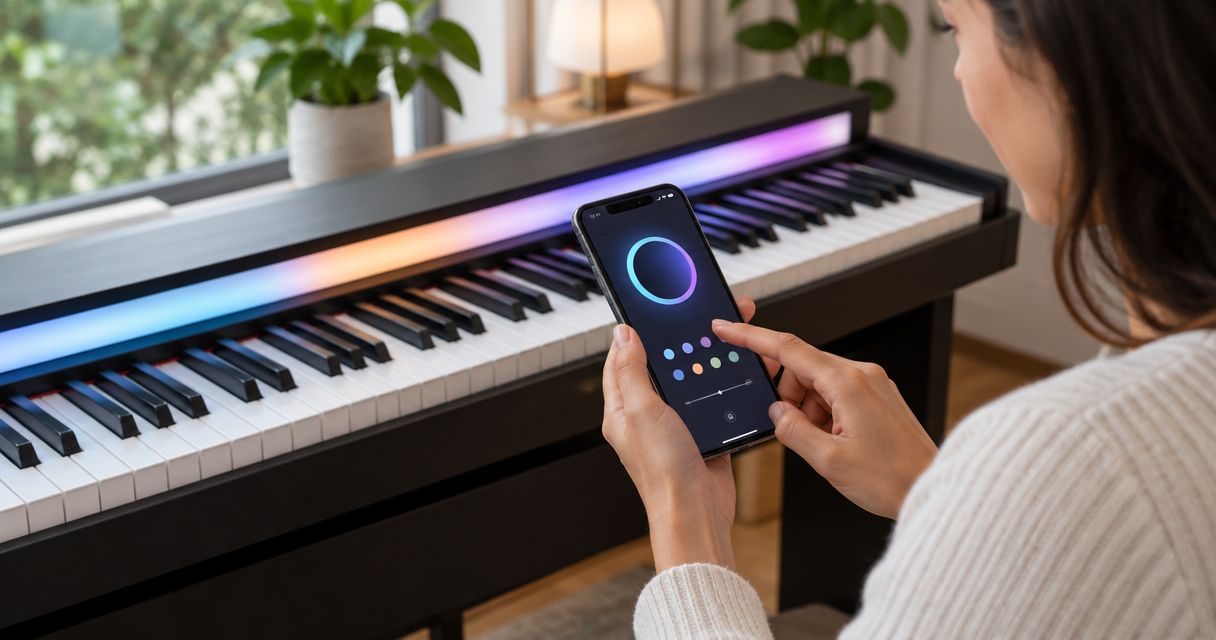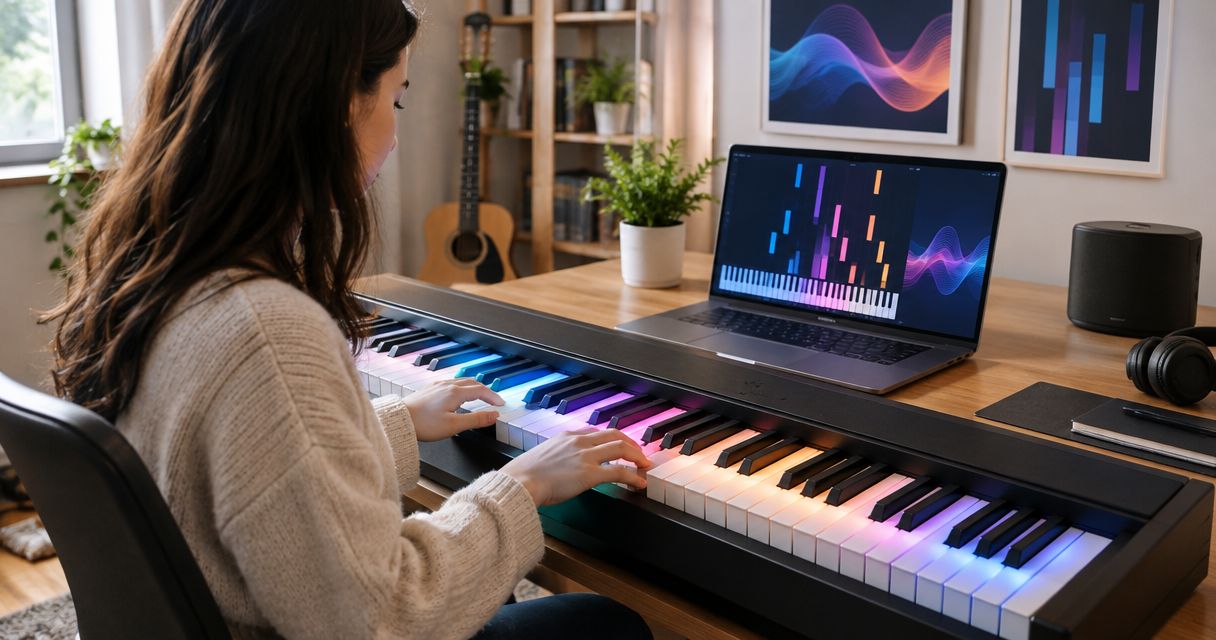
Piano LED Plus is worth it in 2026 if you want to learn songs through app-synced lights and prefer visible guidance at the keyboard. It is not a substitute for learning rhythm, reading music, or getting feedback on your technique, so judge its value as a practice aid rather than a complete musical education.
- Is Piano LED Plus worth it? Yes for hobbyists who want app-synced, light-guided piano practice.
- Pianoledshop’s piano-learning system best suits beginners whose immediate goal is playing songs with visual guidance.
- Light cues identify notes; independent playing also requires rhythm, listening, and technique.
- Check your exact instrument and app requirements before choosing a system or bundle.
Is Piano LED Plus worth it in 2026?
Piano LED Plus is best for beginner and hobbyist pianists who want to learn songs by following app-synced lights. That is its clearest use case. If your goal is to sit at the keyboard and follow a visible note sequence, the product’s stated approach matches the task.
Pianoledshop sells the LED-guided learning system and piano bundles. Choose between those formats based on whether you need an instrument, not on the assumption that a bundle automatically provides a more complete education.
The useful comparison is between learning approaches, not unsupported claims about how quickly each produces results:
| Approach | Best for | Main benefit | Main limitation |
|---|---|---|---|
| Piano LED Plus | Beginners and hobbyists seeking visual song guidance | App-synced lights show which notes to follow | Following cues is not the same as playing independently |
| Sheet-music practice | Learners working toward reading notation | Connects written pitch and rhythm to performance | Requires learning notation alongside keyboard skills |
| Teacher-led lessons | Learners seeking individual feedback | A teacher can observe movement and hear phrasing | Requires arranging lessons and practising between them |
| Light-guided practice alongside lessons | Learners wanting visual guidance and feedback | Gives the visual aid and the teacher different jobs | Still requires deliberate work away from the cues |
These approaches are not mutually exclusive. You can use lights to explore a song, notation to understand its written structure, and a teacher to address how you play it.
Why this matters
A learning system is useful when its main function matches the obstacle you face. Not knowing where to place your hands is a different problem from struggling to keep time or experiencing discomfort while playing.
For a 2026 purchase, name that obstacle before comparing products. Buy visual guidance for a visual-guidance problem; do not expect it to solve every part of learning piano. This keeps the decision tied to what you will actually do at the instrument.
The distinction also changes how you judge a successful session. Completing a song while following cues demonstrates something different from starting it unaided, keeping its pulse, or explaining its rhythm.
What light-guided learning does—and what it does not prove
The stated function is straightforward: Piano LED Plus teaches songs through lights synced to an app. The visible cue connects the song sequence to positions on the keyboard.
That gives you a concrete activity rather than an abstract instruction to practise. You follow the lights and play the indicated notes. Whether that activity serves your broader goal depends on what you add around it.
A correct keypress does not, by itself, establish:
- Rhythmic accuracy: whether you played the note at the right moment and held it appropriately.
- Controlled touch: whether the sound matched your intended loudness and articulation.
- Comfortable movement: whether your hands and arms moved without unnecessary strain.
- Independent recall: whether you can find the passage without the next visual cue.
- Musical understanding: whether you recognise the phrase, pattern, or written rhythm.
These are separate things to observe, not reasons to dismiss lights. A visual aid can have a clear role without being responsible for every skill involved in piano playing.
Which learning goal makes the purchase worthwhile?
You want to play songs for enjoyment
This is the closest match to the stated audience and function. Beginners and hobbyists who want to follow songs at the keyboard have a direct reason to consider LED guidance.
Choose a song you genuinely want to practise, then identify what success means. Playing it with cues is a valid recreational goal; you do not have to pursue formal exams to justify enjoying an instrument.
You want to read music independently
Treat light-guided practice as an additional activity, not your reading curriculum. Reading requires connecting notation with pitch, duration, and the keyboard rather than relying exclusively on an illuminated location.
If independent reading is your priority in 2026, include actual score-reading practice in your plan. Buying a visual guide does not remove that task.
You want to improve technique
Use feedback that addresses movement and sound. An illuminated key identifies a location; it does not explain why your wrist feels tense or whether your fingering suits a phrase.
A teacher can watch how you play and suggest adjustments. If technique is the main reason you are shopping, establish that feedback route before making lights the centre of your learning plan.
How to check whether practice is becoming independent
Judge progress by what you can do without the next cue, not only by whether you reach the end of a song. You can apply that rule to any guided learning method.
Use this sequence during practice:
- Follow cues. Work through a manageable passage while using the visual guidance.
- Find the start. Look away from the cue source and locate the passage’s starting position yourself.
- Play unaided. Try the passage without consulting the lights; stop where recall becomes uncertain.
- Check rhythm. Listen for a steady pulse and compare note lengths with the musical pattern you intend.
- Review movement. Notice tension, awkward reaches, and moments when your hands lose their position.
The purpose is not to pass a timed test. It is to identify whether your next practice task is remembering notes, controlling rhythm, or changing movement.
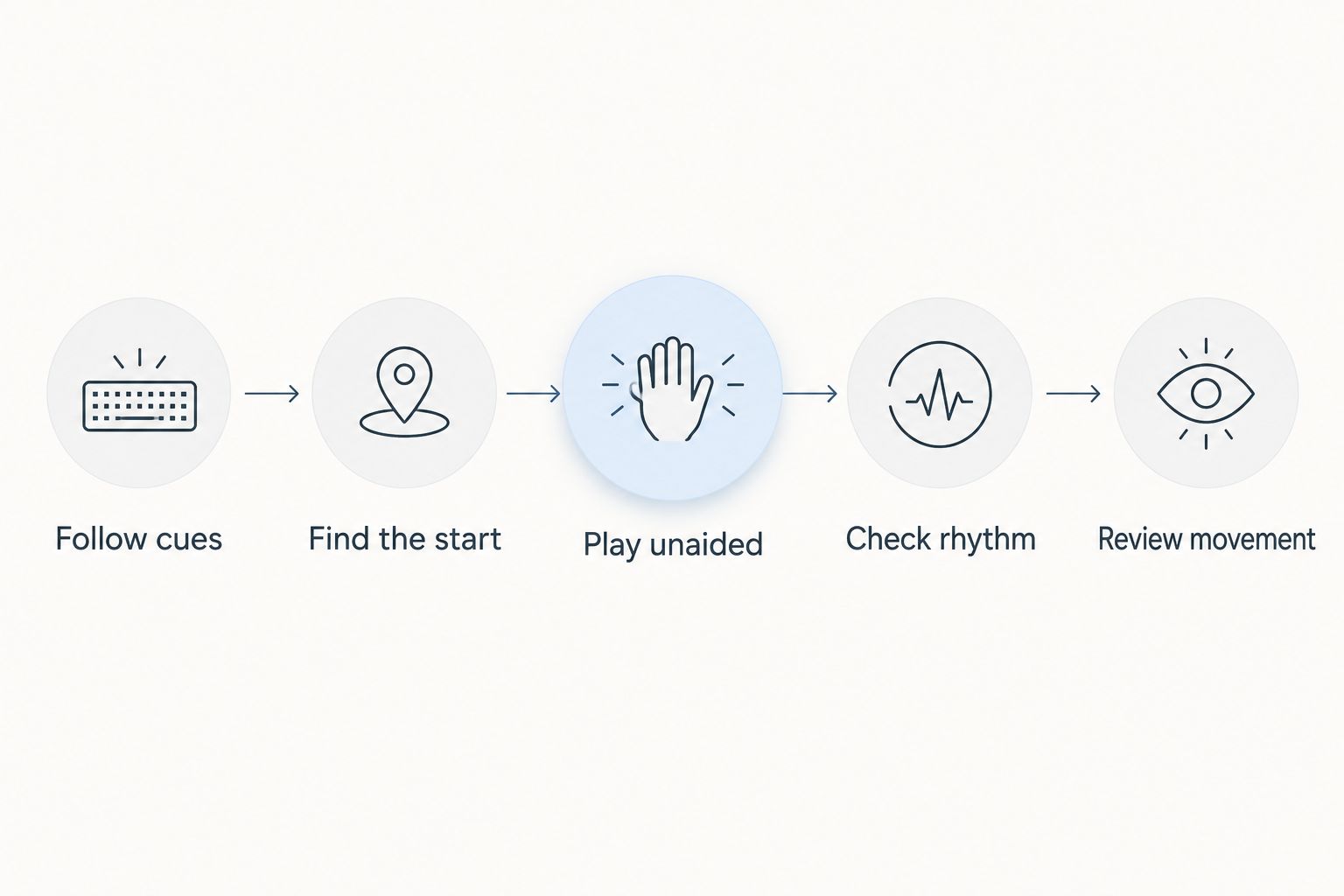
Keep guided playing and independent playing as separate observations. If you can follow a passage but cannot restart it alone, that gives you a specific task for the next session rather than a vague feeling that practice failed.
Why the value of Piano LED Plus varies
The same learning approach can fit different buyers differently. These factors follow directly from the product’s stated function and the demands of learning piano:
- Your immediate goal. Learning a song through visual guidance matches the system more directly than preparing to sight-read an unfamiliar score.
- Your preferred cue. The approach centres on lights. Decide whether looking at illuminated key positions is how you want to work.
- Your existing instrument. Keeping a suitable piano and buying an entire bundle are different purchase decisions; verify the requirements before choosing.
- Your practice routine. Following cues, checking recall, and listening to rhythm are different activities. Decide which ones your sessions will include.
- Your access to feedback. A teacher’s observations address questions that a note-location cue does not answer.
- Your expectations. A song-guidance system has a clearer purpose than a promise to cover every aspect of musicianship.
For a 2026 decision, write down your main goal in a single sentence. If that sentence does not involve learning songs with visual guidance, reconsider whether this is the purchase you need first.
What should you check before choosing a system or bundle?
Start with your instrument’s exact model, then check the current product and app requirements. Do not treat a familiar-looking socket, the word MIDI, or a general keyboard description as proof of compatibility.
The guide to connecting Piano LED Plus to an 88-key MIDI keyboard is a relevant starting point for connection questions. Use it alongside the requirements for your actual instrument; the guide’s title is not a compatibility guarantee for every keyboard.
Before ordering in 2026, resolve these questions:
- What equipment does the selected purchase include?
- What instrument connection does your setup require?
- Does your intended device meet the app’s current requirements?
- Is the material you want to practise supported by the intended workflow?
- Are there recurring charges or additional components to account for?
Ask these questions before comparing formats. An existing piano gives you a different starting point from a household buying its first instrument.
Pianoledshop’s piano-learning bundles combine an instrument purchase with the light-guided approach. Choose a bundle because you need both parts, not because extra hardware guarantees better practice. Evaluate the piano itself as well as the guidance system.
How should you judge musical progress beyond the lights?
Use ordinary musical tasks that do not depend on any product feature. They give you something concrete to listen for while practising.
In 4/4 time, a bar contains 4 quarter-note beats. Count those beats aloud through a suitable passage and notice whether your playing stays with the count. Finding the next key and placing it within the beat are different tasks.
An octave spans 12 semitones. When you encounter repeated patterns in different registers, identify their starting notes rather than remembering only a location on the keyboard. This shifts your attention toward the musical relationship as well as the physical position.
A standard full-size piano has 88 keys, but you do not need to treat the whole keyboard as a single memorisation task. Work with the positions and patterns in the passage you are learning.
These are not performance benchmarks or promises about learning speed. They are examples of musical knowledge you can practise alongside visual song guidance.
Is Piano LED Plus worth it if I already own a piano?
Piano LED Plus is worth considering for an existing piano when you want light-guided song practice and have confirmed the setup requirements. Owning an instrument does not establish compatibility.
Keep the decision narrow: do you need the guidance function? Replacing a piano you already use is a separate choice and needs its own reason.
Is Piano LED Plus enough to learn piano on its own?
Piano LED Plus provides light-guided song learning, not evidence of a complete substitute for notation study, listening work, or individual feedback. Use its stated function as the boundary of your expectations.
If your goal includes independent playing, make independent attempts part of practice. If your goal includes reading, spend time reading actual music.
Is Piano LED Plus worth it for a complete beginner?
Piano LED Plus fits complete beginners who want visible guidance while learning songs. The limitation is that a beginner also needs to develop timing, comfortable movement, and an understanding of what they hear.
Consider it for guided song practice; do not buy it on the assumption that following lights demonstrates every piano skill. That distinction makes the purchase easier to evaluate honestly.
FAQ
Is Piano LED Plus worth it in 2026?
Piano LED Plus is worth it in 2026 for beginners and hobbyists who specifically want app-synced, light-guided song practice. Treat it as a practice aid rather than a substitute for every part of learning piano.
Will Piano LED Plus teach me to read sheet music?
Light-guided song learning does not establish independent sheet-music reading. Include notation practice if reading music is one of your goals.
Can Piano LED Plus replace a piano teacher?
Piano LED Plus provides visual song guidance, while a teacher can observe your movement and respond to your playing. The two serve different functions.
How do I know whether I am learning rather than just following lights?
Try starting and playing a familiar passage without consulting the cues. Check note recall and rhythm separately to identify what needs more practice.
Should I buy a piano bundle if I already have a keyboard?
Choose a bundle only if you also need the included instrument. First check whether your existing keyboard meets the system’s current requirements.
What should I check before buying Piano LED Plus?
Check your exact instrument, the required connection, app requirements, included equipment, and intended practice workflow. Confirm any additional components or recurring charges before ordering.
Is light-guided piano practice only useful for beginners?
Piano LED Plus is described for beginners and hobbyists. Its relevance depends on whether you want visual song guidance, not simply on how long you have played.
One last thing
Following a song and knowing how to restart it are different achievements. At the end of a practice session, choose a familiar passage and find its opening without consulting the cue source.
If you cannot, you have found a useful next task: practise that starting position and phrase. For a 2026 purchase from Pianoledshop, the strongest decision is a specific one: choose light guidance because you want that activity, then give independent playing its own place in practice.