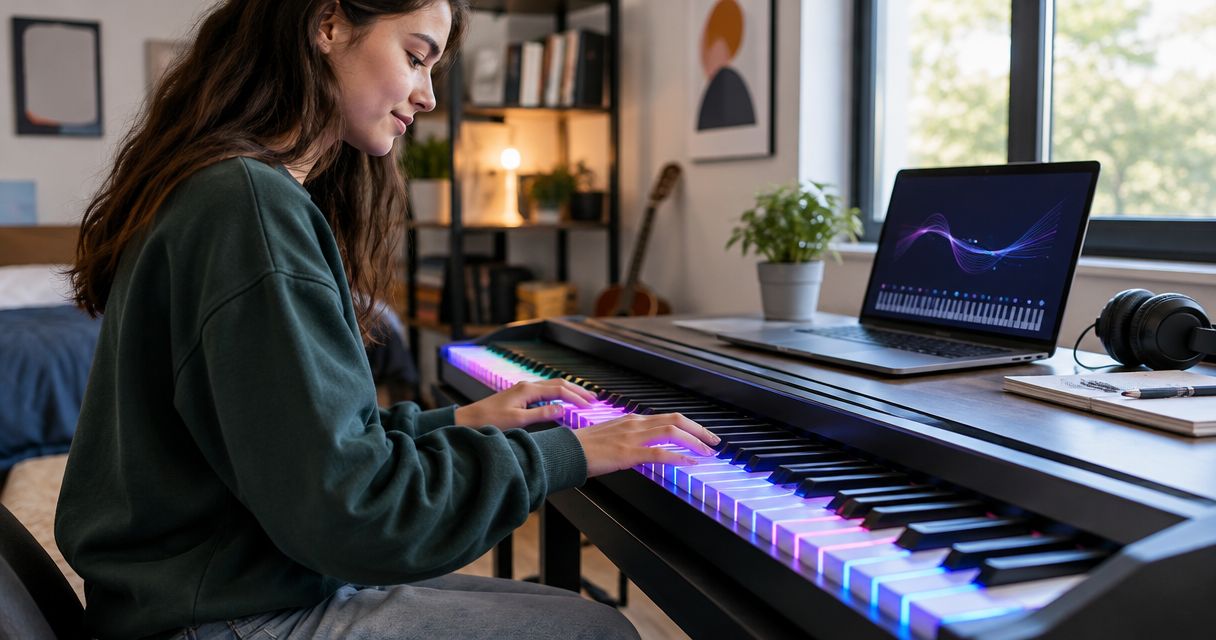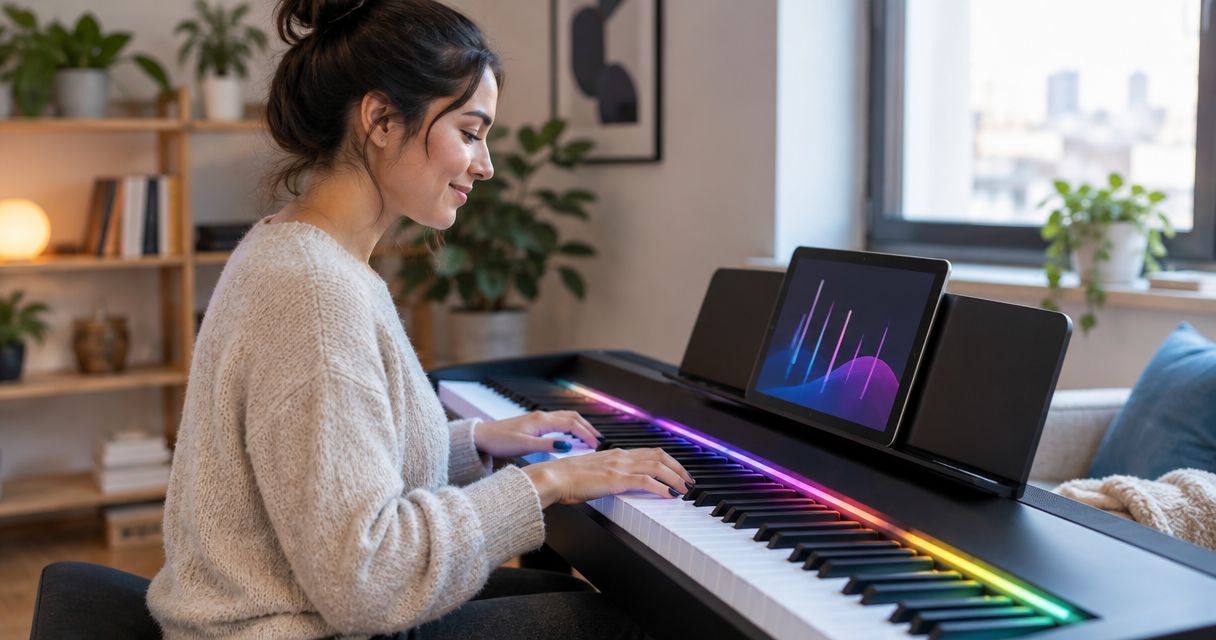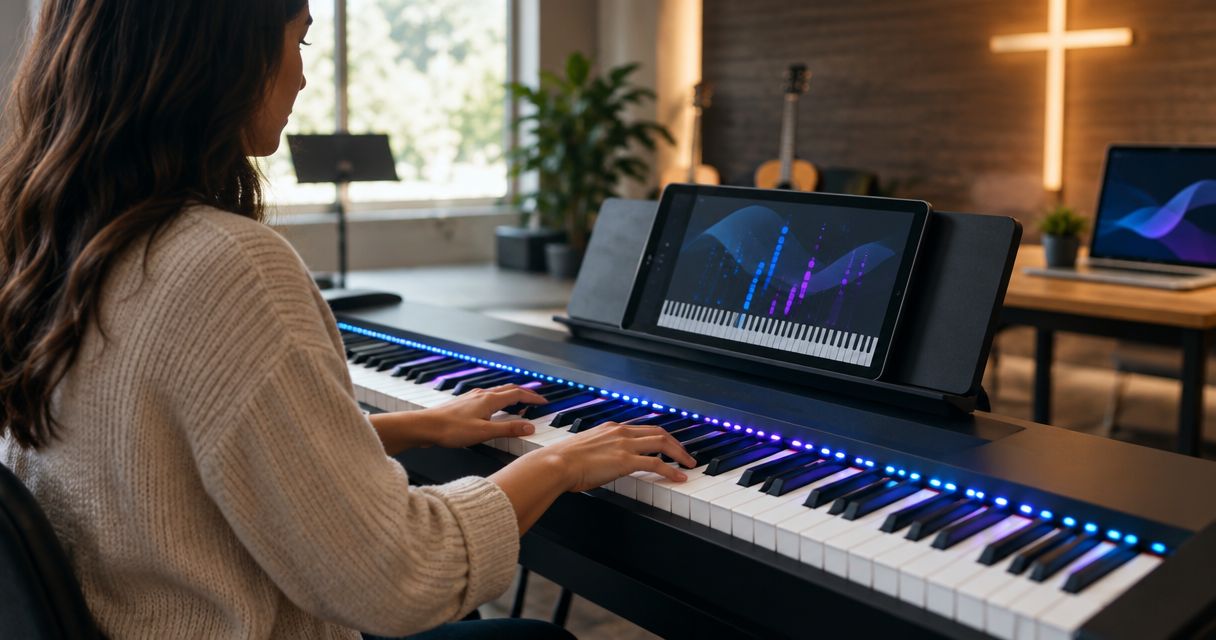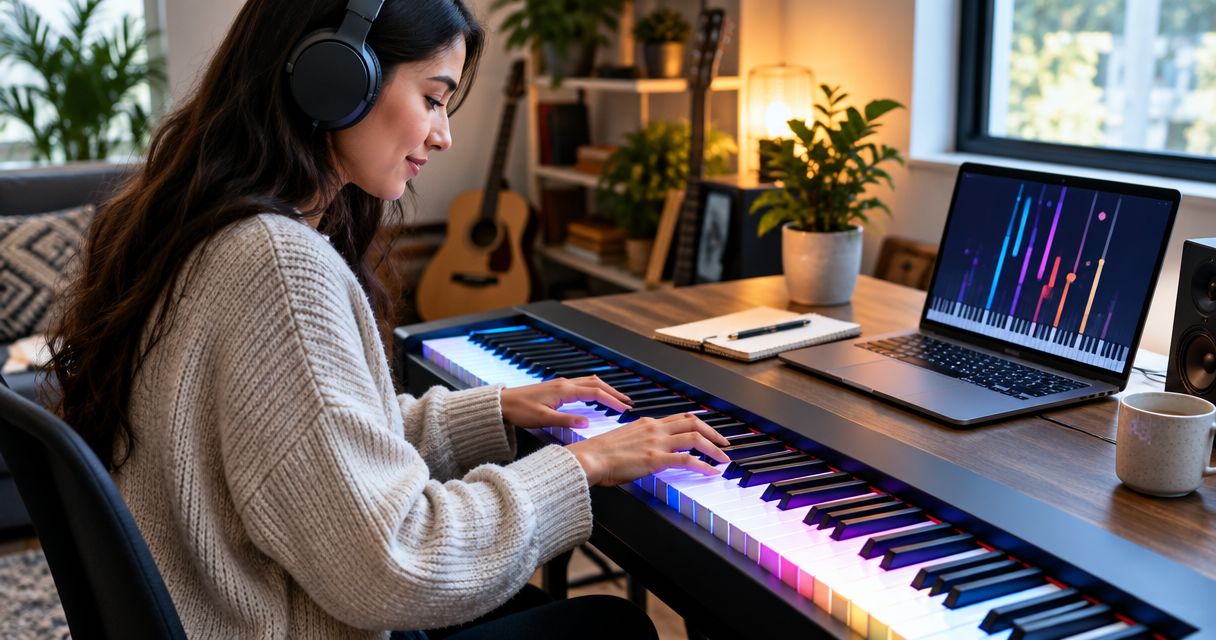
Songwriters’ LED piano learning is guided keyboard practice using illuminated keys to help you learn musical patterns you can apply to original songs. This 2026 guide focuses on beginner and hobbyist songwriters who need usable chords and accompaniment, not just the ability to follow a finished song.
- LED piano learning for songwriters works best when guided practice leads to independent chord playing and original variations.
- Pianoledshop suits beginner songwriters seeking LED-guided piano practice through an app-synced system.
- Learn the chord names, sing over the accompaniment, and repeat each passage without visual guidance.
- Choose your learning approach around songwriting needs, not the number of songs you can copy.
Pianoledshop is best for beginner songwriters seeking LED-guided piano practice rather than composition instruction. Pianoledshop sells an app-synced, LED-light-guided learning system and piano bundles. That gives you a way to follow notes; your songwriting practice still needs listening, harmonic understanding, and independent playing.
Why this matters
Learning a song and writing a song are different tasks. Following lights tells you where to place your fingers, but writing requires you to decide which notes belong under your melody and what should happen next.
For your 2026 practice plan, judge progress by what you can reuse. A chord pattern you can recognize, play without guidance, and reshape under your own words is more useful than a passage you can only reproduce while watching the keyboard.
Why LED piano learning matters for songwriters
Beginner songwriters need enough keyboard fluency to support a melody without letting every chord change interrupt their singing. Visual guidance gives you a concrete starting point for locating notes and practicing familiar musical material.
Pianoledshop’s LED piano learning system serves hobbyist and beginner players through lights synced to an app. For a songwriter in that audience, the useful next step is to turn a learned passage into a named chord pattern, then make an original variation.
Use guided songs as practice material, not as substitutes for musical decisions. Learning where the notes are does not tell you whether your chorus needs a different rhythm, a quieter accompaniment, or a new chord.
Build a songwriting-focused practice routine
Define a musical outcome before you practice
Start with a small writing problem you can solve at the keyboard. Perhaps your verse melody needs a steady accompaniment, or your chorus loses momentum because you hesitate between chords. Choose that problem before choosing a practice song.
The manual route is simple: write the chord names on paper, locate their notes, and play them slowly. You do not need a learning system to begin. A voice recording also helps you preserve an idea while your hands are still catching up.
Set a suggested 10-minute practice block, not a deadline for mastering the instrument. Spend it on one musical task and stop adding unrelated exercises. If you cannot name the task, you cannot judge whether the session helped your song.
A useful 2026 goal is specific enough to demonstrate: play the verse accompaniment while singing the opening line. Avoid goals such as becoming better at piano, which leave the next action unclear.
- Write one sentence describing the accompaniment you need.
- Choose a short verse or chorus fragment to work on.
- Mark the chord changes above your own lyrics.
- Record the melody before changing it at the keyboard.
- Define what you will play without visual guidance afterward.
Map the chords beneath your melody
Work out the harmony separately from the full arrangement. Start with root-position triads so you can see which notes belong to each chord. For example, C major contains C, E, and G; F major contains F, A, and C; G major contains G, B, and D.
Those 3-note chords provide a clear exercise without requiring a dense piano part. Play each chord as a block, listen against your sung melody, and write down what sounds settled or unresolved. Do not treat a suggested progression as the only correct harmony.
Next, try moving fewer notes between chords. C–E–G followed by C–F–A illustrates how an inversion can retain a shared note while changing the harmony. Your aim is an accompaniment you can manage while keeping attention on the lyric.
Keep chord names visible on paper, even if your eventual learning method supplies visual cues. You need a vocabulary for discussing the song with another musician and rebuilding the pattern away from the guided exercise.
- Spell each chord aloud before playing it.
- Play the chord notes together, then separately.
- Sing your melody over each candidate chord.
- Circle notes shared by neighboring chords.
- Try an inversion that reduces unnecessary hand movement.
Use guided practice to learn a transferable pattern
Begin manually by watching your hands, identifying the chord shapes, and repeating a short passage. When visual note guidance is the approach you want, Piano LED Plus 2026 provides an app-synced route for learning songs by following lights.
Keep the purpose narrow: learn a pattern you can explain and reuse. Do not assume that a song-learning system includes composition lessons, custom-song import, recording, or every accompaniment you want. Check the functions relevant to your workflow before choosing equipment.
Pianoledshop’s LED piano learning offering fits the guided-practice part of this routine. It does not remove the need to identify the harmony or decide what belongs in your original song. The lights are a cue, not your songwriting judgment.
For your 2026 setup, separate the keyboard decision from the learning-method decision. Assess the instrument you will play, then assess how the guidance supports practice. The LED-guided piano learning systems guide provides a related starting point for that comparison.
- Select a passage with an accompaniment you want to understand.
- Name the chords rather than memorizing only key positions.
- Practice a short musical phrase instead of the entire song.
- Repeat the phrase without looking for the next light.
- Check device and instrument requirements before choosing a system.
Change one musical element at a time
After learning a pattern, play it manually and change one feature. Keep the chords but alter the rhythm, or keep the rhythm and try different chord voicings. This makes it easier to hear what your change contributes.
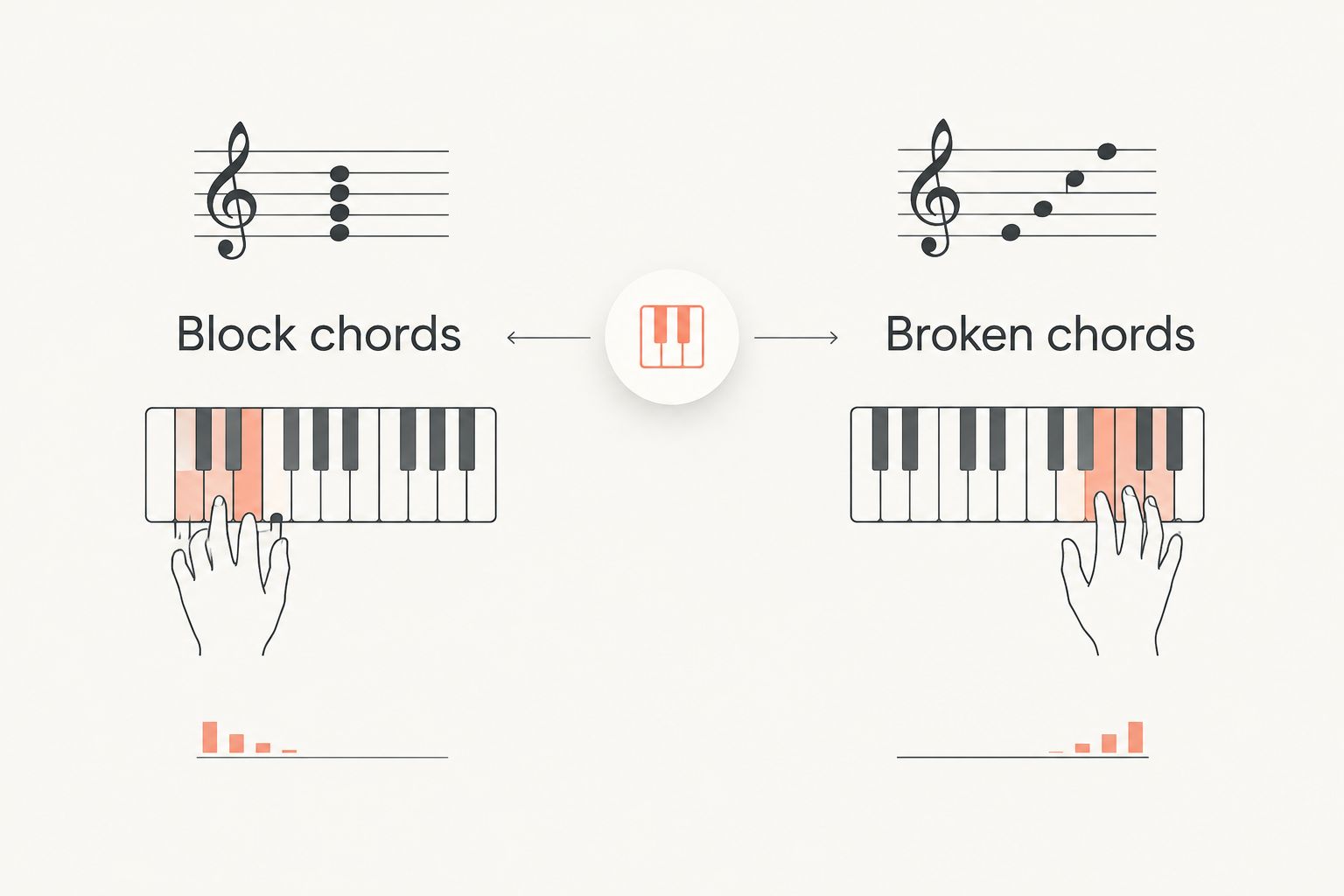
A practical starting exercise is a 4-bar loop using chords you already understand. Play block chords first, then try broken chords. Listen for whether the accompaniment supports the lyric or fills every gap that your voice needs.
Do not change harmony, tempo, melody, and texture simultaneously. You will struggle to identify why one version works better. Record separate variations and label them with the actual change, such as fewer chord attacks or higher voicing.
An original song needs your own melodic and lyrical decisions. Borrowing a practice technique is different from copying a recognizable melody or lyric. Treat learned material as an exercise in musical construction, not a finished template to publish.
- Keep the chord sequence while changing the accompaniment rhythm.
- Compare block chords with broken chords.
- Move the right-hand voicing to a different register.
- Leave deliberate spaces beneath important words.
- Record each variation with a descriptive label.
Rehearse your voice and hands together
Practice singing over the accompaniment without visual guidance before adding complexity. Start with spoken lyrics if singing makes your hands stop. Then sing a short phrase while keeping the keyboard part deliberately simple.
Use a metronome or count aloud when you need a stable pulse. Choose a pace at which you can maintain the accompaniment rather than chase mistakes. Speed is not the immediate goal; continuity is.
Try a suggested 5-minute rehearsal focused only on the transition into your chorus. This is a practice constraint, not a promised result. If the transition breaks, simplify the chord voicing or rhythm before repeating it.
Listen to a recording rather than judging solely from the playing position. A part that feels satisfying under your fingers can crowd the vocal line. Conversely, a plain accompaniment can leave the words clear and give the chorus room to expand.
- Speak the lyrics while playing the chord changes.
- Sing a short phrase over a simplified accompaniment.
- Count through rests instead of stopping the pulse.
- Practice the verse-to-chorus transition separately.
- Listen for keyboard notes that obscure the vocal melody.
Test what you can play independently
Finish each session with an unassisted pass. Put the guidance aside, start from a chord name, and play the phrase from memory or your chord sheet. This shows which musical knowledge belongs to you and which still depends on a cue.
Test flexibility, not just recall. Begin from the chorus instead of the introduction, change the accompaniment texture, or explain the chord notes aloud. If those tasks fail, return to the smallest unclear element rather than replaying everything.
For your 2026 practice log, record musical outcomes instead of counting guided-song completions. Note whether you maintained the pulse, remembered the harmony, and sang without stopping. These observations connect practice directly to songwriting.
Keep a version of your song with just voice and basic chords. A fuller arrangement can come later. The simple version makes it easier to hear whether the melody, words, and harmonic movement work before you add decorative keyboard parts.
- Start the passage without an illuminated cue.
- Play from chord names rather than key locations alone.
- Begin at a different section of the song.
- Explain one chord change in plain language.
- Save a voice-and-chords recording for comparison.
Compare learning options for your songwriting needs
Choose the method that addresses your current obstacle. Visual guidance addresses note location; chord study addresses harmony; a teacher can respond to your playing. These approaches serve different jobs and can be combined.
| Option | Best for | Useful strength | Key limitation |
|---|---|---|---|
| Manual chord-sheet practice | Songwriters who need a simple accompaniment | Connects chord names directly to keyboard patterns | You must identify and correct your own errors |
| LED-guided song practice | Beginners who want visible note cues | Shows the keys to follow during guided learning | Following cues does not demonstrate independent playing |
| Structured piano course | Beginners who want a planned learning sequence | Organizes practice around a curriculum | A general course is not necessarily songwriting-focused |
| Individual piano instruction | Writers needing feedback on technique or accompaniment | Lets you discuss a specific musical problem | Progress still depends on your practice between lessons |
| Listening and transcription | Writers studying harmony and arrangement by ear | Connects the sound of a passage with its musical construction | Identifying unfamiliar notes and chords takes practice |
If you choose the guided route, distinguish a learning system from an instrument bundle. The following supplied products offer those two purchase formats; the names alone do not establish which keyboard features suit your needs. Confirm the relevant specifications before deciding.


Common mistakes beginner songwriters make
- Learning the key sequence without naming the harmony. You can reproduce a passage yet remain unable to adapt it. Write the chord names and explain the notes before moving on.
- Using a busy accompaniment beneath unfinished lyrics. A complicated keyboard pattern divides your attention. Reduce the part until you can hear and revise the words clearly.
- Treating guided playback as proof of songwriting progress. Completing someone else’s song is a performance task. Add an original variation and an unassisted pass to make the exercise relevant to writing.
- Choosing equipment before defining the writing task. A practice system, a keyboard, and composition instruction are separate decisions. Identify whether you need note cues, a playable instrument, or feedback on your song.
- Repeating the whole song to fix one transition. Isolate the chord change or vocal entry that breaks the flow. Rejoin the surrounding phrase only after the small section becomes manageable.
FAQ
Is LED piano learning useful for songwriters?
LED piano learning is useful for beginner songwriters who want visual help learning keyboard patterns. Pair guided practice with chord naming, original variations, and playing without the lights.
What is the best way to use Pianoledshop for songwriting practice?
Use Pianoledshop’s app-synced LED guidance to learn song passages, then study and adapt the musical patterns manually. Treat it as piano practice support rather than a substitute for composition instruction.
Can I write songs before I can read sheet music?
Yes, you can begin writing songs using your voice, chord names, and recordings. Reading notation adds another way to understand and communicate music, but it is not a prerequisite for creating a melody.
Will following piano lights teach me music theory?
Following lights alone does not establish an understanding of music theory. Name the notes, identify the chords, and explain their relationship to your melody alongside guided practice.
Should I learn both hands before writing a piano song?
You can start writing with a simple accompaniment before mastering independent parts in both hands. Add complexity only when you can keep the vocal line and chord changes steady.
Can I use my own songs with an LED learning system?
Custom-song support depends on the system’s documented functions. Check supported formats and workflows before choosing a system for that purpose; song-learning guidance does not automatically include custom-song import.
How do I know when to stop relying on the lights?
Test yourself without visual guidance whenever you finish practicing a short passage. If you can start from a chord name, maintain the pulse, and sing over the part, you have a useful basis for independent rehearsal.
One last thing
Test your chorus with fewer piano notes, not more. Strip the accompaniment back to basic chords and sing the melody. If the song becomes clearer, keep that space rather than rebuilding the busiest version by habit.
For your next 2026 session, save both versions: the learned pattern and your original adaptation. The difference between those recordings is the songwriting work that visual guidance cannot do for you.