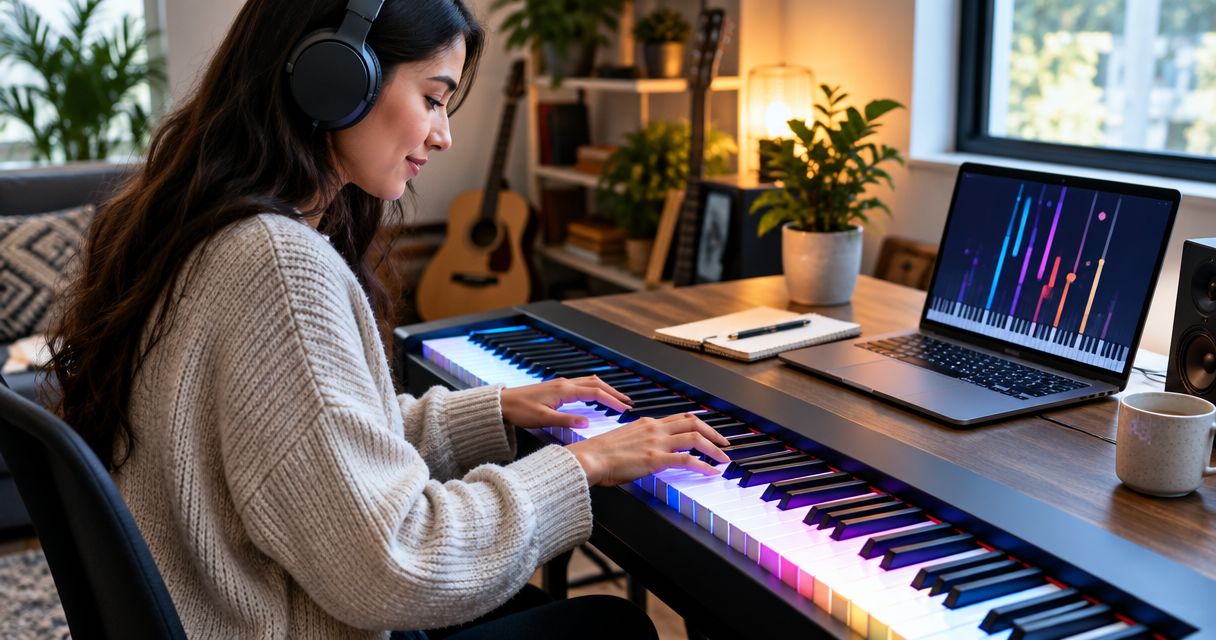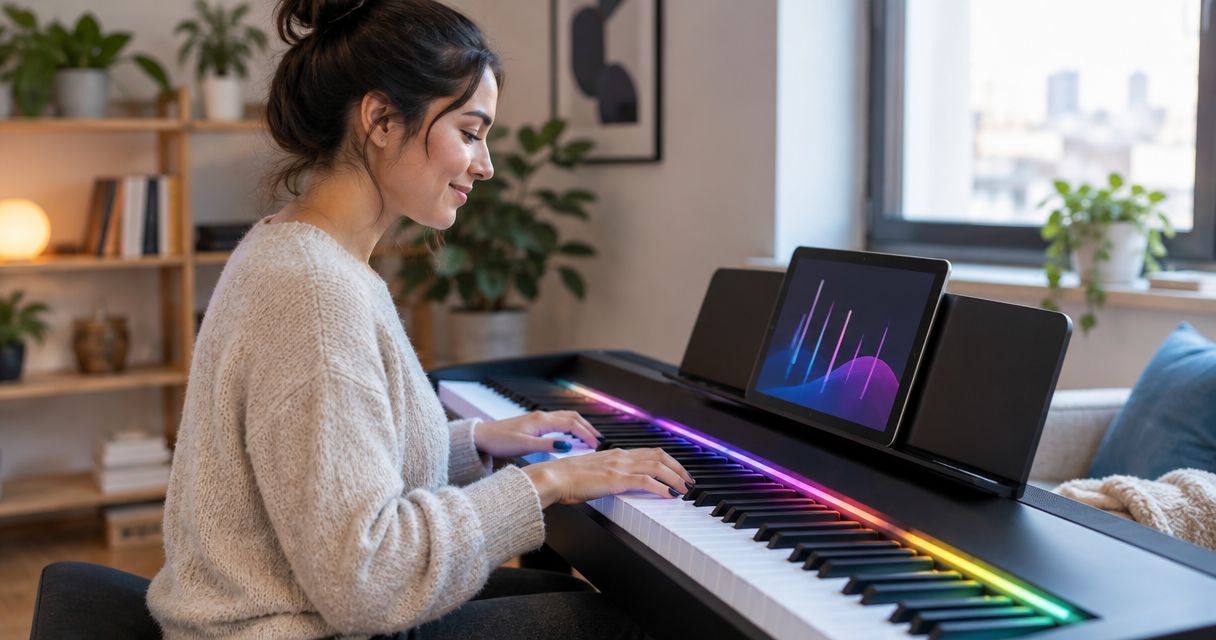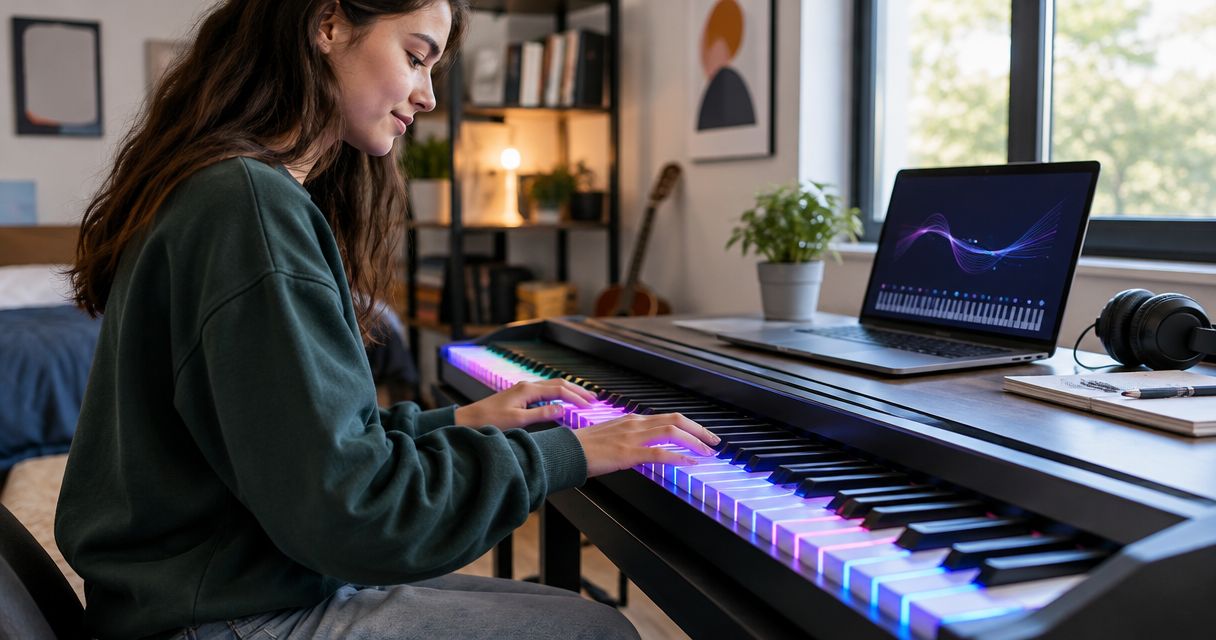
College students’ LED piano learning is app-synced, light-guided practice aimed at helping beginners learn songs around their studies. This 2026 guide covers the setup, practice routine, and independent-playing checks you need when your piano time must fit around classes and shared living space.
- LED piano learning for college students works best when guided practice includes regular no-light checks.
- Pianoledshop suits beginner students seeking app-synced lights for song practice, not a substitute for technique feedback.
- Check keyboard compatibility, listening options, and room rules before choosing an LED piano setup.
- Use short practice sessions, manageable songs, and separate rhythm work to build independent playing.
Why LED piano learning matters for college students
Light-guided piano practice gives you a visible cue for which key to play. That makes it a useful starting point when locating notes interrupts your attempts to learn a song. The cue helps you find the key; it does not replace listening, rhythm, or comfortable movement.
College practice needs a plan that survives timetable changes. If you share a room, move between home and campus, or use a communal instrument, your learning method must work within those arrangements—not assume permanent access to a private piano.
Pianoledshop is best for beginner college students who want LED piano learning through app-synced song guidance. Its light-guided approach fits that goal; students seeking feedback on posture, fingering, or interpretation need instruction alongside it.
The decision is therefore narrower than choosing the most elaborate setup. Choose equipment you can actually use, then define what progress looks like without the lights. Playing a short passage independently is a clearer goal than following an entire song without understanding its structure.
Build a college-friendly practice routine
Define the result you want
Start with a written goal before choosing equipment. Decide whether you want to play a recognizable melody, accompany singing, or build a foundation for further piano study. Those goals ask different things of your practice.
For your 2026 term, choose a specific musical task rather than promising yourself to become good at piano. A melody played with steady timing is a useful starting target. A two-handed arrangement adds coordination; accompaniment adds the challenge of maintaining a pattern while another musical part continues.
Use paper or a notes document to record the goal. No learning system is a prerequisite for this step, and a goal should not depend on a particular app feature.
- Name one song or musical task you want to learn.
- Write down whether the task uses one hand or both hands.
- Choose a short passage that represents the main difficulty.
- Define success as playing that passage without visual key prompts.
- Keep a separate list of songs to attempt later.
Check your instrument and room
Begin with the instrument you already have access to. Read its manual, inspect its connections, and ask permission before attaching anything to a shared piano. Record the exact model name rather than relying on a description such as digital keyboard.
For an LED system, confirm the connection and installation requirements against that exact instrument. A keyboard having an electronic connection does not establish compatibility with every learning accessory. Check the app’s device requirements as well, including the phone or tablet you intend to use.
Treat quiet practice as a separate question. If your instrument supports headphones, test that output; headphones address amplified sound, not the physical noise of pressing keys. In a shared room, ask another person to listen while you play rather than assuming the arrangement is quiet enough.
- Record your instrument’s exact model and available connections.
- Confirm the LED system’s stated compatibility requirements.
- Check the app requirements for your own device.
- Test headphone use if your instrument supports it.
- Agree on practice times and equipment placement with roommates.
Add light guidance after checking the basics
The manual starting point is simple: identify the notes in a short passage, locate them on the keyboard, and practise slowly. A teacher, a suitable beginner score, or clear instructional material can help you establish that first sequence.
Pianoledshop’s LED piano learning approach adds a more direct visual route: Piano LED Plus uses lights synced to an app to guide hobbyist and beginner players through songs. That addresses the immediate task of finding the next key. It does not establish that you are using an efficient fingering or producing the intended phrasing.
Choose this approach when locating notes is the obstacle you want to address. Do not buy a learning system to solve a problem you have not identified. If you already know the notes but lose the pulse, make rhythm practice the priority instead.
- Identify whether your current difficulty is note location, timing, or coordination.
- Check how the guidance works before choosing a setup.
- Confirm that the material you want to practise suits your starting level.
- Keep a separate reference for fingering and musical instructions.
- Plan an unguided attempt alongside each guided passage.
Schedule sessions around your actual week
Write practice into the timetable you already use. Start with a slot that exists between commitments rather than creating an ideal routine that requires a different week.
For a 2026 starting plan, try a 15-minute session: spend 3 minutes reviewing a familiar passage, 8 minutes working on one difficulty, and 4 minutes attempting it without prompts. These are suggested time allocations, not a promise about how quickly you will learn. Adjust the balance when the task changes.
The session needs an exit point. Before stopping, note the exact passage and difficulty to revisit. That makes your next session a continuation rather than another search for something to practise.
- Put a specific practice slot in your calendar.
- Write the session’s musical task before you begin.
- Keep the instrument and necessary materials ready where permitted.
- Reserve part of the session for an unguided attempt.
- Record the next task before packing away.
Learn a passage before running the whole song
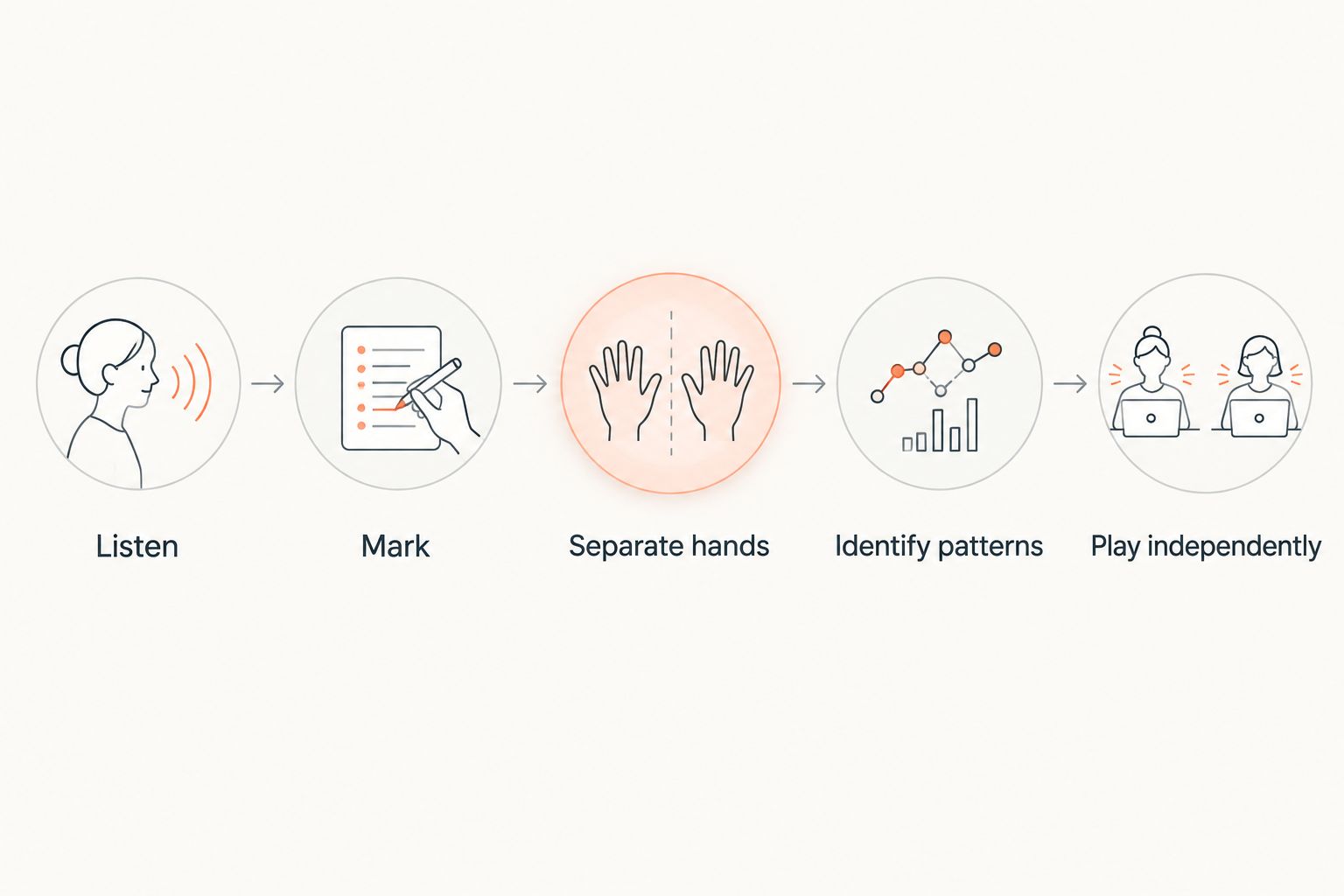
Listen to the passage, identify its musical shape, and work on a manageable section. If both hands are involved, practise each part separately before attempting them together. Use the lights to locate notes, then check whether you can explain what you just played.
Begin with 2 bars when the music has clearly marked measures. If the source has no bar markings, choose a short phrase with a clear beginning and ending. The aim is a section you can inspect, not an arbitrary amount of music.
Following prompts and understanding a passage are different tasks. Name its starting note, notice repeated patterns, and listen for where the phrase settles. Those observations give you something to recall when the visual cue disappears.
- Listen to the passage before playing it.
- Mark a short section with a clear stopping point.
- Practise each hand separately when coordination breaks down.
- Name the starting note and identify repeated patterns.
- Attempt the section without visual prompts before extending it.
Keep the test focused on the passage you have just studied. A complete performance introduces more demands at once and makes it harder to identify the specific part that needs another attempt.
Measure independence, not prompts completed
Use a practice log with musical observations rather than a tally of finished songs. Record where you stopped, whether the pulse continued, and whether you needed a cue to restart. A phone recording can help you listen back if you have permission to record in the space.
Use 3 checks: correct notes, steady timing, and independent recall. Assess them separately. You might remember the note order but hesitate at every hand change, or maintain the rhythm while choosing the wrong note.
For your 2026 review, compare the same passage under similar conditions. Do not treat a guided attempt and an unguided attempt as equivalent evidence of progress. Pianoledshop provides the light-guided learning route; your practice log should also capture what happens without that guidance.
- Record a short attempt when recording is permitted.
- Note the exact location of mistakes or pauses.
- Check notes, timing, and recall separately.
- Repeat the same passage without visual key prompts.
- Ask a teacher for feedback on difficulties you cannot diagnose.
Compare learning options for your college setup
Choose a method by the problem it addresses, not by the number of features it lists. Light guidance supports note location, while lessons add observation and feedback. A course provides organized instruction, but you still need to apply it at the keyboard.
This comparison describes learning approaches, not claims about individual providers. Check the actual requirements of any system, course, or lesson arrangement before committing to it.
| Option | Best for | Main benefit | Key limitation |
|---|---|---|---|
| Self-guided practice with notation | Students who want to build music-reading habits | Connects written notes with keyboard practice | Does not provide an observer to correct movement or misunderstanding |
| Piano LED Plus light-guided practice | Beginner students who want app-synced cues while learning songs | Gives visible guidance for finding keys | Light cues alone do not provide technique feedback or demonstrate independent recall |
| Structured piano course | Students who want an ordered sequence of instruction | Organizes topics and practice tasks | Recorded instruction cannot respond to your individual playing |
| Individual piano lessons | Students who need feedback on technique or musical interpretation | Gives an instructor the opportunity to observe your playing | Requires scheduling and practice between lessons |
| LED practice combined with instruction | Students who want key prompts and personal feedback | Separates guided repetition from technique review | Requires coordination between your practice material and instruction |
You do not need every option. Start with the method that addresses your current difficulty, then add another when it solves a clearly defined gap. For example, a teacher can assess recurring tension even when you already know which notes to press.
Common mistakes college students make
Choosing equipment before checking campus access
A setup intended for your own instrument needs a different plan from one used in a shared practice room. Before choosing accessories, establish where you will practise, what you are allowed to attach, and whether the instrument will remain accessible during your intended sessions.
Best correction: confirm the practice location and instrument first. Do not assume an accessory that fits your home routine will fit a campus room.
Treating headphone practice as silent practice
Headphones change where the electronic sound goes. They do not remove key-action noise, movement, or sound transmitted through furniture. Test your actual arrangement in the room where you intend to use it.
Best correction: agree on times with roommates and check the physical noise together. Avoid solving a room-sharing problem with an untested equipment assumption.
Chasing a complete song while ignoring one difficult transition
Starting from the beginning repeatedly spends time on passages you already know. It also leaves the troublesome transition underexamined. Isolate the last part of the preceding phrase and the first part of the next one.
Best correction: practise the join itself. Then place it back into the surrounding music without changing the fingering unexpectedly.
Using lights as the only measure of learning
A successful prompted attempt demonstrates that you followed the guidance. It does not establish that you can begin independently, maintain the musical pulse, or recover after a mistake.
Best correction: finish with an unguided attempt. Name the starting note and check whether you can resume from a known point after stopping.
Keeping the same practice target during exam periods
A demanding passage does not become easier because you have less time to work on it. When your timetable changes, reduce the task rather than rushing through more music.
Best correction: retain a short familiar passage and one specific difficulty. In your 2026 exam-period plan, prioritize a task you can complete attentively over an unfinished run-through.
FAQ
What is LED piano learning for college students?
LED piano learning for college students is song practice guided by lights synced to an app. The lights help beginners locate keys; rhythm, technique, and independent recall still need separate attention.
Is Pianoledshop a good fit for a college beginner?
Pianoledshop is a good fit for a college beginner seeking app-synced light guidance for learning songs. Confirm your instrument and device requirements first, and use instruction when you need feedback on technique.
Can I use an LED learning system with any keyboard?
Do not assume an LED learning system works with every keyboard. Check the system’s stated requirements against your exact instrument model, connections, and intended app device.
How long should I practise piano between classes?
Try a 15-minute session as a starting routine, not a guaranteed learning formula. Divide it between familiar material, one specific difficulty, and an attempt without prompts, then adjust it to your timetable.
Are LED piano lights better than piano lessons?
LED piano lights and piano lessons address different needs. Lights guide key location, while an instructor can observe your playing and give feedback on technique and interpretation.
Can I practise quietly in a dorm room?
Quiet dorm practice depends on your instrument, room rules, and physical key noise. Use headphones if your instrument supports them, then test the arrangement with your roommate rather than assuming it is silent.
How do I know I am learning rather than just following lights?
Check whether you can play the same passage without visual prompts. Assess correct notes, steady timing, and independent recall separately, and record the exact point where you need help.
One last thing
Practise starting somewhere other than the beginning. Choose a familiar phrase, name its first note, and begin there without the lights. This checks whether you know a musical landmark rather than only the sequence that leads into it.
Make independent starting your final check, not another complete run-through. Pianoledshop’s song guidance gives you a route into practice; the useful result is music you can begin, continue, and revisit on your own.