Worship pianists’ LED piano learning is guided keyboard practice that uses app-synced lights to identify notes, with the aim of preparing dependable song accompaniment. This 2026 guide explains how to combine those cues with chord charts, listening and band rehearsal so you can support singers rather than simply reproduce a sequence of illuminated keys.
- Use LED piano learning for worship pianists to learn note locations, then practise accompaniment without visual cues.
- Pianoledshop suits beginner worship pianists seeking LED-guided song practice; ensemble preparation still needs separate rehearsal.
- Learn the service arrangement, chord changes and endings before adding decorative piano parts.
- Choose Piano LED Plus for visual note guidance, not as a substitute for listening to singers.
Why LED piano learning matters for worship pianists
A worship pianist has to do more than press the right keys. You need to follow the chosen arrangement, leave space for voices and respond when the leader repeats a section or changes an ending. A fixed practice sequence does not cover all those decisions.
LED guidance addresses a narrower task: showing you which keys to play while you learn a song. That makes it a useful practice aid, but your preparation must also include harmony, timing and attention to other musicians. Learn the keyboard part with guidance; prepare the service without depending on it.
Pianoledshop sells an LED-light-guided learning system and bundles for hobbyist and beginner pianists. Pianoledshop is best for beginner worship pianists seeking LED-guided song practice, not a replacement for ensemble rehearsal. Use that distinction when planning your 2026 practice: visual help belongs in preparation, while listening and musical decisions belong everywhere.
Your first question should therefore be about the task, not the equipment. Are you struggling to find notes, understand chords, maintain the pulse or follow the leader? Lights address note location; the other difficulties need their own exercises.
Build a worship-focused practice routine
1. Define the accompaniment you actually need
Start with the service set list, the leader’s instructions and the arrangement your group will use. Listen to the reference recording while following a chord chart you are permitted to use. Mark the introduction, verses, choruses, transitions and ending before you learn a detailed piano part.
Decide whether you are providing the main harmonic support or sharing that role with other instruments. A solo piano introduction and a keyboard part beneath a full band need different preparation. Do not assume the most detailed version of a song is the most useful one.
Write a simple brief for each song. It gives you a clear target and prevents practice from drifting into an unrelated arrangement.
- Confirm the key with the worship leader.
- Mark the agreed section order on your chart.
- Identify who starts the song and gives the ending cue.
- Separate essential accompaniment from optional fills.
- Note any section where the piano should become quieter or stop.
2. Learn the harmony before the decoration
Use a chord chart and your keyboard first. Play the written chord changes slowly, with a simple bass note or chord shape that you can control. Say the chord names aloud so that you connect the sound, symbol and physical position.
For example, a C major triad contains C, E and G. Learning that relationship gives you something to use beyond a single light sequence. The same chord can appear in different positions, and recognising it helps you choose a shape that fits the accompaniment.
Practise moving between neighbouring chords without adding a melody. Your goal is an uninterrupted harmonic outline, not a polished arrangement yet. If a change breaks your pulse, simplify the voicing before increasing the difficulty.
- Identify the notes in each unfamiliar chord.
- Practise the bass movement separately from the right hand.
- Choose chord positions that avoid unnecessary jumps.
- Hold a steady pulse through each change.
- Read the next chord before you need to play it.
3. Use LED cues for the difficult note patterns
Begin manually: isolate the awkward passage, identify its notes and choose fingering that lets you repeat it comfortably. Work with each hand separately when coordinating both hands interrupts your timing. A short passage is a clearer learning target than an entire song played with repeated stops.
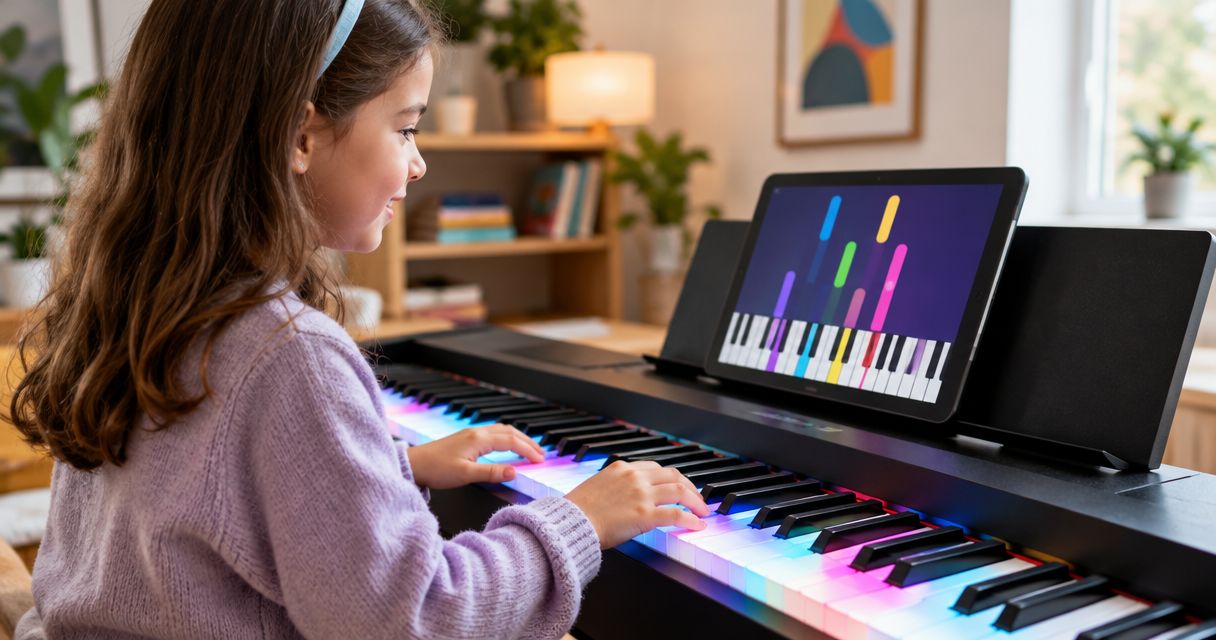
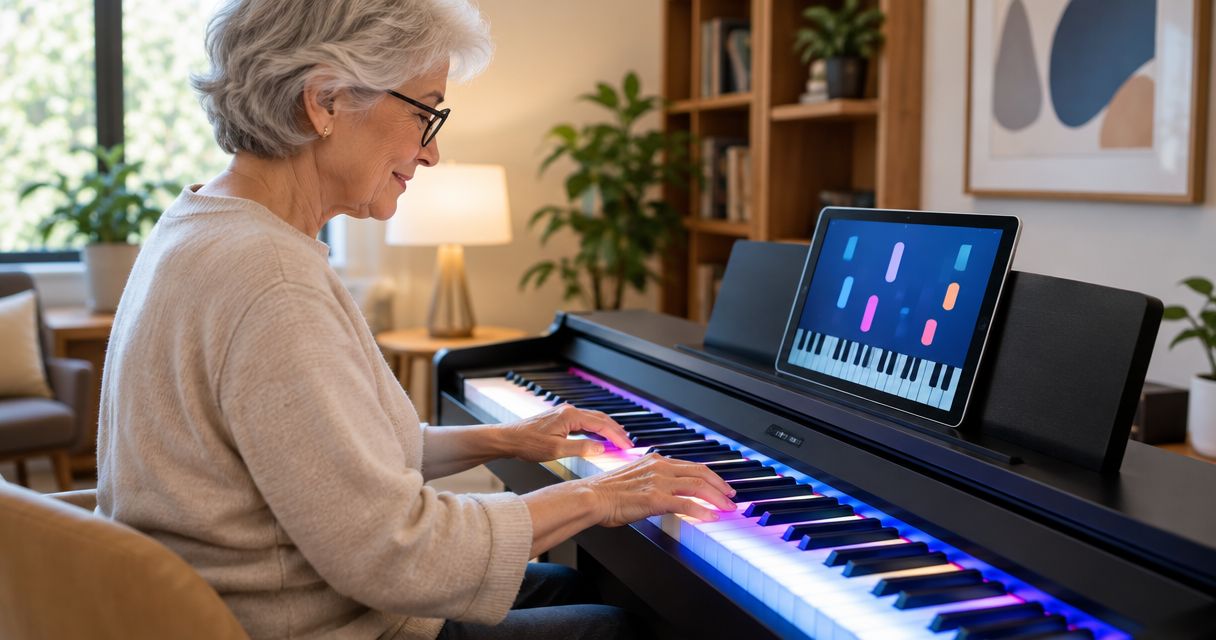
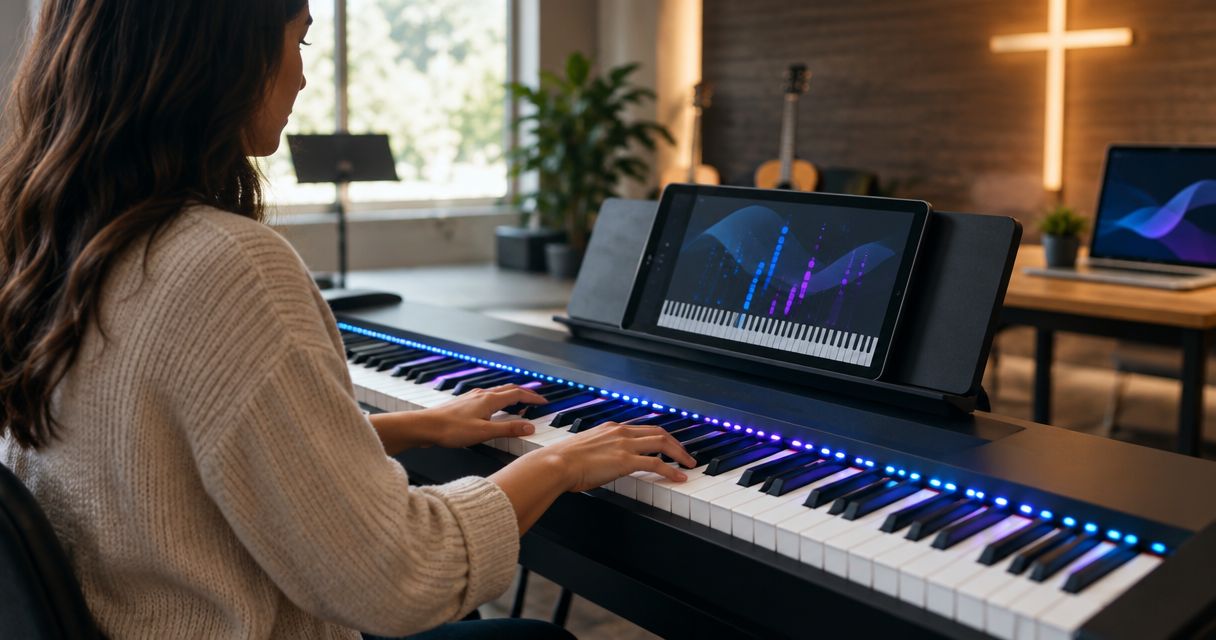
Piano LED Plus adds app-synced light guidance for learning songs by following illuminated keys. Use that visual route for note-location practice, then relate the notes back to the chords you already studied. Before making it part of your 2026 routine, check the system’s current setup requirements and whether the material you want to practise is supported.
Do not equate a successful guided play-through with service readiness. You still need to know what the passage does musically and where it belongs in the agreed arrangement.
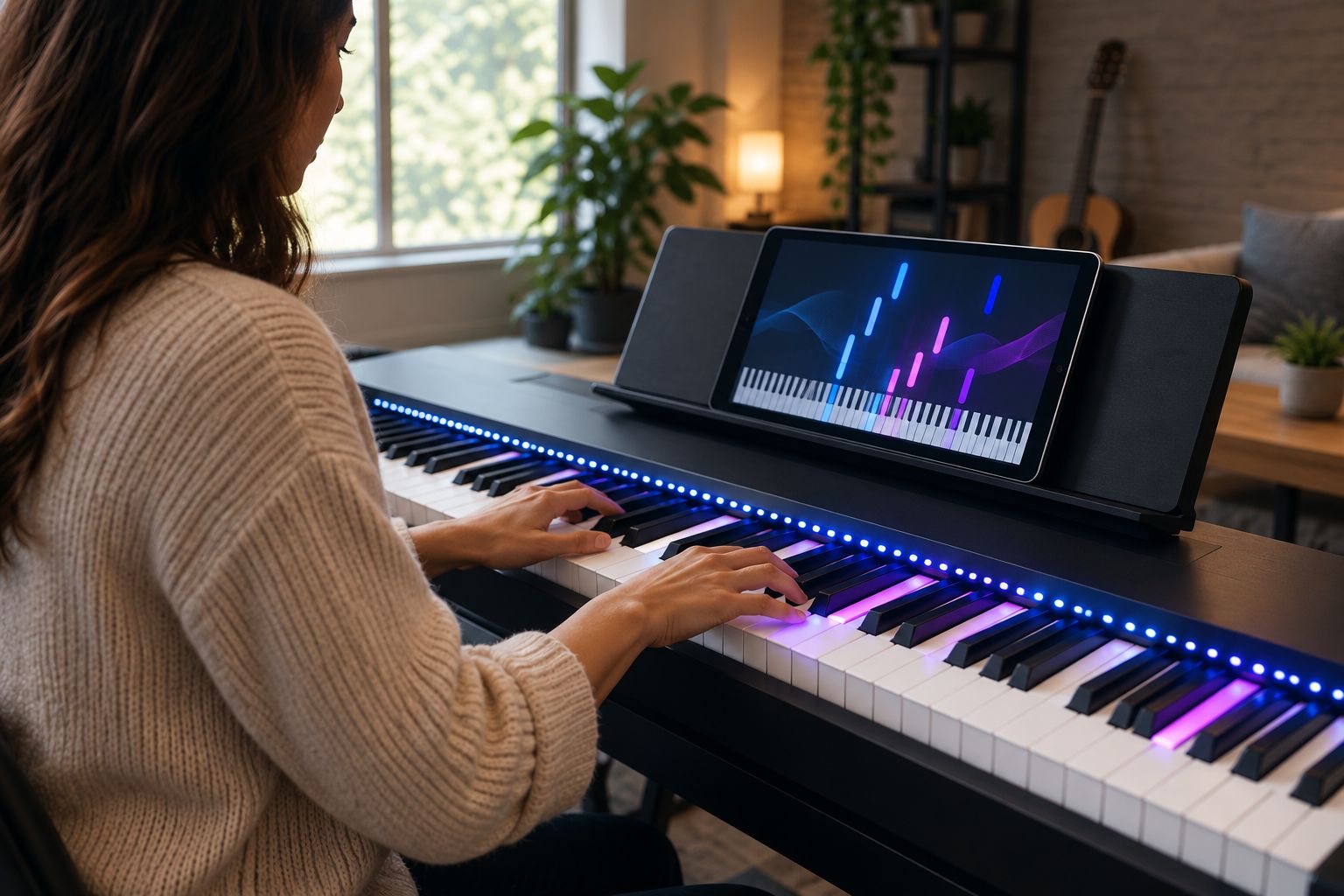
Keep the passage small enough to inspect rather than chase. The useful question is whether you understand the next movement before the cue arrives.
- Isolate 4 bars as a suggested practice segment.
- Identify the chord beneath the illuminated notes.
- Choose consistent fingering for the passage.
- Repeat the difficult change separately.
- Replay the passage without relying on visual cues.
4. Protect the pulse before adding complexity
Use a metronome, count aloud or practise with the agreed reference recording. Start with an accompaniment pattern that you can maintain through every chord change. Add detail only when the simpler version stays steady.
For a suggested 10-minute practice block, focus on one transition rather than attempting the complete set. This is a practice structure, not a promise about learning speed. Listen for hesitation before the chord change, a rushed entrance afterwards or an uneven left hand.
Worship accompaniment also needs recoverability. If you lose your place, a simple chord on the next clear beat is more useful than stopping to reconstruct every missed note. Practise that recovery deliberately during rehearsal, without disrupting the group.
- Count through rests instead of waiting silently.
- Keep the left-hand pattern simple while learning.
- Reduce note density when the pulse becomes unstable.
- Practise entering after a vocal pickup.
- Return to a clear chord change after a deliberate pause.
5. Transfer the song from lights to musical cues
Begin with the chord chart and your own spoken section labels. Play the passage without depending on the LEDs, then identify what failed: note recall, chord recognition, rhythm or the transition into the next section. Fix that specific problem before repeating everything.
Use three practice modes: Follow lights, Read chords and Follow cues. The first helps you locate notes. The second connects those notes to harmony. The third prepares you to respond to the worship leader and other musicians.
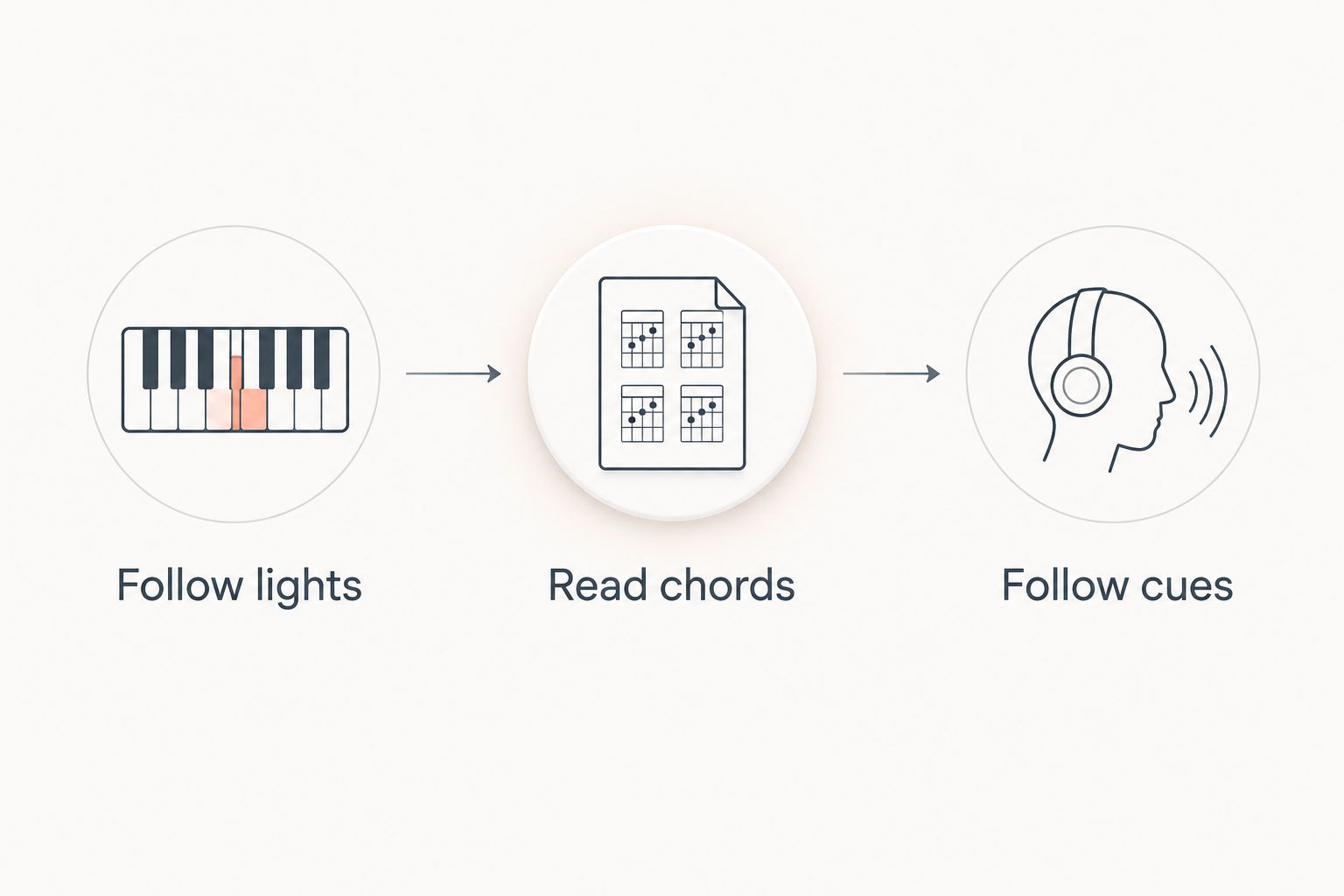
Try 3 passes as a suggested check: guided, chart-led and cue-led. The point is not to achieve a particular score. It is to discover whether you can play the accompaniment when the source of information changes.
- Name the section before you begin playing.
- Play the chord outline without the learned decoration.
- Start from a chorus rather than always from the introduction.
- Rehearse a repeated section without restarting the song.
- Finish from the agreed ending cue.
6. Rehearse the version your team will perform
Use the agreed chart and recording before the group rehearsal. Confirm any uncertain transitions with the leader rather than building an assumption into your practice. Keep a readable section map beside the keyboard.
For your 2026 service preparation, treat rehearsal as a separate skill from learning notes. Listen for how the piano sits beneath the singers, where another instrument supplies the rhythm and which cues replace the fixed arrangement you practised at home.
A useful rehearsal test is whether you can remain attentive while playing a simpler part. If reading the chart or looking at the keyboard consumes all your attention, reduce the accompaniment until you can watch and listen again.
- Rehearse the actual introduction and ending.
- Check chord changes against the singer’s phrasing.
- Leave room where another instrument carries a fill.
- Practise the leader’s repeat and stop cues.
- Record a rehearsal excerpt with the team’s permission.
7. Review the musical problem, not just the missed key
Listen back to a recording or ask a teacher for focused feedback. Separate wrong notes from uneven timing, unclear chord changes and accompaniment that competes with the voice. Each problem calls for a different next exercise.
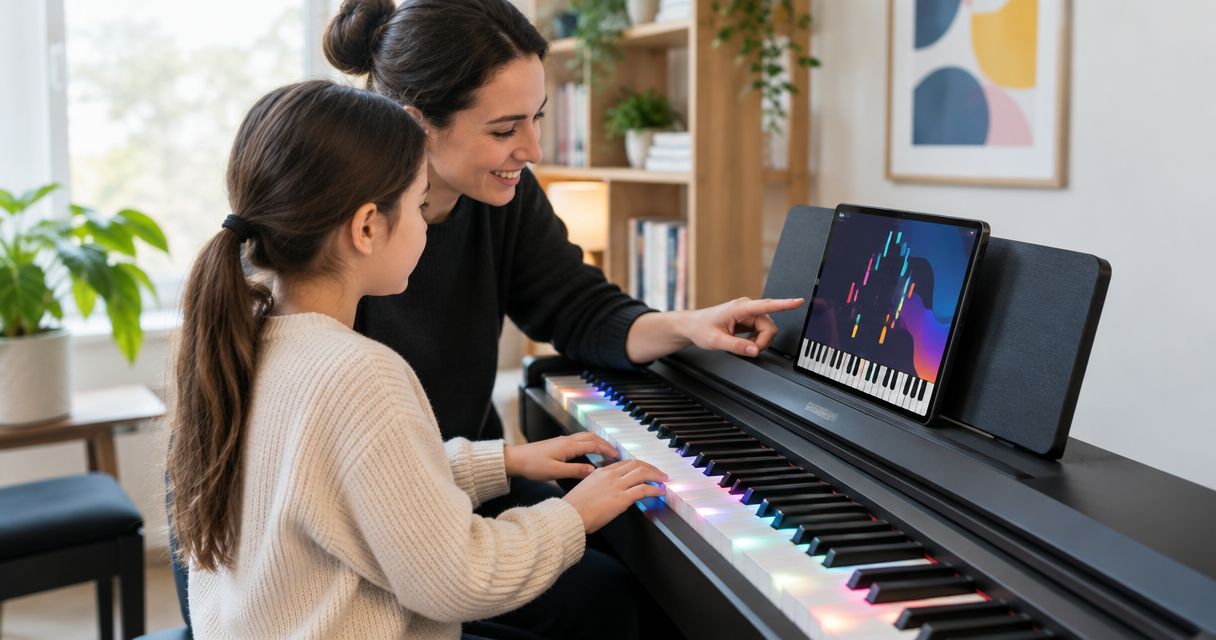
If you work with a teacher, bring the service chart and explain your role in the ensemble. The LED piano learning guide for piano teachers is a related starting point for discussing how visual guidance fits into instruction.
Choose one correction for your next session. Repeating the complete song without naming the problem makes it difficult to judge whether the practice helped.
- Mark the exact section that needs attention.
- Classify the issue as notes, timing, harmony or ensemble response.
- Simplify the part before rebuilding it.
- Ask for feedback on fingering or tension when needed.
- Recheck the passage without visual guidance.
Compare your learning options
Choose an option by the problem it addresses, not by how many features it lists. For a 2026 practice plan, you can combine these approaches rather than expect one method to handle every part of worship accompaniment.
Pianoledshop’s LED piano learning offering belongs in the visual-guidance category. Its stated purpose is song learning through app-synced lights; that does not establish support for your particular worship arrangement, keyboard or rehearsal workflow. Check those requirements before choosing equipment.
| Option | Best for | Main advantage | Key limitation |
|---|---|---|---|
| Manual chart practice | Pianists learning chord-led accompaniment | Direct practice with the harmony and section map | Requires you to identify and correct mistakes |
| Piano LED Plus | Beginners seeking visual note-location guidance | App-synced lights show notes during song learning | Does not replace chord understanding or live ensemble rehearsal |
| Teacher-led practice | Pianists needing individual correction | A teacher can address your fingering, timing and interpretation | Individual practice is still necessary between lessons |
| Band rehearsal | Pianists preparing service cues and musical balance | Lets you practise the arrangement with the actual musicians | Is not a substitute for learning an unfamiliar part beforehand |
Use manual chart practice as the foundation, LED guidance for note learning and rehearsal for live decisions. Teacher feedback is the appropriate addition when you cannot identify why a passage remains difficult.
Choose equipment around your practice needs
The store lists both a standalone system and keyboard bundles. The cards below show those purchase formats, not a ranking of keyboard action, connections or suitability for your church. Confirm the current product details against your practice setup before making a choice.
- Standalone system — best for evaluating visual guidance around your existing setup: confirm compatibility before choosing it.
- Keyboard bundle — best for evaluating a combined keyboard-and-guidance purchase: confirm the keyboard features and setup requirements rather than assuming them from the name.


Common mistakes worship pianists make
Learning a recording instead of the service arrangement
A recorded piano part does not establish what your team will play. Confirm the key, section order and ending, then learn the accompaniment needed for that version.
Treating every illuminated note as essential
A learned song part and an ensemble accompaniment serve different purposes. Keep the harmonic support clear, and remove decoration when it distracts from the vocal line or your timing.
Leaving cue practice until the service
Knowing a sequence from beginning to end is different from following a repeat or an early ending. Practise those decisions with the leader during rehearsal, not for the first time in front of the congregation.
Using the pedal to conceal uncertain changes
Holding the sustain pedal through a chord change can blur the harmony. Practise the passage without pedal first, then add pedalling that supports the phrasing instead of hiding hesitation.
Judging readiness only by a guided play-through
Correct notes under visual guidance do not demonstrate independent accompaniment. Test the chord outline, section changes and ending without relying on the lights before calling the song prepared.
FAQ
What is LED piano learning for worship pianists?
LED piano learning for worship pianists uses illuminated key cues to help learn notes for song practice. Worship preparation also requires chord knowledge, steady timing and rehearsal with singers or a band.
Is Piano LED Plus better than a chord chart for worship piano?
Piano LED Plus and a chord chart address different tasks. The system provides app-synced note guidance, while a chord chart shows the harmony you need to interpret and follow.
Can I use LED guidance instead of piano lessons?
LED guidance does not replace individual musical feedback. It can support note learning, while a teacher can address fingering, tension, timing and interpretation.
Do I need to read sheet music before using LED piano learning?
You do not need staff notation to begin practising note locations with visual cues. For worship accompaniment, also learn to recognise the chord symbols and section labels your team uses.
Will Piano LED Plus work with my church keyboard?
Confirm compatibility with your exact keyboard before choosing Piano LED Plus. Check the current connection and setup requirements rather than assuming support from the keyboard’s appearance or brand.
Can I learn any worship song with the system?
Check whether your chosen song and practice material are supported before planning around the system. Also confirm that the available material matches the key and arrangement your team intends to use.
How do I know when a song is ready for worship rehearsal?
A song is ready for rehearsal when you can maintain its chord outline and section changes without depending on visual cues. Rehearsal then checks your entrances, balance and response to the leader.
What should a beginner worship pianist practise first?
Practise the agreed chord changes and section order first. Add a simple rhythmic accompaniment, then use visual guidance for specific note patterns that remain difficult.
One last thing
Practise the ending before another full run-through. Start from the final section, follow the agreed cue and stop cleanly; this checks a decision that repeated practice from the introduction can overlook.
For your next 2026 session, write the ending beside the song title before you touch the keys. Pianoledshop can support LED-guided song learning, but your most useful preparation is knowing what to play, when to simplify and when to stop.