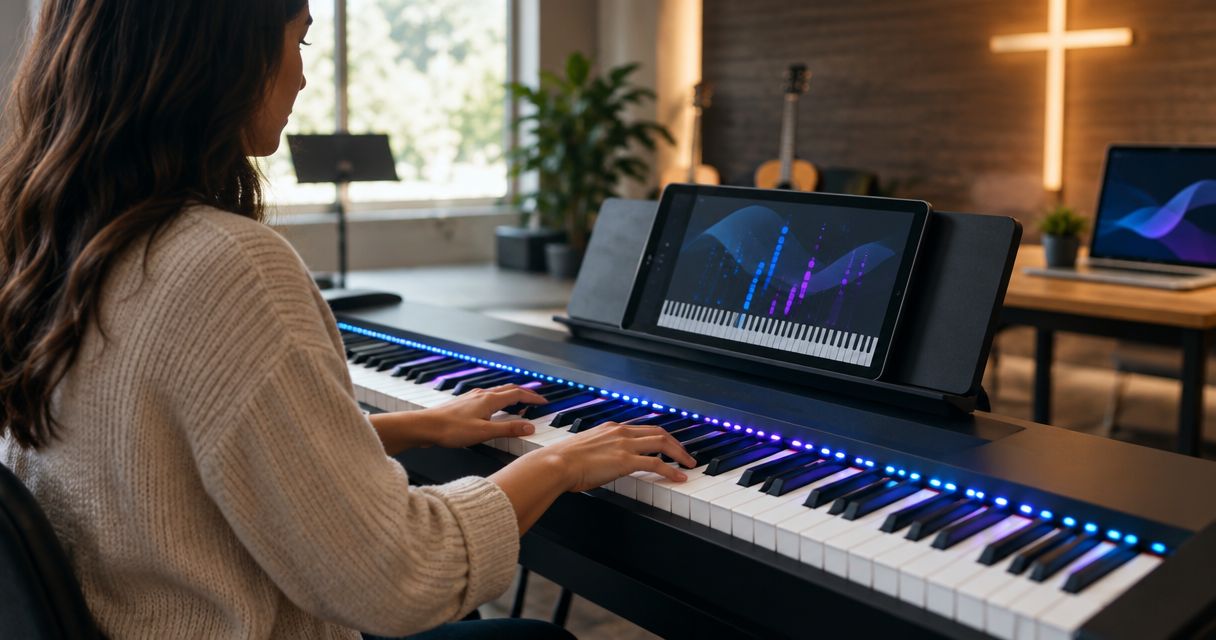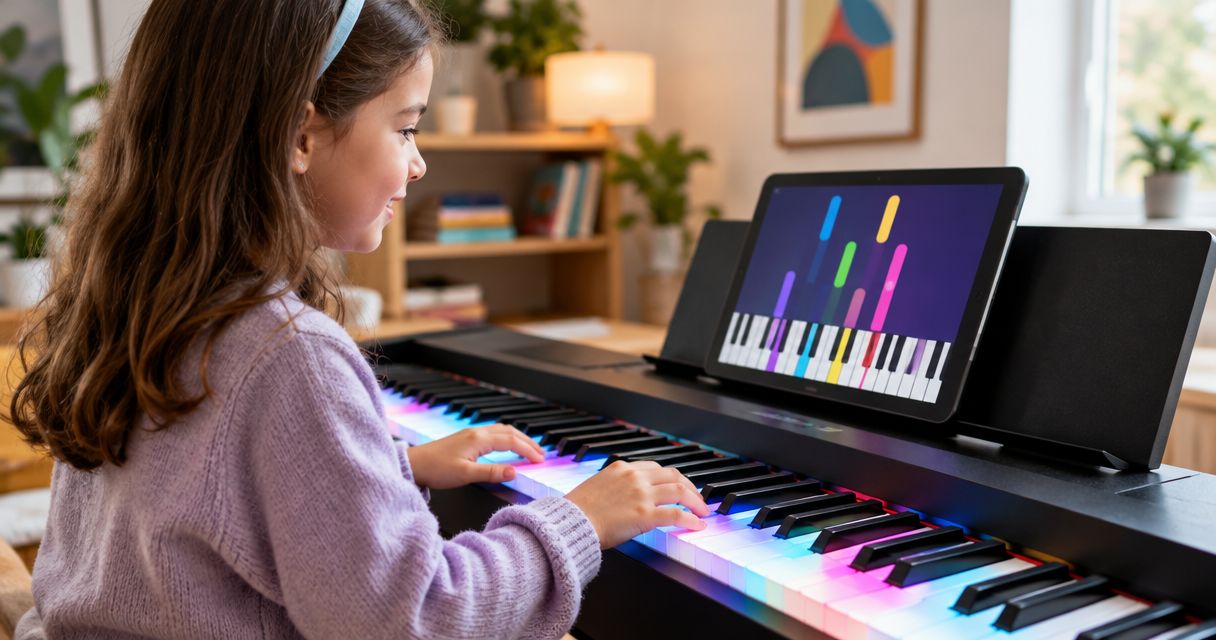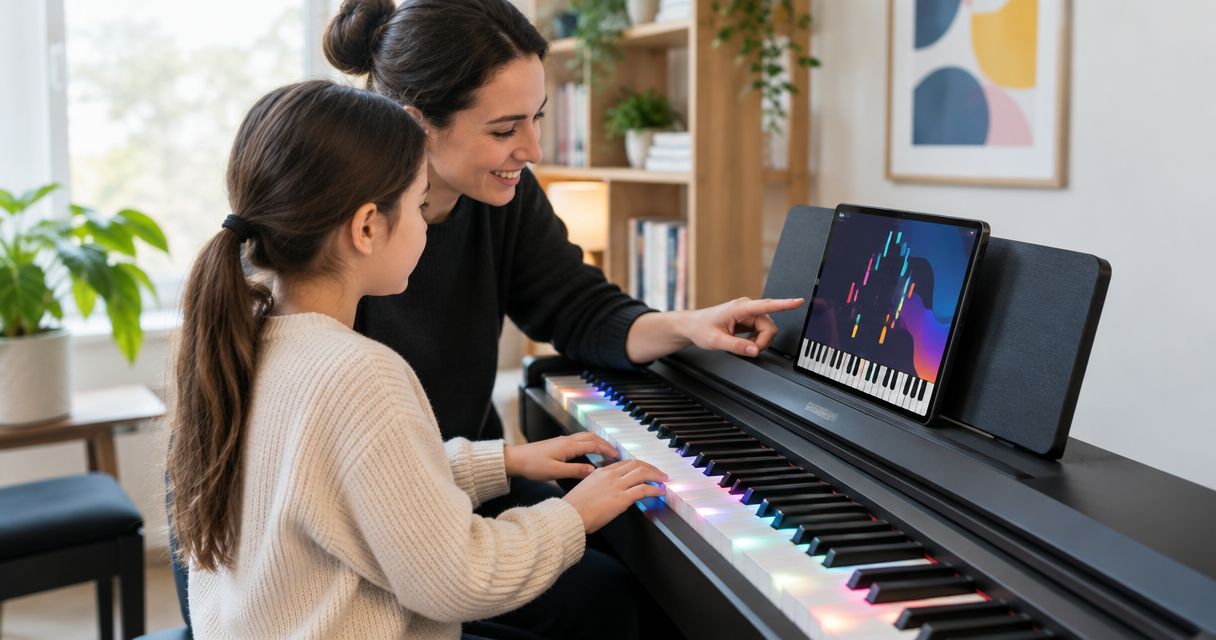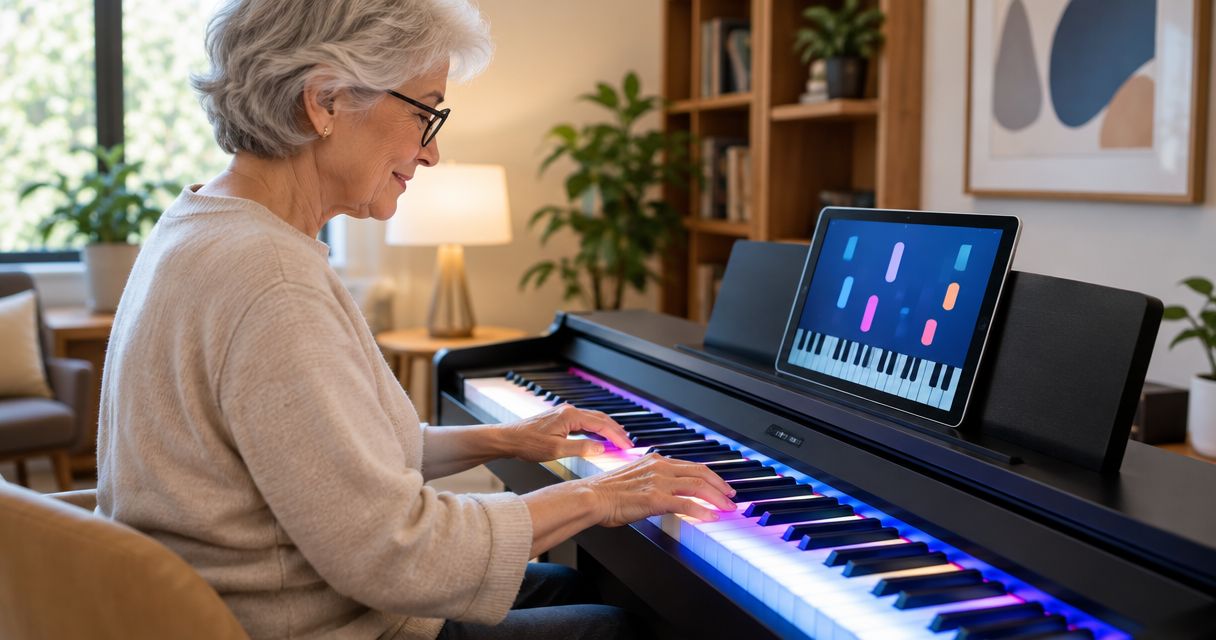
Seniors’ LED piano learning is piano practice guided by illuminated keys, with the aim of helping older beginners and returning players learn songs through visible note cues. This 2026 guide explains how to choose a comfortable setup, use the lights without becoming dependent on them, and build a practice routine around your own goals.
- Pianoledshop suits beginner hobbyists seeking app-synced visual cues; LED guidance does not replace technique instruction.
- LED piano learning for seniors should combine visible note cues, comfortable seating, and listening practice.
- Choose your learning setup around your keyboard, eyesight, hand comfort, and willingness to use an app.
- Practise short song passages, then repeat them without watching the lights to check independent recall.
Why LED piano learning matters for seniors
LED guidance addresses a specific beginner task: finding the next key. Instead of translating every written note into a keyboard position before playing, you follow a visible cue while learning the passage. That makes illuminated keys a useful entry point, not a complete music education.
Pianoledshop is best for beginner hobbyists who want to learn songs by following app-synced lights. Its LED piano learning approach matches that goal; it does not establish that every keyboard, phone, or accessibility need is supported. Start with Pianoledshop to understand the approach, then check the details of the setup you are considering.
Your age alone should not decide the method. A returning player who reads music needs a different starting point from someone who has never found middle C. Likewise, you should assess visibility, seating, hand comfort, and app handling individually rather than assume all seniors share the same constraints.
For your 2026 learning plan, define success as something observable: play a familiar melody, keep a steady pulse, or remember a short phrase without a prompt. These goals give the lights a job and give you a way to judge whether the method helps.
How to build a senior-friendly LED piano routine
Choose a musical goal before choosing equipment
Start manually: name a song you want to play, listen to it, and identify whether your first goal is the melody or an accompaniment. If you already own a keyboard, use it to explore the tune before buying a learning system. This separates a musical goal from an equipment decision.
Choose a first passage that you can hear clearly in your mind. Familiarity gives you something to compare against when a note sounds wrong. Avoid making a complete two-handed arrangement your first test of whether you can learn piano.
Write down what you want help with. Finding notes, reading notation, coordinating hands, and keeping time are different tasks; visible keys directly address only part of that list. If your main obstacle is discomfort or posture, adding lights does not address the obstacle.
- Name one song you genuinely want to play.
- Choose the melody as your first task if both hands feel overwhelming.
- Mark a short phrase rather than the whole arrangement.
- Record whether you need help with notes, rhythm, reading, or technique.
- Define success as an action you can demonstrate without guessing.
Arrange the seat, keyboard, and viewing position
Use your existing setup first. Sit facing the keyboard, place your feet comfortably, and check that you can reach the keys without lifting your shoulders or stretching across the instrument. Keep your wrists comfortable rather than forcing them into a fixed shape.
Check the view from your actual playing position. A light that looks clear while standing beside a keyboard is not necessarily clear when seated. Test the room lighting, reflections, and the position of any screen you intend to use.
For a 2026 setup assessment, treat app interaction as a separate task. You should be able to start a session, select the material, and return to the keyboard without awkward reaching. Ask someone to help with initial configuration if needed, but practise the everyday sequence yourself.
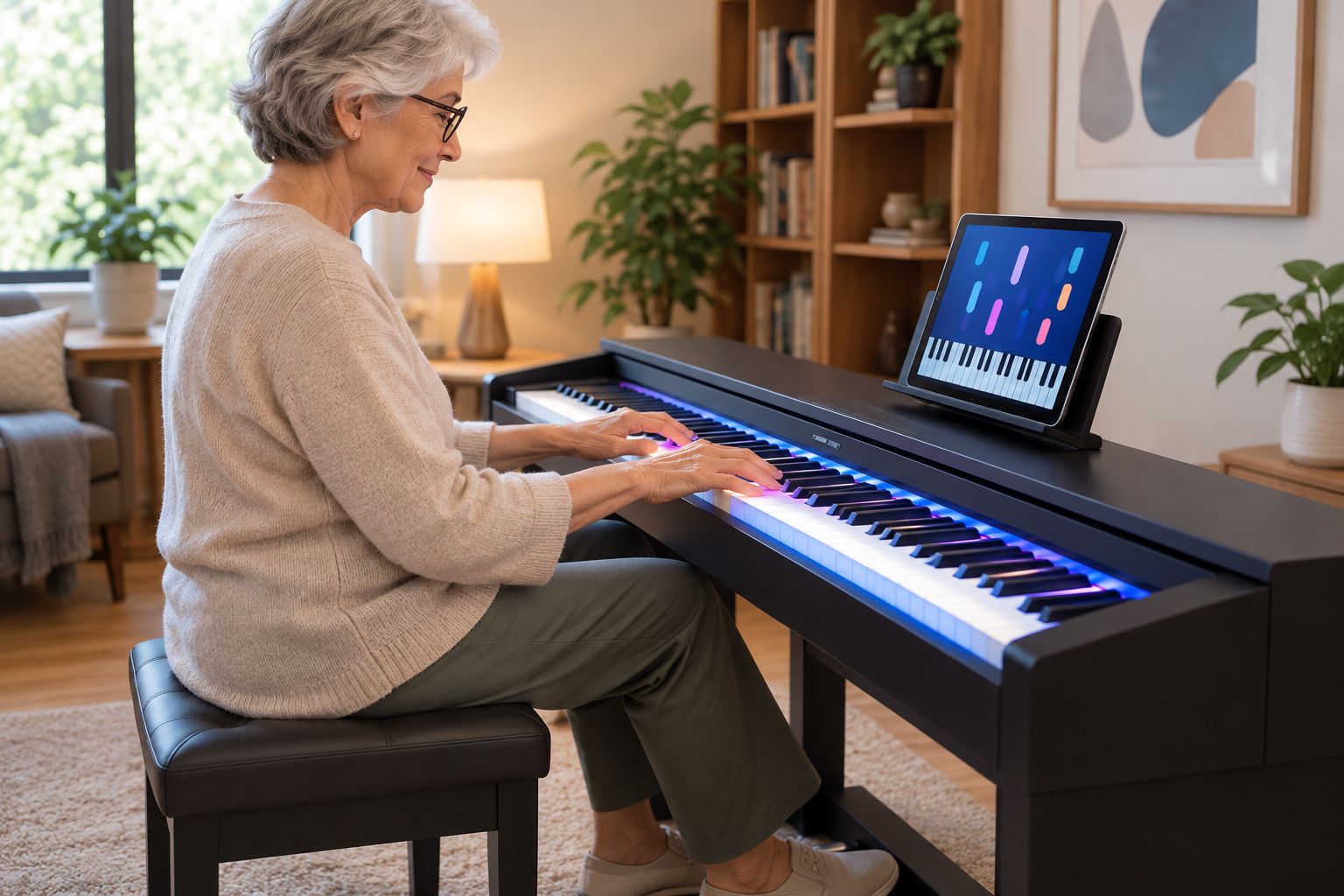
Do not continue through pain to finish a song. Stop and reassess the setup; persistent symptoms belong with a qualified health professional, not a learning app.
- Position the seat directly in front of the passage you are practising.
- Keep the instrument and seat stable.
- Check key visibility while seated, not standing.
- Move the screen within comfortable viewing and reaching distance.
- Stop when playing causes pain rather than treating it as progress.
Check the learning system against your actual needs
Before adding equipment, try a manual demonstration: have a teacher or helper point out a short melody, then repeat it. This shows whether direct key-location cues help you. It also reveals whether the larger difficulty is timing, fingering, or remembering the sequence.
Pianoledshop offers LED piano learning through lights synced to an app, along with product bundles. That is a more direct visual route to finding notes than repeatedly looking between a written score and the keyboard. You still need to assess whether the complete setup suits you.
Choose a learning system for a task you have identified, not for a promise of effortless playing. Confirm compatibility, installation requirements, app requirements, and the song material before committing. A product name does not answer those questions.
For a purchase decision in 2026, separate an add-on system from a piano-and-system bundle. The first decision starts with an instrument you already own; the second also requires you to assess the instrument itself.
- Confirm compatibility with your exact keyboard model.
- Check what installation and connection involve.
- Review the app’s device requirements.
- Verify that the material includes music you want to practise.
- Check whether the visible cues are comfortable for you to follow.
The following store options illustrate the two purchase routes. The standalone system and bundled instrument are not substitutes for checking fit, touch, visibility, and connection requirements.


Practise one short passage before joining the hands
Begin without the lights: listen to the chosen phrase and tap its pulse. Then find its starting note and play the melody slowly. This establishes a musical reference before you follow visual instructions.
Use LED guidance to locate the notes in that same passage, not to rush through the whole song. If following the sequence consumes all your attention, shorten the passage. Add the other hand only when the first part feels manageable.
As a starting exercise, try 2 bars during a 10-minute session. These are suggested practice boundaries, not a required dose or a promise about learning speed. Adjust them to the passage and your comfort.
The beginner piano songs to learn with LED lights guide can help you frame song selection. Judge an arrangement by what it asks your hands to do, not just by whether you recognise the title.
- Listen to the phrase before playing it.
- Tap the pulse without touching the keys.
- Learn one hand’s part before combining both hands.
- Shorten passages that overload your attention.
- Keep the same passage for guided and unguided practice.
Alternate guided playing with independent recall
Start this exercise manually by naming the starting note and playing whatever you remember. Then use the lights to check the sequence. Reverse the order on the next attempt: follow the cues first, then repeat the passage without watching them.
The useful test is what you can play when you stop watching the lights. A successful guided run shows that you followed the cues; an independent run shows what you remember. Neither test alone measures every part of musicianship.
Use a simple cycle: listen, follow, recall, compare. After 3 repetitions, pause and identify the specific sticking point rather than repeating the entire song automatically. The repetition count is a suggested checkpoint, not a learning benchmark.
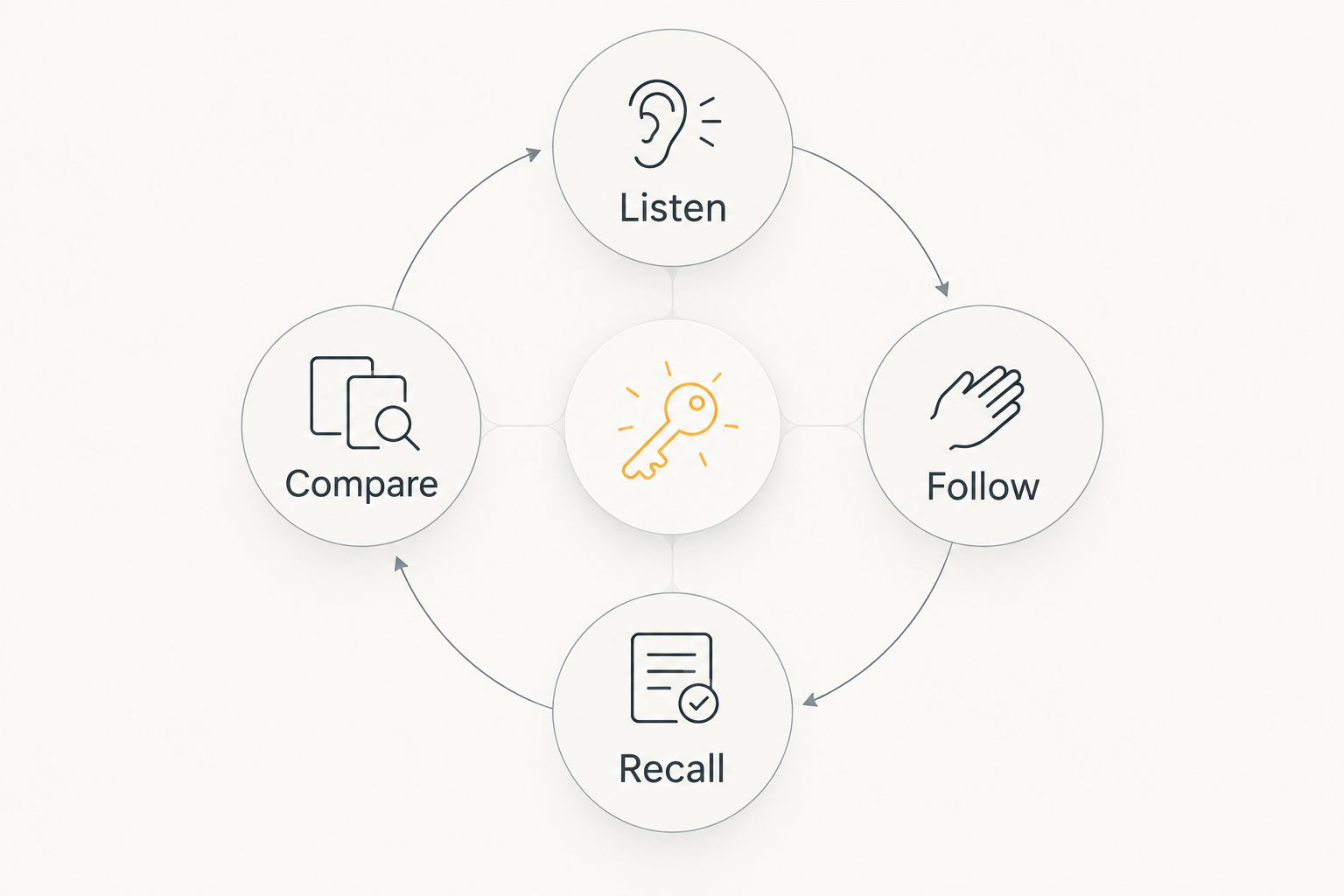
If you repeatedly miss the same transition, isolate that transition. If the notes are correct but the rhythm is uneven, return to listening and pulse work rather than adding more visual prompts.
- Name the starting note before each attempt.
- Follow the cues for one complete short passage.
- Repeat without watching the lights.
- Compare note accuracy and rhythm separately.
- Isolate the transition that causes the mistake.
Record progress that matches your original goal
Use a notebook before adding another app. Write the passage, the difficulty, and the next action in plain language. A note such as needing help with the left-hand entry is more useful than a general judgement that the session went badly.
Make an occasional audio recording if you are comfortable doing so. Listening without looking at the keyboard lets you assess continuity and rhythm separately from the visual experience. You do not need to publish or share the recording.
Keep your 2026 practice record focused on independence, comfort, and the music you chose. If you can follow lights but cannot recall a phrase, devote the next session to recall. If your goal changes toward reading scores, add explicit notation work rather than expecting the lights to teach it indirectly.
- Note the passage you practised.
- Record whether you played it with or without cues.
- Describe one specific difficulty.
- Choose one action for the next session.
- Reassess the method when your musical goal changes.
Compare learning options for your situation
Choose by the task you need help with. LED guidance, notation, lessons, and video demonstrations provide different kinds of support; none automatically covers everything.
| Option | Best for | Main strength | Key limitation |
|---|---|---|---|
| LED-guided learning through Pianoledshop | Beginner hobbyists seeking visible key-location cues | Links song practice to app-synced lights | Following cues does not establish independent recall or correct technique |
| Printed beginner notation | Learners who want to read music | Connects written notes and rhythm to playing | Requires learning symbols and keyboard positions together |
| Individual piano lessons | Learners seeking feedback on movement and musical interpretation | Gives you direct observation and correction | Requires arranging time with a teacher |
| Video demonstrations | Learners who prefer watching a passage being played | Shows a musical example you can replay | Does not correct your individual playing |
For your 2026 choice, distinguish assistance from feedback. Lights can tell you where to look; a recording lets you hear the result; a teacher can observe how you produce it. Combine methods when their jobs differ, not simply because more materials seem better.
Common mistakes seniors make with LED piano learning
Buying around age rather than personal needs
A senior-friendly setup is one you can see, reach, understand, and use comfortably. Do not select equipment because it is labelled easy without checking the actual learning sequence and physical setup.
Treating every difficulty as a note-finding problem
Lights address key location, but a hesitant passage can also involve rhythm, fingering, or hand coordination. Identify the problem before deciding that more guided repetition is the answer.
Adding both hands before the phrase is familiar
Combining unfamiliar parts can turn a short melody into an attention problem. Learn the parts separately and then join a small section, rather than restarting the whole song after every interruption.
Confusing guided completion with independent playing
Finishing a song while watching prompts is a useful milestone, not proof that you know the song without them. Include an unguided attempt while the passage is still fresh.
FAQ
Is LED piano learning suitable for seniors who have never played?
LED piano learning suits beginners who find visible key-location cues helpful. Check seating, visibility, app handling, and compatibility individually rather than choosing solely by age.
What is the best way to start learning piano with lights?
Start with a familiar melody and a short passage played by one hand. Listen first, follow the cues, and then repeat the same passage without watching the lights.
Do I need to read sheet music before using LED piano guidance?
You do not need to read sheet music to follow illuminated key cues. Reading notation is a separate skill, so add notation practice if reading scores is one of your goals.
Will an LED learning system work with my existing piano?
Compatibility must be checked against your exact instrument and the system’s requirements. Confirm the connection, installation, and app requirements before choosing an add-on.
Is LED guidance better than a piano teacher?
LED guidance and a piano teacher serve different purposes. Lights provide note-location cues, while a teacher can give individual feedback on technique, rhythm, and interpretation.
How long should a beginner senior practise each day?
Use a comfortable session length rather than a fixed age-based target. A suggested starting exercise is one short passage in a 10-minute session, shortened whenever comfort or attention drops.
How do I stop depending on the illuminated keys?
Alternate guided attempts with attempts made without watching the lights. Keep the passage unchanged so you can identify what you remember and where you still need help.
One last thing
Make an unguided attempt before ending your next session. Even an incomplete phrase tells you more about recall than another flawless run while watching the lights. Keep the visual support, but give it a defined role: help you find the notes, then step back while you learn to remember them.