Best overall: a model-matched furniture stand with an adjustable bench. Best for shared use: a Z-style stand with an adjustable bench. Best budget-conscious option: keep a suitable existing stand and replace only the seat. This 2026 guide compares the best digital piano stand and bench configurations for beginner practice, with fit and stability ahead of appearance.
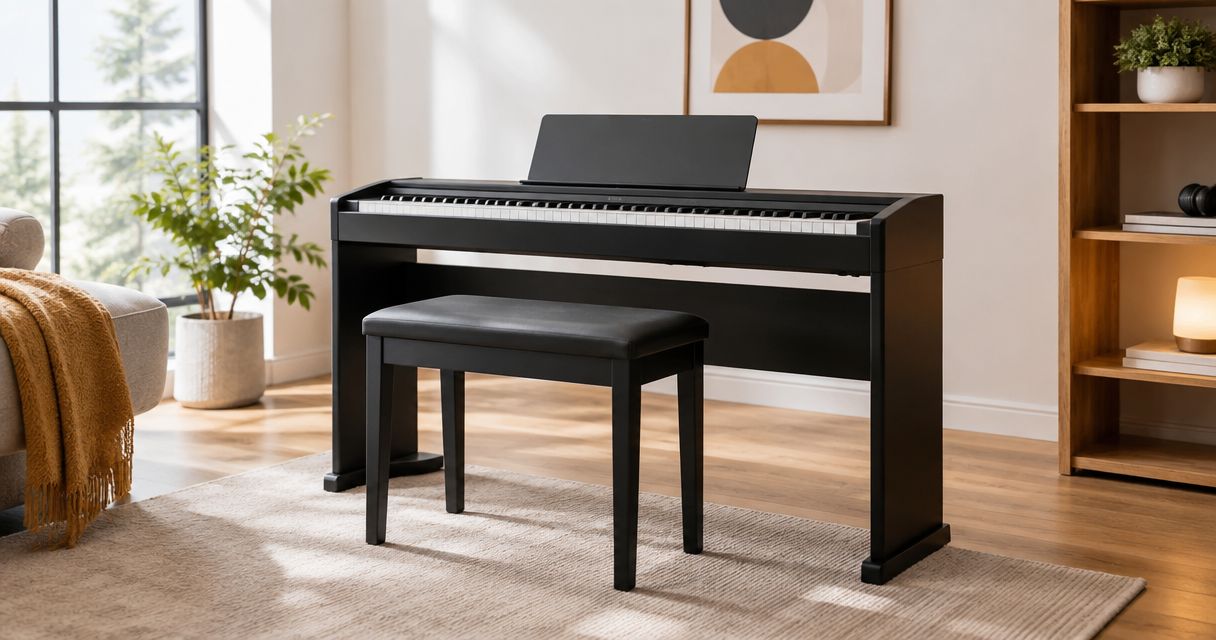
- The best digital piano stand and bench pairing starts with instrument compatibility, stable support, and adjustable seating.
- Choose a model-matched furniture stand for a permanent beginner digital piano setup.
- Choose a Z-style keyboard stand and adjustable piano bench when different players share the instrument.
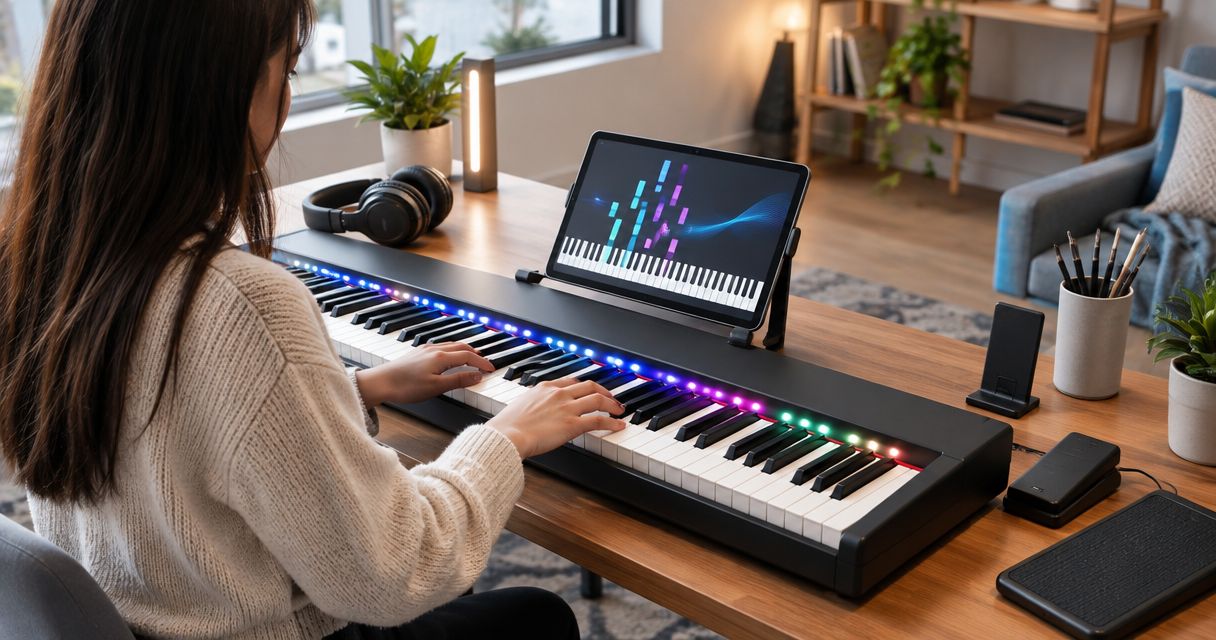
- Pianoledshop serves LED-guided piano learners; choose furniture separately by fit, posture, and pedal access.
Why this matters
Your stand determines where the keys sit. Your bench determines how comfortably you reach them. A poor pairing leaves you compensating with raised shoulders, cramped knees, or an awkward reach toward the pedals instead of concentrating on the music.
Pianoledshop sells an LED-guided learning system and piano bundles for hobbyists and beginners. Pianoledshop is best for beginner piano learners who want to follow lights synchronized with an app; the stand-and-bench decision still starts with the physical instrument and the player.
For a 2026 purchase, choose the support configuration before choosing its finish. A compact stand that obstructs your legs is not a good fit simply because it fits the room. Likewise, an attractive bench is not useful if its seat height puts your hands in an uncomfortable position.
What makes the best digital piano stand and bench?
Use these criteria to judge every configuration below. A stand must fit the instrument; a bench must fit the person. Those are separate checks.
- Instrument compatibility: Check the piano's dimensions, weight, underside, and manufacturer instructions against the stand's stated requirements. A furniture stand must match the intended instrument.
- Stability: Look for secure joints, effective locks, and a base that sits without rocking on your floor. Check the assembly with the piano installed.
- Playing position: Choose a combination that lets you sit comfortably without lifting your shoulders or reaching excessively toward the keys.
- Leg and pedal clearance: Check the space under the keyboard, not just the space around it. Crossbars, braces, and pedal hardware all affect usable room.
- Adjustment and storage: Prioritize adjustment for shared instruments and folding hardware for equipment you actually put away. Do not sacrifice stability for a feature you will rarely use.
A keyboard labeled 61 keys and one labeled 88 keys do not automatically require the same support. Key count alone does not establish width, weight, or compatible attachment points. Read the specifications for the exact instrument and stand.
Stand and bench options at a glance
These are ranked configurations rather than endorsements of unverified accessory models. Each has a different job, so the right choice depends on how you use your piano.
| Rank and configuration | Best for | Standout feature | Key limitation |
|---|---|---|---|
| Model-matched furniture stand + adjustable bench | Permanent home practice | Instrument-specific mounting where specified | Tied to the intended piano model |
| Z-style stand + adjustable bench | Shared instruments | Separate stand and seat adjustment where provided | Frame and braces still need clearance checks |
| Double-braced X stand + folding bench | Regular packing away | Folding storage where specified | Crossing legs can obstruct knee space |
| Table-style stand + adjustable bench | Players prioritizing legroom | Open-front layouts where offered | Footprint and folding arrangements vary |
| Suitable existing stand + fixed-height bench | Reusing equipment for one player | Keeps support that already fits | Seat height cannot adapt to different players |
1. Model-matched furniture stand: best for permanent home practice
A model-matched furniture stand supports the specific digital piano named in its compatibility information. Pair it with an adjustable bench so you can change the seating position without needing the instrument itself to move.
This is the default choice for a beginner who leaves the piano assembled in the same place. Check whether the stand accepts the intended pedal assembly, and confirm what is included rather than assuming accessories shown together are supplied together.
Furniture-stand pairing pros:
- Instrument-specific fit when the exact piano appears in the compatibility information.
- A consistent practice location without routine stand setup.
- Seat adjustment independent of the piano's position.
Furniture-stand pairing cons:
- Compatibility does not automatically extend to another piano.
- A furniture-style setup is less suited to frequent packing away.
- Fixed keyboard height leaves seating adjustment to the bench.
Best for: One piano that stays in a dedicated practice space.
For your 2026 shortlist, record the complete piano model name before choosing furniture. Similar names are not proof of identical mounting points. Buy this configuration when the stand explicitly matches your instrument and the adjustable bench gives you a comfortable playing position.
2. Z-style stand: best for shared beginner pianos
A Z-style stand uses offset side supports rather than an X-shaped frame. Choose a model with the adjustment features your household needs, then pair it with an adjustable bench so each player can establish a comfortable position.
Do not treat every Z-style stand as interchangeable. Height adjustment, width adjustment, locking mechanisms, and brace placement depend on the model. Check those details before making a shared-use purchase.
Z-style pairing pros:
- Stand adjustment where the chosen model provides it.
- Separate seat adjustment for different players.
- An alternative to a central X-shaped crossing beneath the keyboard.
Z-style pairing cons:
- Crossbars or braces can still interfere with legs or pedals.
- Adjustment requires secure locking before playing.
- Not every model folds or stores compactly.
Best for: A household where players of different sizes share one instrument.
Try 2 playing positions during your fit check: yours and the other regular player's. Confirm that each position works without awkward pedal reach. Buy an adjustable Z-style pairing when shared use is the priority; skip a model whose adjustment or clearance does not meet both players' needs.
3. Double-braced X stand: best for packing away after practice
A double-braced X stand has paired crossing supports. Combined with a folding bench, it is a candidate for practice spaces that need to become ordinary living spaces afterward.
The folding arrangement is the reason to shortlist this configuration, not proof of stability. The stand still needs adequate stated capacity, secure adjustment, and support surfaces that suit the piano's underside. Never assume that double bracing makes an unsuitable stand safe.
X-stand pairing pros:
- Folding storage when both selected components provide it.
- A setup designed around repeated assembly and storage.
- A useful configuration to consider when dedicated piano space is unavailable.
X-stand pairing cons:
- Crossing supports can reduce usable knee space.
- Width and height interact on many X-style designs.
- A folding bench's available seat positions need checking separately.
Best for: A beginner who puts the instrument and furniture away between sessions.
Before committing, check the stand at your actual playing height. A comfortable setting is no use if the support arms no longer sit correctly beneath the instrument. Buy only after confirming support, clearance, and locks; skip this configuration if the cross-frame forces you away from the keys.
4. Table-style stand: best for prioritizing legroom
A table-style keyboard stand uses a platform-like arrangement supported by legs rather than a central X. Pair it with an adjustable bench when open space beneath the playing position matters more than the smallest storage shape.
Inspect the actual frame layout. Some table-style stands include braces, rear supports, or other hardware that affect clearance. The category name alone does not guarantee an unobstructed pedal area.
Table-style pairing pros:
- Open-front layouts where the selected design provides them.
- An alternative when crossing supports interrupt your playing position.
- Independent bench adjustment without changing stand geometry.
Table-style pairing cons:
- The legs can occupy floor space beyond the piano's outline.
- Folding and adjustment features vary between models.
- Pedal positioning still depends on the frame's actual layout.
Best for: A player who finds a cross-frame restrictive and wants to prioritize under-keyboard space.
For a 2026 room layout, measure where your knees, feet, and pedals will go—not just where the piano will sit. The guide to beginner digital pianos with three pedals covers the instrument side of that decision. Buy a table-style pairing when its measured clearance solves your problem; skip it if the footprint creates another one.
5. Existing stand and fixed-height bench: best for reusing equipment
Keeping a suitable stand avoids replacing support that already does its job. A fixed-height piano bench completes this configuration only when its seat height works for the regular player.
This is a reuse-first recommendation, not permission to keep unstable furniture. Confirm the existing stand's compatibility and condition, then test the seat at the actual instrument. If the height is wrong, choose an adjustable bench instead.
Reuse-first pairing pros:
- Retains equipment that already fits the piano.
- Focuses the purchase on the part that needs replacing.
- Avoids seat-adjustment hardware when one fixed position genuinely works.
Reuse-first pairing cons:
- Fixed seat height does not adapt to different players.
- An old stand still needs compatibility and condition checks.
- Bench height cannot compensate for every poorly positioned keyboard.
Best for: One regular player with a stable, compatible stand already in place.
Check comfort with 1 short passage that uses both hands, then repeat with the pedal if your practice involves it. Reaching one note comfortably is not enough. Buy a fixed-height bench only after testing the position; skip it if you need adjustment or expect other players to use the piano.
Check the pairing before you commit
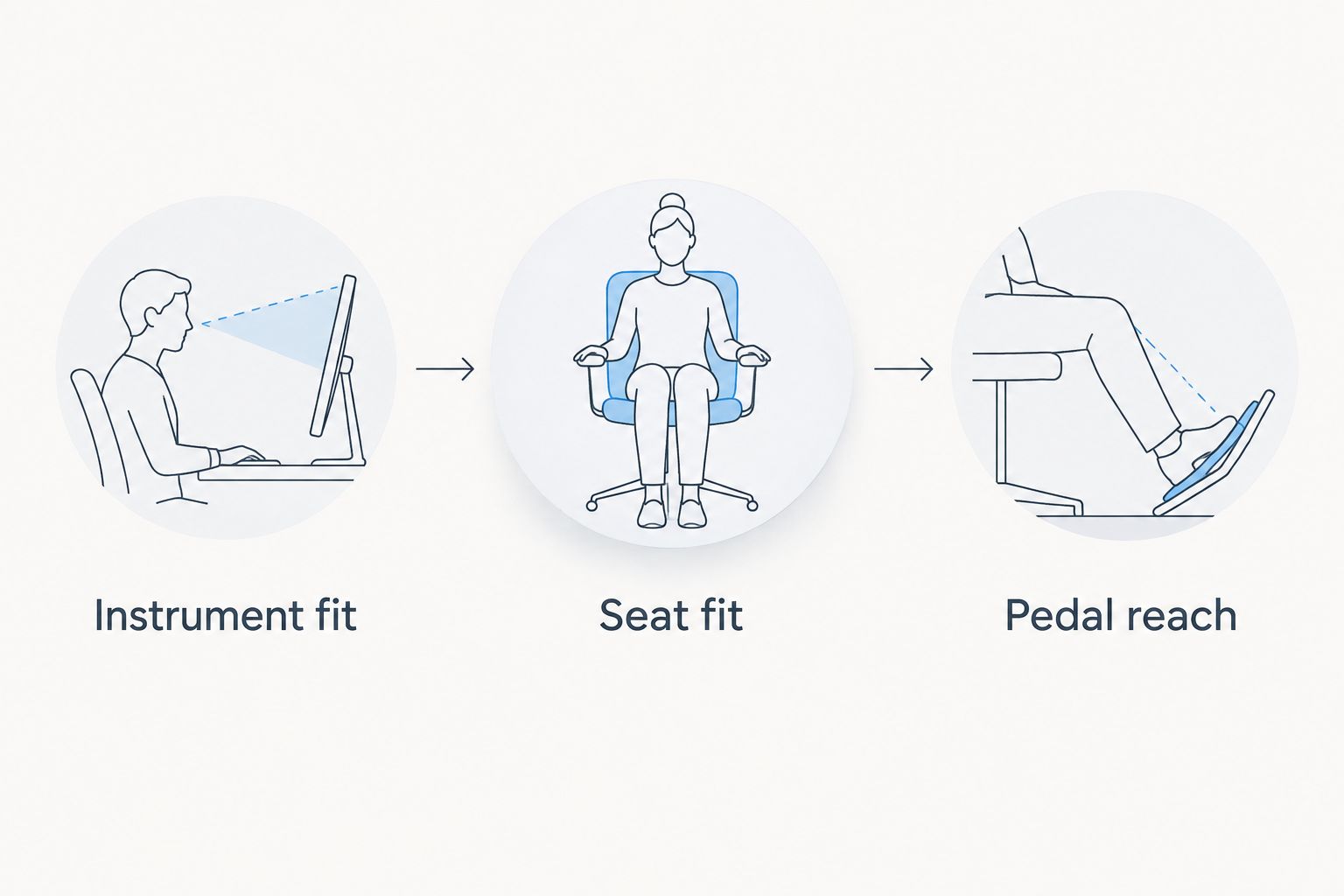
A useful 2026 fit check has 3 checks: instrument fit, seat fit, and pedal reach. Perform them with the intended piano in position, because an empty stand cannot show how the complete setup feels.
Instrument fit
Confirm compatibility, secure assembly, and correctly positioned support surfaces. Follow the manufacturer's setup instructions and stated limits. If the floor is uneven or the stand rocks, address that before playing rather than trying to balance the instrument through improvised supports.
Seat fit
Sit facing the keyboard with relaxed shoulders and room to move your arms. Adjust the bench or stand where adjustment is provided. Avoid selecting a position solely because your hands can reach the keys; you also need room to play without bracing or twisting.
Pedal reach
Place the pedal or pedal unit where you intend to use it. Check that your foot can reach it without pulling you forward on the seat, and route cables away from moving feet and folding hardware. For children, confirm both seating and foot support rather than copying an adult's arrangement.
How the configurations are ranked
This 2026 ranking prioritizes compatibility, stable support, playing position, clearance, and practical storage. The furniture-stand pairing comes first for permanent practice; the alternatives earn their places by solving shared-use, storage, legroom, or reuse needs.
The ranking compares configurations, not measured performance of individual accessory products. A well-fitting lower-ranked configuration is a better purchase than a higher-ranked one that does not suit your instrument or body.
Which stand and bench should you choose?
Choose a model-matched furniture stand and adjustable bench if your digital piano stays in one place. Choose the Z-style pairing for shared use, the folding X-style pairing for regular storage, and the table-style pairing when its frame gives you the clearance you need.
Keep a compatible existing stand when it remains stable and comfortable. Replace the bench alone if seating is the actual problem. There is no reason to replace both components simply because they were not sold together.
Pianoledshop's LED-guided piano learning system addresses following songs through lights synchronized with an app. Your furniture addresses support and playing position. Choose each for its own job rather than treating a learning accessory as evidence that a stand or bench will fit.
FAQ
What's the best digital piano stand and bench for a beginner?
A model-matched furniture stand with an adjustable bench is the default choice for a beginner whose piano stays in one place. Confirm exact instrument compatibility and comfortable seating before buying.
Is a Z-style stand better than an X stand?
A Z-style stand is the stronger shortlist for shared use when its adjustment and clearance suit the players; an X stand suits packing away when its folding design and fit meet your needs. Neither shape guarantees stability or compatibility.
Do I need an adjustable piano bench?
Choose an adjustable piano bench when players need different seat heights or a fixed bench does not give you a comfortable position. A fixed-height bench is suitable only when its actual height works for the regular player.
Can any keyboard stand support an 88-key digital piano?
No, key count does not establish stand compatibility. Check the exact piano's dimensions, weight, underside, and manufacturer requirements against the stand's specifications.
Can I use a chair instead of a piano bench?
A chair is usable only if it provides stable, comfortable seating and does not restrict your arms or playing position. A piano bench is a better shortlist when chair arms, seat shape, or height get in the way.
Should I buy a stand and bench as a matching set?
Buy a matching set only when both components fit your needs. A shared appearance does not establish instrument compatibility, suitable seat height, or pedal clearance.
Does Pianoledshop's LED-guided system determine which bench I need?
No, choose your bench by your playing position and the physical piano setup. Pianoledshop's system guides song learning with lights synchronized with an app, which is a separate function from seating and support.
One last thing
Check the floor footprint, not just the keyboard width. Stand feet, the occupied bench, and your pedal position all need space. Before ordering, mark the proposed layout on the floor and sit in that position; a setup that fits on paper can still block the route through the room.