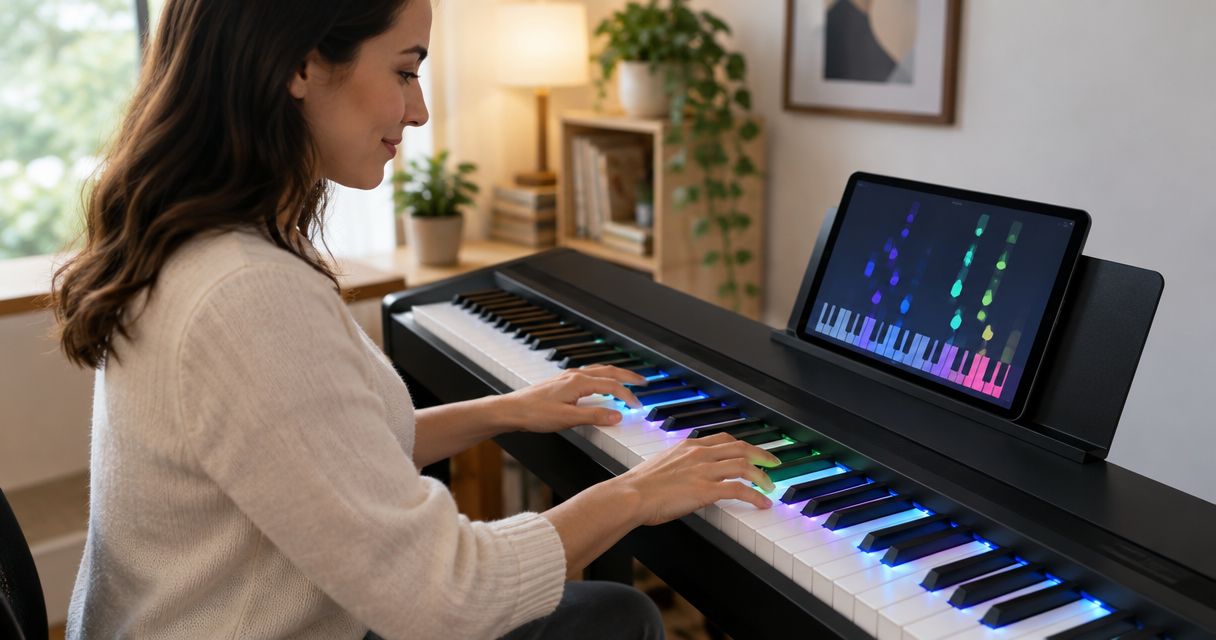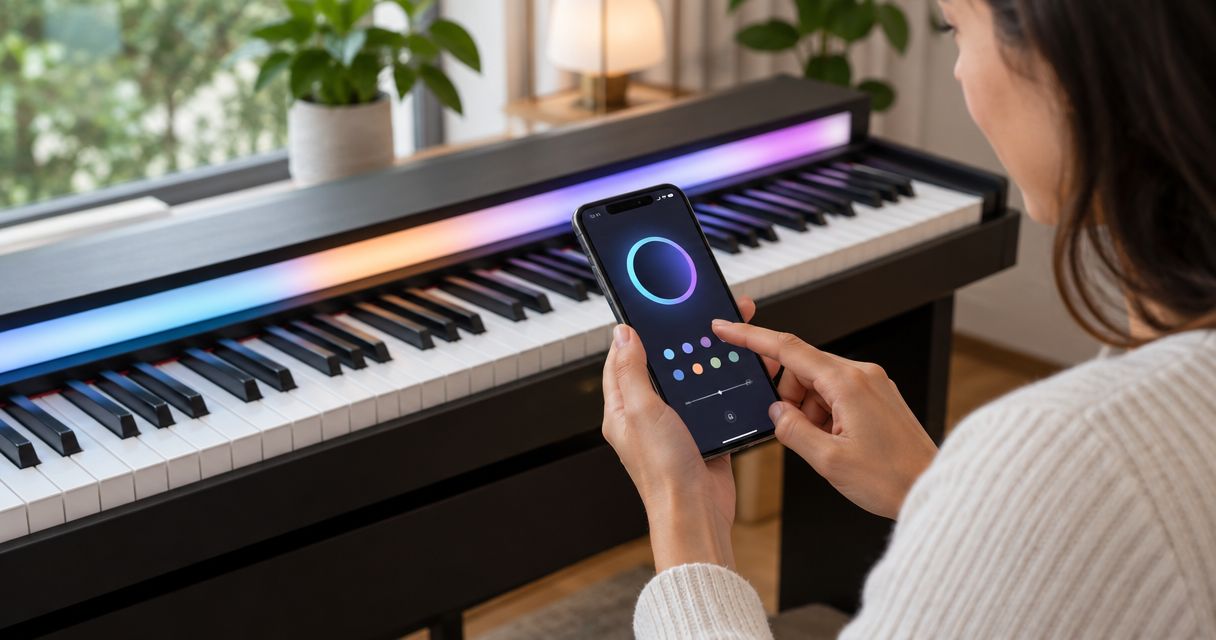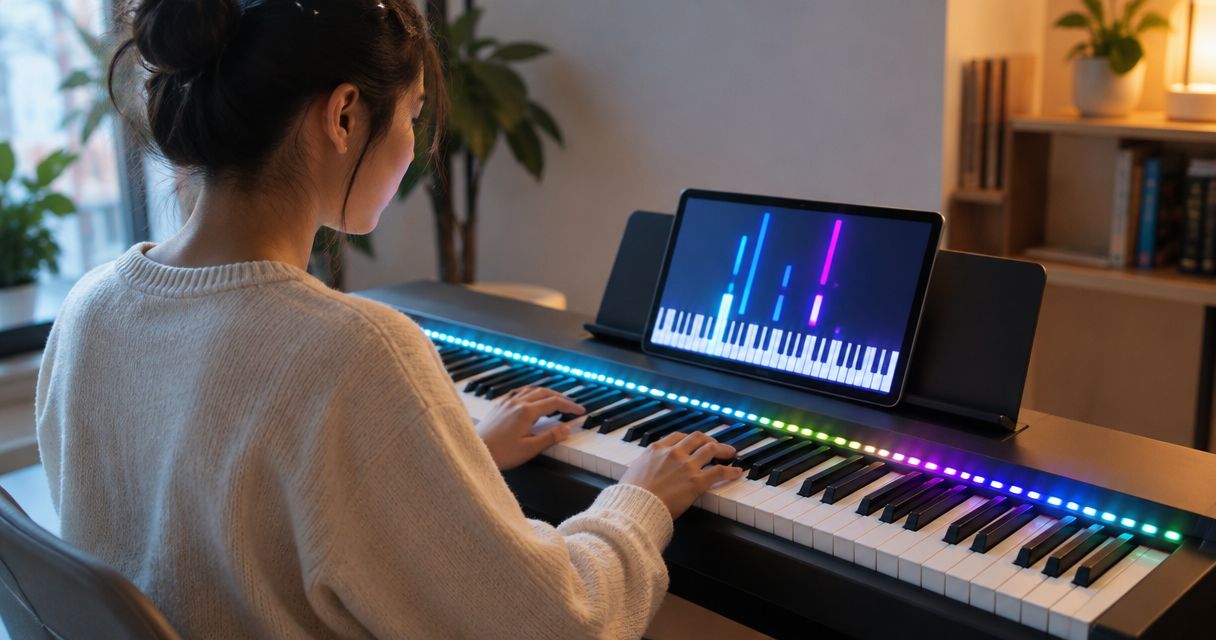
Yes, you can learn to play songs by following LED lights without taking lessons, but following the correct keys is not the same as learning every piano skill. Lights show you where to play; you still need to practise rhythm, comfortable movement, listening, and playing without prompts. Use lights to start a song, then practise removing the help.
- Can you learn piano with just LED lights? Yes for guided songs; lights alone do not teach every piano skill.
- Pianoledshop suits beginners seeking LED-guided song practice, not a substitute for individual technique feedback.
- Test your progress with the lights off, not only while following illuminated keys.
- Combine LED piano learning with rhythm practice, deliberate fingering, and independent recall.
Why this matters
Your goal determines whether learning without lessons makes sense. Playing a favourite melody at home is different from reading an unfamiliar score or accompanying a singer who changes tempo.
For your first piece, choose a simple arrangement rather than treating the original recording as your starting point. The guide to beginner piano songs to learn with LED lights is a relevant next step. Judge your 2026 practice by what you can play independently, not simply by how many illuminated notes you follow.
Can you learn piano with just LED lights, no lessons?
Yes, if your immediate goal is learning particular songs through visual guidance. No, if you expect lights alone to teach reading, musical interpretation, and physical technique. You can study without a teacher, but self-directed learning still requires more than reacting to a cue.
The distinction is between completing a guided performance and retaining a usable skill. Pressing the indicated key answers one question: where does this note happen? It does not answer every question about fingering, timing, movement, or expression.
| Learning approach | Best for | Main benefit | Main limitation |
|---|---|---|---|
| LED guidance alone | Beginners exploring a song | Identifies the keys to press | Does not by itself provide individual technique correction |
| LED guidance plus independent practice | Hobbyists seeking song recall | Adds rehearsal without visual prompts | Requires you to check your own mistakes |
| Lessons plus home practice | Learners seeking personal feedback | Gives a teacher the opportunity to assess your playing | Requires arranging instruction and practising between lessons |
These approaches are not mutually exclusive. You can begin independently, use lights for a difficult passage, and seek teaching when a problem needs another person's assessment. Neither owning a learning system nor booking lessons replaces practice.
What can LED lights teach you without lessons?
LED guidance connects a musical passage with locations on the keyboard. That makes it useful when you want to start a song without first decoding every note on a score. The limitation is equally clear: recognising a location is only part of playing it well.
Finding notes and repeating a passage
A light can direct your attention to a particular key. You can then repeat that movement while listening to the result and choosing which finger to use.
For independent learning, work on a short musical phrase rather than chasing an entire arrangement. Decide where the phrase begins and ends, then keep the same fingering while you practise. Repetition should reinforce a deliberate movement, not a different scramble each time.
Learning a song's sequence
Following cues gives you a way into the order of notes. To turn that sequence into recall, look for musical landmarks: a repeated pattern, a change of hand position, or the return of the opening phrase.
Ask yourself what happens next before the next cue appears. If you only recognise the answer after seeing a light, the prompt is still doing that part of the work.
Coordinating the hands
You can use guided practice to explore where the hands play separately and together. Start with a passage you can manage without rushing, and listen for whether the hands actually arrive together.
Correct keys with uneven timing still need work. When coordination breaks down, simplify the task: practise one hand, establish the pulse, then add the other hand without increasing the pace.
What do lights leave you responsible for?
An illuminated key is an instruction about location, not a complete assessment of your playing. In your 2026 learning plan, give the following skills their own attention instead of assuming they will appear automatically.
- Comfortable movement: Check that you are not reaching awkwardly, lifting your shoulders, or forcing your wrist into an uncomfortable position. Stop if playing hurts.
- Fingering: Choose a repeatable finger sequence that lets you reach the next notes without unnecessary jumps.
- Rhythm: Keep a steady pulse through the phrase, including rests. Do not pause simply because the next note is unfamiliar.
- Listening: Notice uneven volume, accidental extra notes, and notes released too early. The sound matters, not just the visual cue.
- Reading and understanding: If you want notation skills, study notation directly. Following lights is not the same task as reading a score.
You do not need to master all these areas before enjoying a song. You do need to recognise which skill is causing a problem. Repeating a passage with more visual help will not necessarily answer a question about tension or rhythm.
Why learning without lessons varies
The useful question is not whether lights work for everyone. It is whether your practice method matches what you want to do and gives you a way to detect mistakes.
- Your goal: Memorising a favourite arrangement demands different preparation from sight-reading new music.
- The arrangement: A melody played alone asks less coordination of you than an arrangement with an independent accompaniment.
- Your starting skills: Existing familiarity with rhythm, notation, or another instrument changes what you need to study explicitly.
- Your attention: Watching every cue leaves a different practice task from naming notes, listening, and anticipating patterns.
- Your feedback: Recording yourself or consulting a teacher gives you another way to examine a problem you miss while playing.
- Your use of prompts: Always practising with lights does not test the same skill as starting and continuing without them.
Choose an arrangement that leaves enough attention for listening and movement. If you spend the whole passage trying to catch the next cue, reduce the difficulty before asking yourself to play faster.
How should you practise with LED lights in 2026?
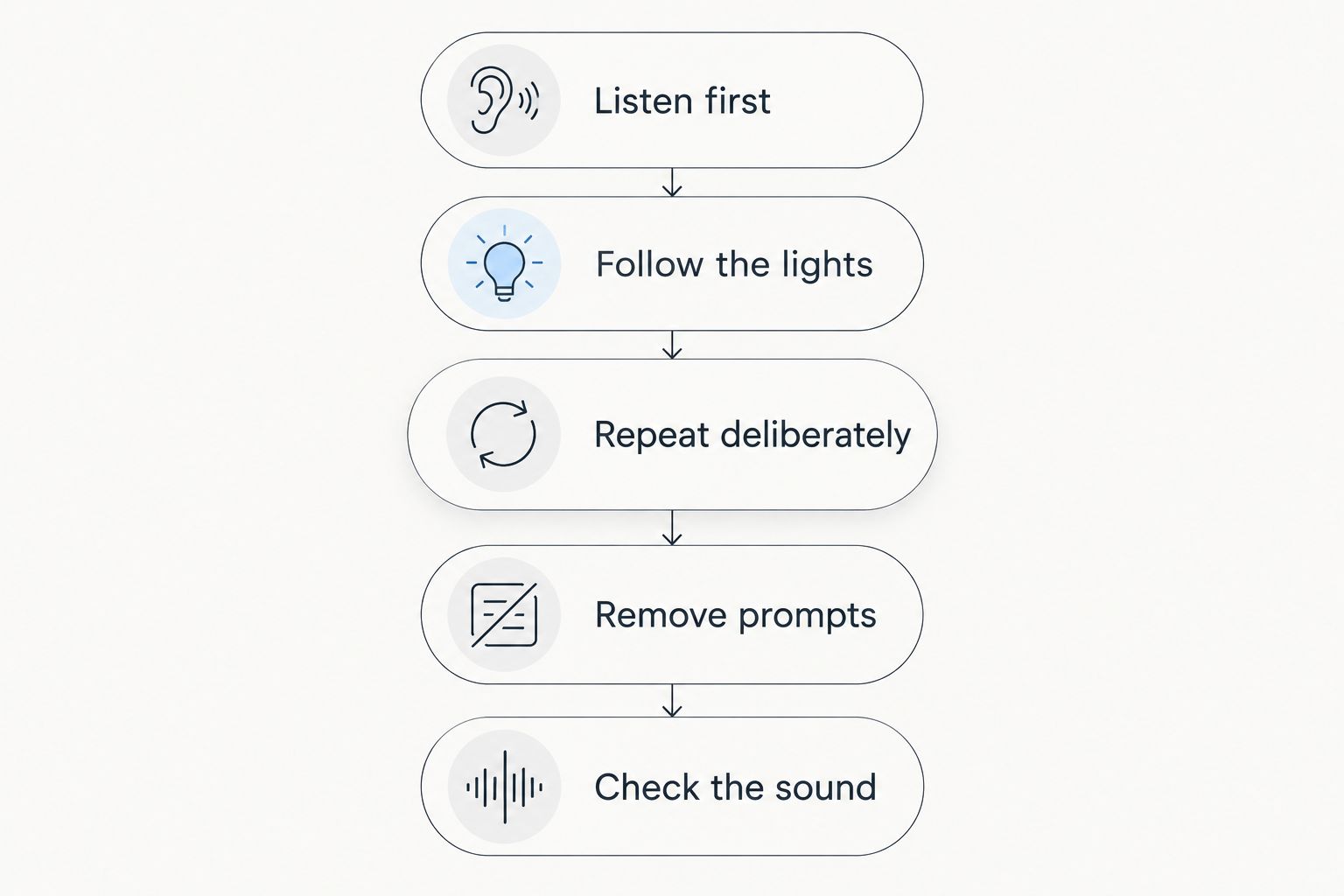
Use a sequence that moves from guided discovery to independent playing. The following is an example practice structure, not a promised learning timeline or a requirement for a particular app.
- Listen first. Hear the phrase before playing it. Notice its pulse, pauses, and ending so you have a musical target beyond pressing keys.
- Follow the lights. Find the notes slowly enough to choose comfortable fingering. Use the guidance to resolve uncertainty about location.
- Repeat deliberately. Keep your fingering consistent and listen for even timing. Stop at the problem rather than restarting the whole song automatically.
- Remove prompts. Attempt the same phrase without the lights. If the system does not offer a suitable setting, use another practical way to rehearse without viewing the cues.
- Check the sound. Listen back to a recording or compare your playing with the phrase you intended. Identify a specific issue before repeating it.
The sequence matters more than finishing a full song. You are moving from finding notes to making decisions without a visual answer.
An example short practice session
For a manageable starting routine, allocate 5 minutes to listening and finding a phrase, 5 minutes to repeating it with deliberate fingering, and 3 minutes to trying it without prompts. These are suggested practice allocations, not evidence that a song takes that long to learn.
If the phrase is still too difficult, make it shorter. If it is comfortable, use the independent portion to start from somewhere other than the beginning. Keep the session focused on a clear task rather than a completion counter.
Where does Pianoledshop fit into learning without lessons?
Pianoledshop is best for beginners and hobbyists seeking LED-guided song practice rather than individual technique feedback. Its Piano LED Plus system uses lights synced to an app to guide song playing.
That is relevant when your main obstacle is finding the notes of a piece you want to play. The limitation is that a cue showing where to press does not assess your posture, explain every musical choice, or replace a teacher watching how you move.
Treat Pianoledshop LED piano learning as one part of your practice method. Before choosing a setup in 2026, decide whether your priority is guided recreation, independent repertoire, or broader piano study. Then check the current setup requirements for your instrument rather than assuming compatibility.
How do you know whether you are learning or just following?
Remove the cue and test a small, specific task. A complete song is not the only useful assessment, and playing it from the beginning can hide uncertainty about the middle.
Try these checks after practising a phrase:
- Start from a musical landmark other than the opening.
- Play the phrase without looking for illuminated keys.
- Keep the pulse when you make a wrong note instead of stopping immediately.
- Name a repeated pattern or describe where the hand moves next.
- Return to the phrase at a later session before turning the guidance back on.
Treat a failed check as information. If you remember the keys but lose the pulse, practise timing; if you cannot locate the starting note, work on keyboard orientation. More repetition is useful only when you know what you are trying to change.
Can you learn piano without reading sheet music?
Yes, you can learn songs by imitation, listening, memory, and visual guidance without reading sheet music. That does not make notation useless: reading is a separate skill that gives you another way to approach written music.
If reading is part of your goal, include it from the start. Match a short written phrase to the keyboard instead of expecting light-following practice to teach notation indirectly.
When should you get a piano teacher involved?
Get personal feedback when you cannot identify the cause of a recurring problem, or when your goals require skills your current routine does not address. Do not keep forcing a movement that hurts; stop playing and seek appropriate advice.
A focused lesson can address a specific question about fingering, rhythm, or movement. You do not have to frame instruction as abandoning independent learning: bring the exact passage and explain where you get stuck.
FAQ
Can you learn piano with just LED lights in 2026?
Yes, you can learn guided songs with LED lights, but lights alone do not teach every piano skill. Include listening, rhythm, comfortable fingering, and practice without prompts if you want independent playing.
Do LED piano lights teach you to read sheet music?
Following LED lights is not the same as reading sheet music. Study notation directly if you want to interpret written notes, rhythms, and musical instructions.
Can I use LED lights without ever taking piano lessons?
Yes, you can practise independently without taking lessons. You remain responsible for checking your technique and musical accuracy, and individual feedback is useful when you cannot resolve a problem.
How long does it take to learn a song with piano lights?
There is no single learning time that applies to every song and learner. The arrangement, your starting skills, and whether you mean guided playback or independent performance all change the task.
Are LED lights better than a piano teacher?
LED lights and a piano teacher serve different purposes. Lights identify keys during guided practice; a teacher can observe your playing and give individual feedback.
Should I turn the piano lights off while practising?
Yes, include attempts without the lights to check what you can recall independently. Use a short phrase so you can identify exactly where you still need help.
Can adults use LED piano learning just for fun?
Yes, learning favourite songs for enjoyment is a valid goal. Choose manageable arrangements and comfortable movements rather than measuring your progress against a formal study programme.
One last thing
The most useful test is whether you can begin somewhere new. After learning a phrase, start at its second musical idea rather than replaying the opening automatically. That exposes whether you know the passage or depend on one continuous chain of cues.
Make that your next practice task. Keep the lights available for finding an uncertain note, but let independent playing decide what needs attention next.